
The Pirate
Launch Plan
From zero to shipped and launched on a weekend – for vibe coders who want an AI-native tech stack, zero security surprises, and the freedom to scale.
When the MVP Is Faster Than the Survey
Steve Blank told us to get out of the building. Eric Ries told us to build the smallest thing that tests an assumption. Both were right — for their era.
My old validation playbook looked like this: build a landing page, collect 1,000 waitlist signups, and then — and only then — write a line of code. My team and I ran this play dozens of times. 150 landing pages. Six apps built. Two of them crossed a million users. The rule worked: it forced us to find demand before we built supply.
Vibe coding changes the timeline so dramatically that a working magic interaction is now faster to build than a survey campaign. A year ago, 25% of the current YC batch already had codebases that were 95% or more AI-generated. Today, functional MVPs are being shipped in 48 hours to a week. The promise — “building is now faster than surveying” — is no longer theoretical.
The Pirate Launch Plan is a direct response to this shift. It's a modern, micro-scale take on the Lean Startup framework — designed for teams of 1–3 people building bootstrapped SaaS, not enterprise. The core question is unchanged: What is the problem? For whom? What is your unique solution? What changes is how fast and how concretely you answer it.
Pirate Launch Plan
Get Clear on Your Idea
Stage 1 has one output: a clear answer to three questions. Not a deck, not a business plan — just enough clarity to know what you're testing and for whom. If you can't answer all three, you are not ready to build.
Problem: What specific pain does your audience feel right now? Not a category — a felt reality. “Small businesses struggle with marketing” is a category. “Solo founders spend 6–8 hours per week writing content they can't measure” is a problem.
Audience: Who specifically feels this problem and has both the urgency and the ability to pay? The narrower your answer, the faster you get signal. Rob Walling calls it picking a winnable niche. Paul Graham says make something people want — but “people” is too broad. Make something this person wants.
Solution: What is your specific angle on solving it? This isn't your product description — it's your bet. The solution will change. The hypothesis is what you're testing.
The hardest discipline here is staying at the problem level. Every founder wants to jump to the product. The product is the fun part. The problem is the part that decides whether any of it matters.
If you want AI prompts and step-by-step guidance to work through each of these three questions, Level 1.1 — Your Idea in the Builder Codex covers exactly this.
Stage 1 has no deliverable except clarity. Do not build anything yet. The keyboard stays closed.
Build the Magic Interaction
Every product has a magic interaction — the moment a user first experiences the value, the thing that makes them think: “Oh. This is different.”
When OpenAI put a chat interface out for their research model, they expected researchers to use it. What happened: everyone did. The interface was so immediately usable, so obviously useful, that millions of people understood the value in seconds. That prototype became ChatGPT. The lesson isn't about AI — it's about what happens when you make the core experience accessible enough for real people to just try it.
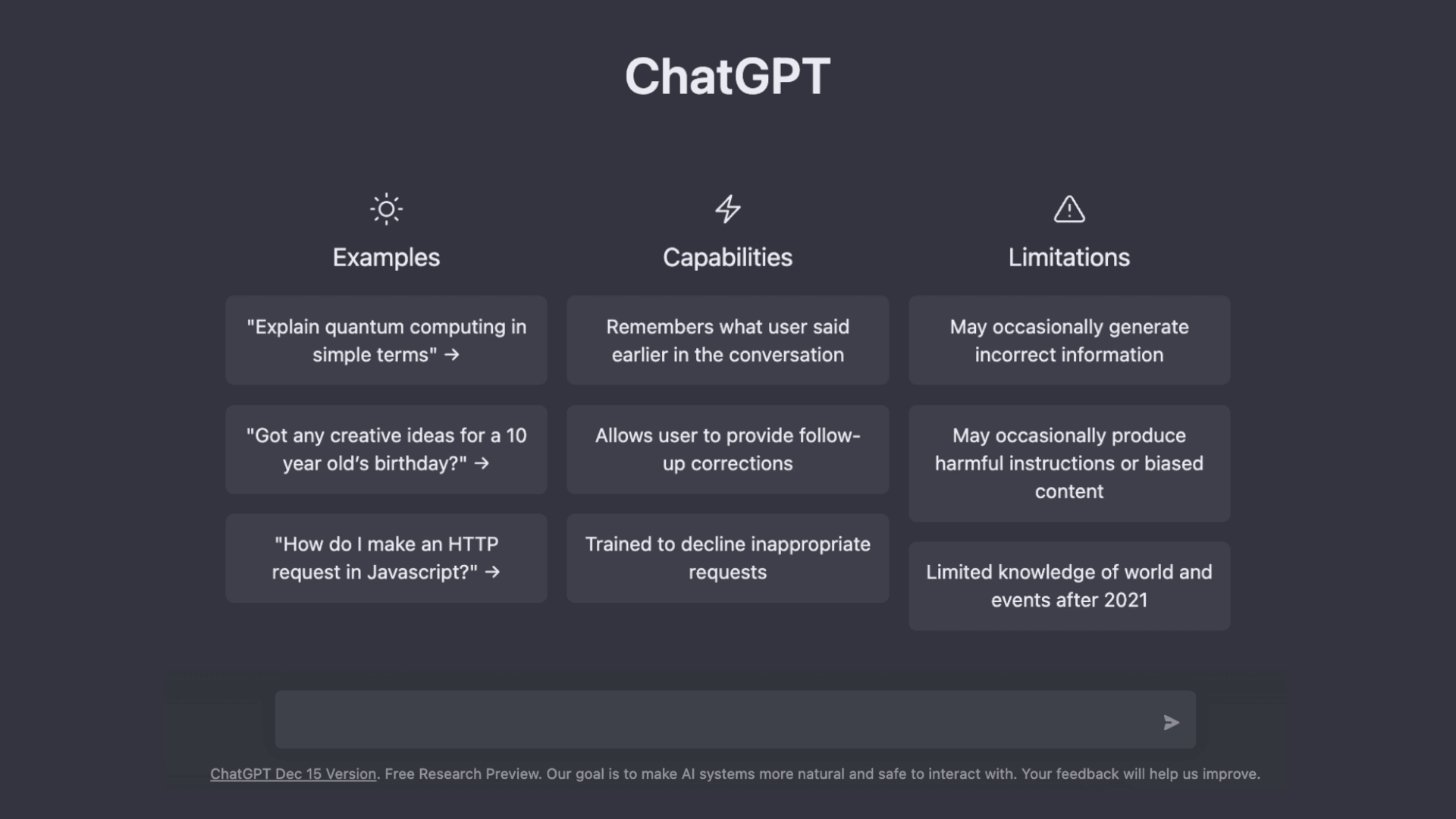
ChatGPT's original interface, December 15, 2022 – two weeks after launch. Just a box. Just try it.
Stage 2 is about building that accessible moment. Ideally, no account required — just the core experience a user can actually go through. If a fully open version feels too risky, a demo with mock data works. If even that feels premature, record yourself running it and share the video. The medium matters less than this: someone needs to be able to experience the value, or vividly imagine experiencing it.
Before you share it, define the moment where a user genuinely gets something out of it — where they create something, see a real result, or clearly imagine themselves using this fully. Not signups. Not clicks. Something like: “They used it to solve their actual problem.” “They asked if they could keep it.” “They immediately thought of someone else who needs this.”
If you can't build the magic interaction in two days, you're scoping too big. Cut features until you have the single thing that proves the idea is real. The concierge variant is also valid: manually fulfil the first version yourself before writing a line of code. Pieter Levels processed Avatar AI orders by hand before automating anything. That counts.
What stack? Next.js on Vercel gets you to a live URL fastest. No database needed yet — localStorage or URL parameters are enough for Stage 2. The Vibe Coding Stack article covers the full recommended setup. Getting through Stage 2 is roughly the equivalent of completing Levels 1 and 2 of the Builder Codex.
What I learned about magic interactions:
"The most tempting thing in Stage 2 is to keep building. You get the core interaction working and immediately start thinking about the next feature. Resist it. The goal of Stage 2 is not a good product — it's a hypothesis on a live URL. I once spent three weeks building features onto a Stage 2 prototype before showing it to anyone. By the time I shared it, the magic interaction was buried under three layers of UI. Nobody could find it. Start ugly. Share early. Let the interaction do the work."
Make First Contact
You have a live URL. Now get it in front of real people — the minimum number necessary to get a real signal.
Start by making a list of 10 places or people you can actually reach. LinkedIn connections who are in the space. A WhatsApp group where the right people hang out. A Reddit thread or community you're already active in. A Slack group. People you've met at events. You probably already know where your people are — write it down before you do anything else.
Then write one message. Not a launch post — just a genuine “I built this thing, curious what you think.” One message you can adapt for all 10. Then send it.
If you're not sure how to frame it, the Growth Codex lesson Why We Do This walks you through building the story that actually resonates with your people — the foundation your message should come from.
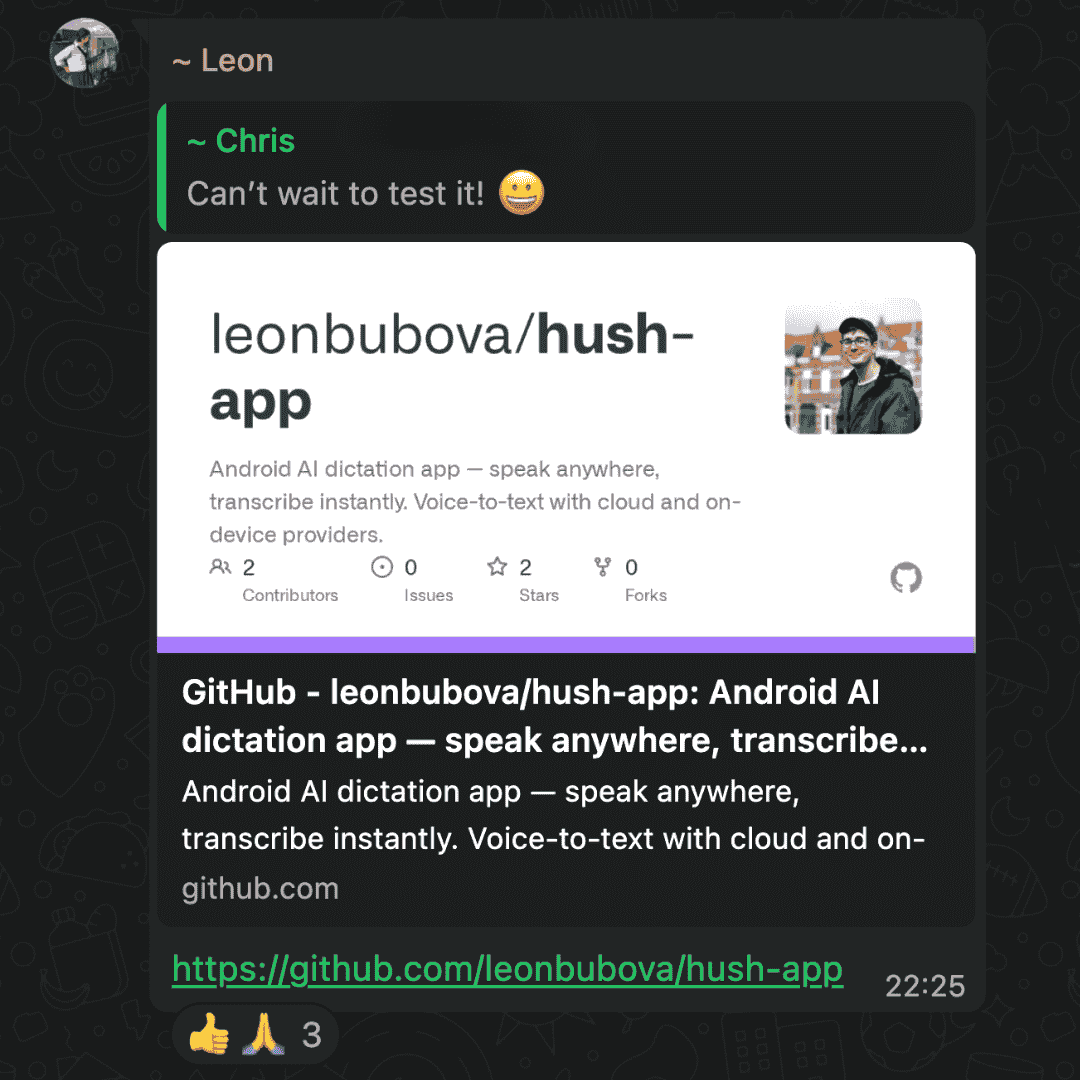
This is what first contact looks like. A WhatsApp message, a link, a question.
What you're looking for isn't signups or positive reactions. It's the behavioral signal you defined in Stage 2. Did anyone actually use it? Did it do the thing it was supposed to do for a real human? That's all that counts here.
Stay close to the people who show up. Paul Graham's “do things that don't scale” starts here — follow up individually, ask what they did with it, watch what they actually did versus what they said. That's the data that matters.
If nobody triggered your behavioral signal and you haven't had a real conversation with at least 5 people who fit the problem — go back to Stage 1. Don't add auth. Don't add payments. Don't build the next feature. The rest of this plan only works if the magic interaction actually works.
Build the MVP
People used the magic interaction. Now it's time to build the real thing — the full SaaS skeleton. Not the complete product, but everything that makes it real: auth, database, payments, onboarding, and a clear path from free to paid.
For auth, database, and payments you want battle-tested infrastructure you didn't write yourself. Personally I use Clerk, Supabase, and Stripe — but there are many strong options. The Vibe Coding Stack article covers all of them layer by layer.
What the MVP includes
Landing page
One clear promise, one call to action, nothing else
Core functionality
The magic interaction rebuilt properly – not a prototype anymore
Sign-up flow
Auth and account creation so users have a real home
Forced onboarding
A path that gets every user to the magic, no detours
Full database setup
User data, state, and persistence built to last beyond launch
Stripe integration
Free trial with card capture and a clear path to paid
You've been vibing fast. That was the right move — Stage 2 was about speed and proof, not perfection. But now real users are coming in, and this is a good moment to slow down a beat and actually know what you shipped. Not because something will break — but because from here on, every layer you add sits on top of this foundation. Addy Osmani, Engineering Director on Chrome at Google, says it better than anyone:
Pieter Levels is making $200k+/month on products built in PHP. The stack isn't what matters — shipping something you understand is. One stack, understood deeply, beats five stacks half-used every time.
After Stage 4 the app feels like a complete product. Not a hack. A real SaaS with a real sign-up flow, a real free trial, and a real payment path.
From Users to Customers
Stage 3 was about getting people to try the magic interaction. That gave you early signal. Stage 5 is a different question entirely: will anyone actually pay for this? That's what you're here to find out.
Pick one acquisition channel and commit to it. One channel done with intention gives you clean signal. Three channels half-done gives you noise. The Vibe Marketing Stack covers the full engine when you're ready to go all in — Stage 5 is not that moment.
Organic
More time than money
- Post as a founder building in public – your personal audience outperforms a new brand account early on
- Create content that teaches your audience to need your product
- Compounds slowly – plan for 90 days before expecting real traction
Paid
More money than time
- Start with small budgets aimed at free trials or lead magnets, not direct sales
- Test one creative angle at a time – measure results, kill losers, scale winners
- Build and optimize the funnel before scaling spend
Outreach
B2B or small targets
- Build a list of 50–100 ideal targets you can contact directly on LinkedIn, email, or Slack
- Personalize every message – you're not blasting, you're starting conversations
- Get on calls, do demos, onboard manually – convert strangers to paying customers
Organic starts with setting up a dedicated social profile for your product and thinking through a basic content strategy. But don't underestimate founder-led growth on your existing personal profile — your audience already trusts you, and building in public there often outperforms a brand-new account. The Growth Codex lesson When We Talk About It gives you a practical content plan to work from.
Paid works best when you start small. Don't try to buy customers from day one — run small-budget campaigns aimed at getting people into a free trial or a lead magnet first. That lowers the barrier to entry and gives you a funnel to optimise before you scale spend. Sending cold traffic straight to a paywall is worth testing, but it's a harder conversion to pull off without established trust. The Traffic Generation section of the Growth Codex covers the channels in depth.
Outreach is the right move if you have an existing community or a clear list of targets you can reach directly — LinkedIn, industry Slack groups, niche forums. The assumption here is that you're willing to get on calls, do demos, onboard people manually, and collect early proposals and feedback. It's labour-intensive, but it's the fastest way to go from strangers to paying customers when you know exactly who you're after. The Funnel Building overview in the Growth Codex is the right starting point.
While you're driving that channel, watch the right numbers. Most founders over-index on acquisition at this stage — how many people signed up, how many visitors. That tells you almost nothing yet.
The AARRR framework gives you a better lens. At this stage, your priority order is: Activation — are new users actually reaching the magic interaction? Retention — are they coming back after the first session? Revenue — is anyone converting to paid? Acquisition and Referral matter too, but doubling down on those comes later. Right now you just need enough people in the funnel to measure these three honestly.
Build. Grow. Repeat.
You've made it through the first five stages. You may have your first paying customers — or you're close. The question now isn't how to launch. It's how to keep going until something real emerges. That's what this stage is: the cycle that doesn't stop.
What you're chasing is product-market fit — and it isn't a switch you flip. It has levels. First Round maps it as a progression: Nascent, Developing, Strong, Extreme. All you need to worry about right now is getting to Nascent. The only thing that matters at that level is satisfaction — do people actually need this? The simplest signal: ask your users “how disappointed would you be if you could no longer use this?” If most wouldn't care, you're not there yet. If a real share says “very disappointed” — that's the signal.
On the build side, your job is to find the friction and remove it. Set up PostHog or equivalent so you can see exactly where users move and where they stop. Talk to paying customers. You'll have a long list of things to build — most of them are wrong. The right ones bring users closer to the magic interaction and keep them coming back. Build those. Ignore the rest.
On the growth side, you're running experiments. Not campaigns — experiments. You pick a channel, you test a message, you measure what happens. What gets traction, you double down on. What doesn't, you cut. Keep communicating what you've built to your current customers and to the people who haven't found you yet. Every week. That consistency compounds.
This is the part most founders skip. They launch, they get their first users, and then they stall — waiting for a sign, a milestone, a reason to keep going. There is no sign. There is only the next cycle. Build something. Grow the audience. Repeat until you find what works, then do it harder.
Now Run It
I built this plan because I wish I'd had it. Not a perfect framework — a forcing function. Something that makes you stop thinking and start moving.
The order matters. You cannot shortcut the checkpoint. Stage 1 forces you to get clear before you build anything. Stage 2 forces you to build the one thing that makes someone say “this is it” before you build the rest. Stage 3 forces you to talk to real people before you invest in a product. Stage 4 builds what they're willing to pay for. Stage 5 finds the channel that reaches more of them. Stage 6 is where you stop thinking in launches and start thinking in cycles.
The founders who make it aren't the ones with the best first idea. They're the ones who kept running the loop — shipping, listening, adjusting — until something real emerged.
Cheers,
Ben
The Pirate Launch Plan
Whether it takes you 48 hours or 48 days — just run it.
Ready to Go Deeper?
Don't miss the next Insight
Join the crew and get fresh perspectives delivered weekly.
Free account. No spam. Unsubscribe anytime.
Questions & Answers
What is the Pirate Launch Plan?
How is the Pirate Launch Plan different from the Lean Startup methodology?
What exactly is a 'magic interaction'?
What's the difference between Stage 2 (Prototype) and Stage 4 (Build)?
Do I really need to skip auth and payments in Stage 2?
How do I reach my first users in Stage 3?
How do I pick the right growth channel in Stage 5?
Can I run this plan solo or do I need a team?
What if nobody responds after Stage 3?
What stack do you recommend for the prototype in Stage 2?
How do I know when I have product-market fit?

Founder from Cologne with 15 years of startup experience across 9 ventures. After helping thousands master growth marketing, Ben learned vibe coding from scratch and launched CaptAIn within three months. He leads the Vibe Coding Cologne community, blending real founder experience with teaching clarity.

