
When we talk about it
Let's make our audience go AARRR every single month
1. Goal
Let's create a concrete content calendar that brings your strategy to life. This isn't about random publishing–it's about creating a consistent rhythm that moves your audience through their journey while keeping your brand top of mind.
2. Why a Content Calendar Matters
Before diving into formats and scheduling, let's understand why a structured content calendar is essential for growth.
The Power of Consistency
Content marketing compounds over time. Each piece you publish:
- Attracts new audience members
- Builds authority and trust
- Supports SEO and discoverability
- Creates assets for future use
- Feeds your growth flywheel
But this only works with consistency. Random publishing doesn't build momentum–a regular cadence does.
Balancing the AARRR Framework
Your content calendar should support the full customer journey:
- Acquisition: ToFu content that attracts new audience
- Activation: Content that gets people engaged and taking first steps
- Retention: Regular content that keeps people coming back
- Revenue: BoFu content that drives conversion
- Referral: Content that's so good people share it
A good calendar balances all these elements every month.
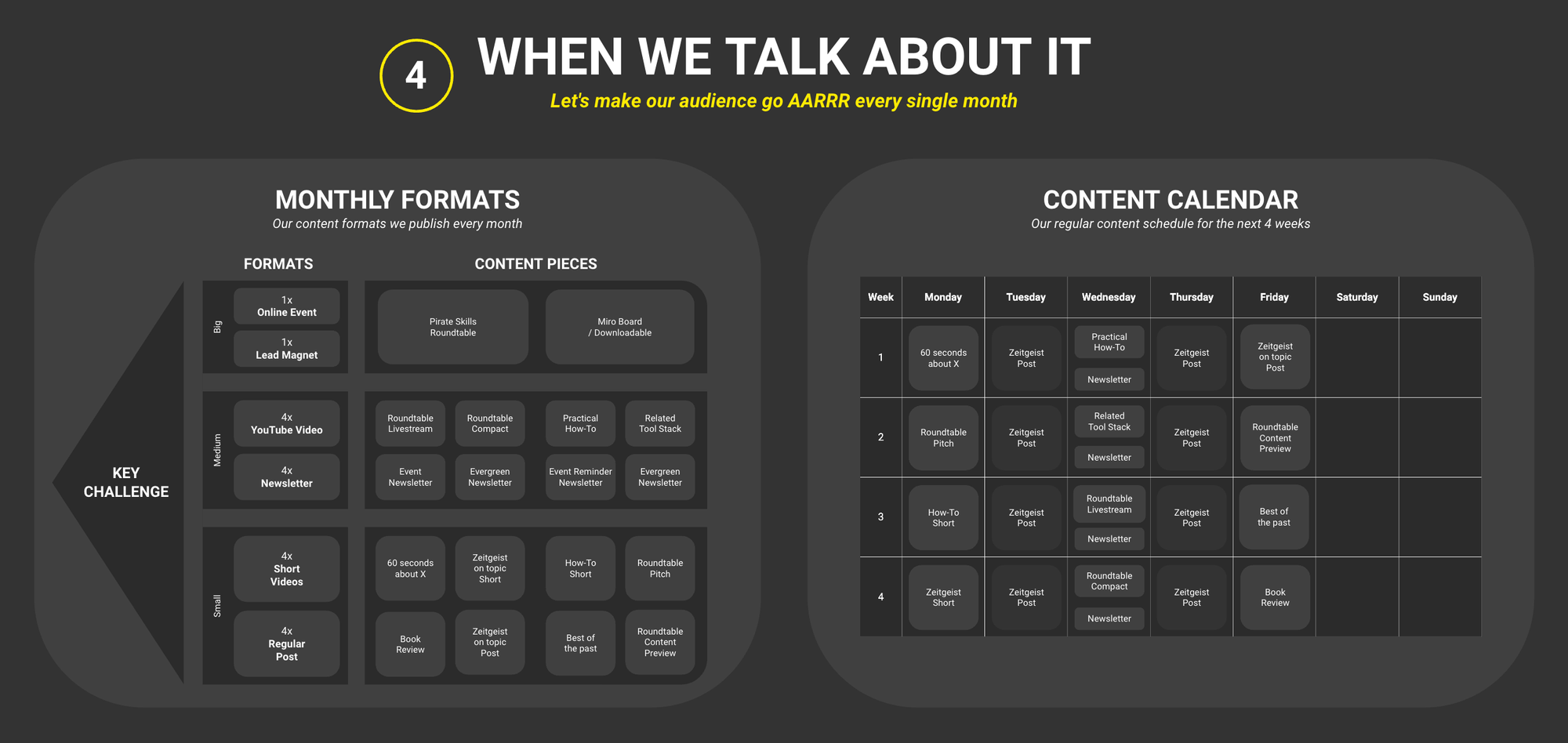
3. Monthly Formats - Our content formats we publish every month
Monthly formats are the recurring content types you commit to publishing regularly. These create predictable rhythms that your audience can rely on and that keep your brand visible.
Continue in the same Claude conversation. We're building on the ToFu/MoFu/BoFu strategies we defined in the previous lesson.
Defining Your Core Formats
Based on your ToFu/MoFu/BoFu strategy, identify 3-5 core formats you'll publish monthly:
Examples of monthly format commitments:
- 4 long-form blog posts (weekly)
- 2 YouTube videos (bi-weekly)
- 1 newsletter (weekly or bi-weekly)
- 12-20 social posts (3-5 per week)
- 1 case study or success story (monthly)
- 1 webinar or live session (monthly)
Balancing Resources and Impact
Choose formats you can realistically maintain:
- Consider production time and resources
- Balance high-effort and low-effort content
- Ensure distribution channels are manageable
- Plan for sustainability over 3-6 months
Creating Content Pillars
Organize your monthly formats around content pillars that align with your themes:
- Each pillar gets representation each month
- Rotate focus while maintaining all pillars
- Create variety within consistency
Outcome: You have defined your recurring monthly content formats that create consistent brand visibility.
4. Content Calendar - Our regular content schedule for the next 4 weeks
Now let's get specific. Create an actual content calendar for the next month with specific topics, formats, publishing dates, and ownership.
Continue in the same Claude conversation. We're building on the monthly formats and content pillars we just defined.
Building Your Calendar
For each piece of content in the next 4 weeks, define:
- Topic/Title: What it's about
- Format: Blog, video, social, email, etc.
- Funnel Stage: ToFu, MoFu, or BoFu
- Content Pillar: Which theme it supports
- Publish Date: Specific date and time
- Owner: Who's responsible
- Status: Idea, In Progress, Ready, Published
Calendar Best Practices
- Start with anchor content: Schedule your biggest, most important pieces first
- Build supporting content around anchors: Smaller pieces that promote or expand on anchor content
- Mix funnel stages: Don't publish all ToFu or all BoFu–balance throughout the month
- Leave buffer time: Don't schedule every single day–allow flexibility for timely topics
- Plan for repurposing: One long-form piece can become multiple shorter pieces
- Schedule strategically: Publish when your audience is most active
Tracking and Accountability
Use your calendar to track:
- What's been published
- What's in progress
- What's coming up
- Performance metrics for each piece
- Lessons learned for future content
Outcome: You have a concrete 4-week content calendar that balances formats, topics, and funnel stages.
5. Summary
You've now created a concrete content plan:
- Defined monthly formats - The recurring content types you'll publish consistently
- Established content pillars - The themes that organize your content
- Built a 4-week calendar - Specific topics, formats, and dates for the next month
Continue in the same Claude conversation. Let's create a comprehensive summary of everything we've defined in this lesson.
Outcome: You have a comprehensive summary of your content calendar strategy including monthly formats, content pillars, and your 4-week calendar.
This transforms your content strategy from theory to action. You now have a clear roadmap for what to publish when, ensuring consistent value delivery to your audience while moving them through their journey.
Next Steps
With your content calendar in place:
- Start executing: Begin creating the content in your calendar
- Stay consistent: Stick to your publishing schedule
- Track results: Monitor which content performs best
- Iterate monthly: Use insights to improve next month's calendar
- Build momentum: Let consistency compound your results
Remember: The calendar is a living document. Adjust as you learn, but maintain your core commitments. Consistency beats perfection.
Further Resources
Dig deeper into content calendars and consistency
Books:
Online:
Tools: