
Content & Story Summary
Working with your content and story strategy
1. Transforming Your Brand into the Ultimate Problem Solver
Congratulations! You've completed the Content & Story section of the Growth Codex. You now have a comprehensive content strategy that positions you as the go-to problem solver in your space.
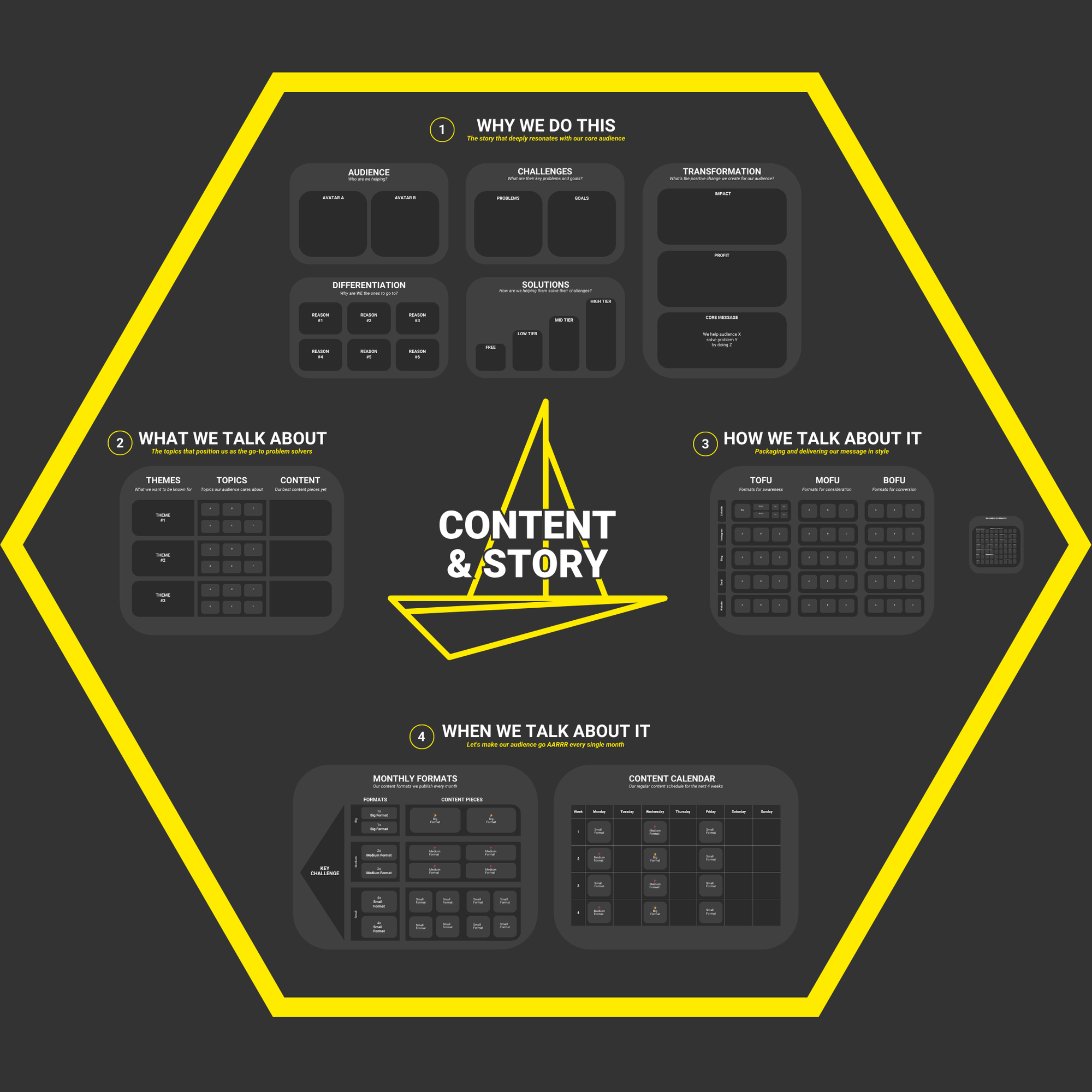
2. What You've Accomplished
Let's recap the journey you've taken and the assets you've created:
1. Crafted Your Foundational Story (Why we do this)
You've defined the story that deeply resonates with your core audience:
- Audience: Crystal-clear understanding of who you're serving, their context, and what drives them
- Challenges: Identified their key problems and goals–the pain points you address
- Differentiation: Articulated what makes you uniquely qualified to help
- Solutions: Mapped how your offerings address specific challenges
- Transformation: Painted the picture of the journey from before to after
This story framework is your north star. Everything else flows from this foundation.
2. Defined What You Talk About (Topics and themes)
You've identified the content focus that positions you as an authority:
- Themes: The 3-5 core areas you want to be known for
- Topics: Specific subjects within each theme that your audience actively searches for
- Best Content Analysis: Understanding of what already resonates and why
Your content now has direction. You know what to create and why it matters.
3. Designed How You Talk About It (Funnel strategy)
You've created a strategic approach to packaging content across the journey:
- ToFu Strategy: Formats and channels for creating awareness
- MoFu Strategy: Content for building trust and helping evaluation
- BoFu Strategy: Conversion-focused content that drives decisions
Your content now has structure. Each piece serves a specific purpose in the customer journey.
4. Planned When You Talk About It (Content calendar)
You've created a concrete execution plan:
- Monthly Formats: The recurring content types you'll publish consistently
- Content Pillars: The themes that organize your monthly content
- 4-Week Calendar: Specific topics, formats, and dates
Your content now has momentum. You have a clear roadmap for consistent execution.
3. The Five Key Actions for Ongoing Success
Now that you have your content and story strategy in place, focus on these five actions to maintain momentum and continuously improve:
1. Refine Your Strategy
Continuously refine your understanding of your audience to ensure your content remains in perfect alignment with your customer persona and ICP.
Actions:
- Review audience feedback monthly
- Update your story framework quarterly
- Validate assumptions with real conversations
- Adjust positioning as the market evolves
2. Prepare Your Content
Evaluate your best content and use those insights to craft new pieces that are primed to resonate across your communication channels.
Actions:
- Analyze performance data weekly
- Extract patterns from winners
- Create content briefs based on successful templates
- Build a backlog of proven ideas
3. Optimize Your Channels
Examine your content formats and tailor them to each phase of the customer journey–awareness, consideration, and decision.
Actions:
- Test new formats quarterly
- Double down on what works
- Sunset underperforming channels
- Stay current with platform changes
4. Plan Your Journey
Outline your content calendar for the coming months, maintaining the flexibility to adapt to emerging trends and seasonal changes.
Actions:
- Plan next month's calendar 2 weeks in advance
- Review and adjust weekly
- Build in buffer time for timely topics
- Track what you publish and how it performs
5. Unite Your Team
Ensure every member is aligned with your content strategy, understanding that each role is crucial for its success.
Actions:
- Share the strategy with all stakeholders
- Assign clear ownership for each content piece
- Create feedback loops between teams
- Celebrate wins and learn from misses
4. Making Your Content Strategy Work
Having a strategy is one thing. Executing it consistently is another. Here's how to ensure your content strategy actually drives results:
Start Small, Build Momentum
Don't try to execute everything at once:
- Start with 1-2 monthly formats you can maintain
- Publish consistently for 90 days
- Analyze what works
- Add new formats gradually
- Build habits before scaling
Measure What Matters
Track metrics that align with your goals:
- Awareness (ToFu): Views, reach, new audience members
- Consideration (MoFu): Engagement, email signups, repeat visits
- Conversion (BoFu): Leads, sales, customer acquisition
- Quality: Time on page, completion rates, shares
Iterate Based on Data
Your strategy should evolve:
- Review performance monthly
- Identify patterns (what topics, formats, channels work best)
- Double down on winners
- Test new approaches systematically
- Pivot when data says to
Stay Consistent
Consistency compounds:
- Commit to your publishing schedule
- Build audience expectations
- Create momentum through repetition
- Let SEO and authority compound over time
- Trust the process even when results feel slow
5. Common Pitfalls to Avoid
As you execute your content strategy, watch out for these common mistakes:
1. Creating Without Strategy
Pitfall: Publishing random content without connection to your story or funnel strategy.
Solution: Before creating any content, ask: "What funnel stage does this serve? How does it connect to our story?"
2. Ignoring Your Audience
Pitfall: Creating content you think is interesting rather than what your audience actually needs.
Solution: Let audience questions, searches, and feedback guide your topic selection.
3. Inconsistency
Pitfall: Publishing sporadically when you "have time" or "feel inspired."
Solution: Commit to a realistic schedule and stick to it. Consistency beats volume.
4. All ToFu, No MoFu/BoFu
Pitfall: Creating only awareness content without nurturing or converting.
Solution: Balance your calendar across all funnel stages each month.
5. Not Repurposing
Pitfall: Treating each piece of content as a one-time effort.
Solution: Create pillar content, then repurpose it into multiple formats and channels.
6. Perfectionism
Pitfall: Not publishing because it's "not perfect yet."
Solution: Done and published beats perfect and hidden. Ship it, then improve.
7. Ignoring Data
Pitfall: Continuing to create the same content regardless of performance.
Solution: Review metrics monthly and adjust based on what's actually working.
6. Your Content Strategy Checklist
Use this checklist to ensure you're maintaining your content strategy effectively:
Monthly:
- Review last month's content performance
- Plan next month's content calendar
- Update content backlog with new ideas
- Check alignment with business goals
- Adjust strategy based on data
Weekly:
- Review upcoming week's content
- Ensure content is on track for deadlines
- Publish scheduled content
- Engage with audience responses
- Note any timely topics to add
Per Content Piece:
- Connects to audience story framework
- Serves specific funnel stage
- Aligned with content pillar
- Has clear CTA
- Optimized for channel
- Scheduled for publication
- Promoted across channels
7. Create Your Content Planner Document
Continue in the same Claude conversation. Now let's create one comprehensive document that consolidates everything we've built–your complete content marketing and storytelling strategy.
Outcome: You have a comprehensive Content Planner document that consolidates your entire content marketing and storytelling strategy into one reference document.
8. What's Next
You've completed the Content & Story section of the Growth Codex. You now have a complete content strategy–from your foundational story to your monthly content calendar.
The strategy you've built gives you a systematic approach to creating content that resonates. Your Content Planner document makes it easy to reference everything you've defined. Now it's time to execute.
Start with your 4-week calendar. Commit to consistency–publish on schedule, track what works, and iterate monthly. Your content strategy will evolve as you learn, but the foundation you've built will guide every piece you create.
From Engagement to Conversion
It's great when people engage with you on social media and your blog, but you need to get them into your own funnel that converts them from interested prospects to customers. Content builds awareness and trust, but a well-designed marketing funnel turns that engagement into revenue.
Ready to build your conversion funnel? The next level–Funnel Building–will show you how to design customer journeys that create trust and generate revenue. (Coming soon)