
Funnel Building
Build a comprehensive marketing funnel that guides potential customers from first interaction to loyal advocate, creating trust and generating revenue at every stage.
1. What You'll Build in This Level
What's a marketing funnel? Think of it as the path someone takes from first hearing about you to becoming a customer – and beyond. It's called a "funnel" because you start with many people at the top (awareness) and guide them down to the smaller group who actually buy (conversion). But it's not just about the sale – it's about the entire journey: how they find you, how you build trust, how they decide to buy, and how they become loyal advocates.
In this level, we're building a reliable system that transforms casual interest into committed customers. You'll create a complete journey from that first interaction on social media to a loyal customer relationship – with clear steps, systems, and tools at every stage.
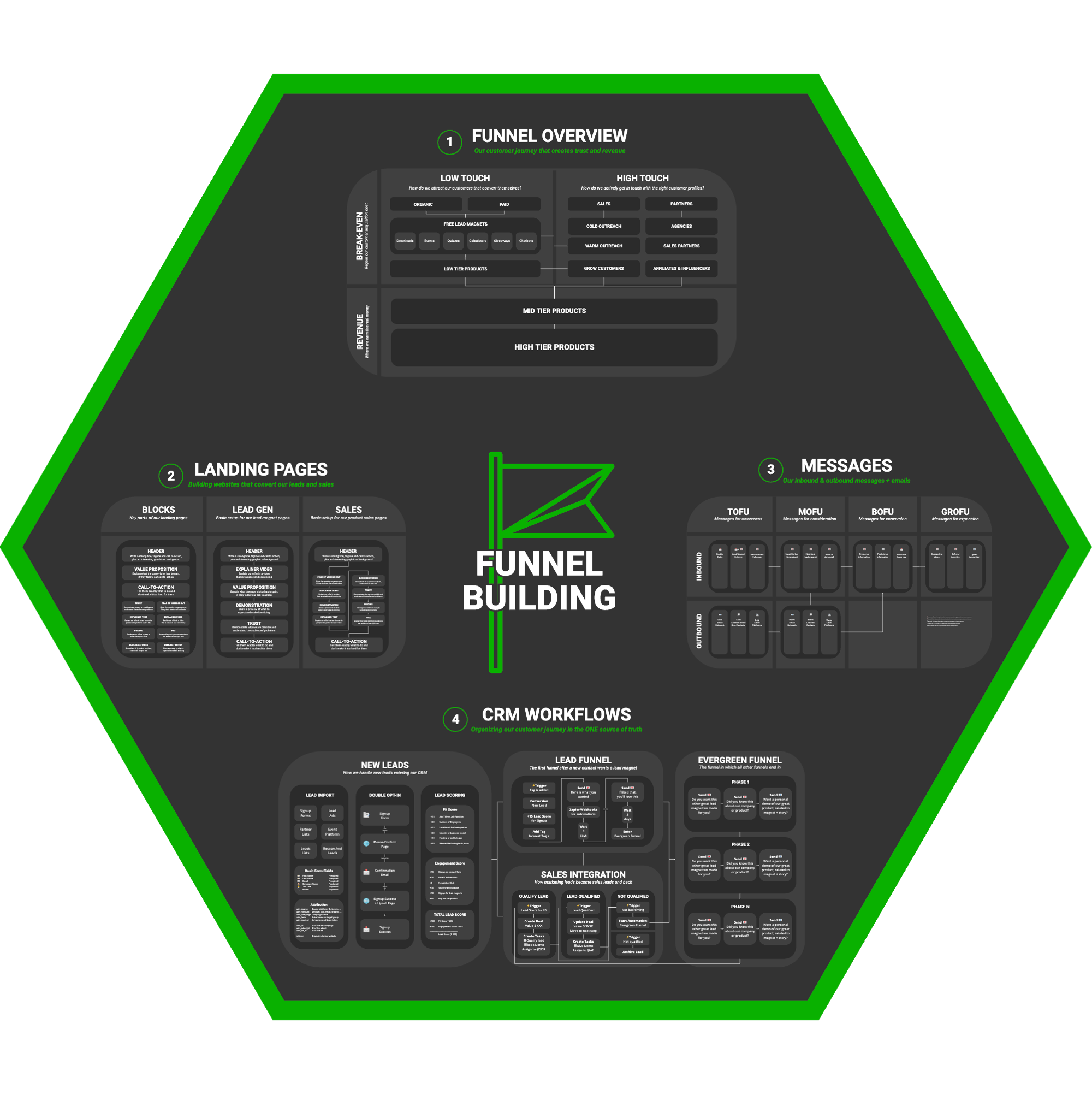
Throughout this level, you'll master four essential components:
- Funnel Overview: Map your customer journey that creates trust and revenue through low touch and high touch strategies
- Landing Pages: Build websites that convert visitors into leads and sales with strategic design and messaging
- Messages: Craft effective inbound and outbound messages that nurture leads through every stage
- CRM Workflows: Organize your customer journey in your CRM as the single source of truth for lead management
2. The Four Steps of Funnel Building
This Funnel Building level is structured into four core steps:
Step 1: Funnel Overview
Map your complete customer journey from lead generation to revenue generation. You'll understand low touch vs high touch strategies, create a break-even funnel, and design a multi-tier offering that guides customers toward higher value.
Step 2: Landing Pages
Landing pages are specific pages on your website designed for one goal: converting visitors into leads or customers. Unlike your homepage (which serves many purposes), each landing page has a single focus – like getting someone to download a guide, sign up for a webinar, or buy a product.
You'll master the essential building blocks, create focused lead generation pages, and design persuasive sales pages.
Step 3: Messages
Messages are how you communicate with people throughout their journey – primarily through emails, email sequences, and notifications. This includes welcome emails when someone first signs up, nurture sequences that build trust over time, and follow-ups that guide people toward the next step.
You'll craft targeted messages for every stage of the customer journey: awareness (ToFu), consideration (MoFu), conversion (BoFu), and expansion (GroFu).
Step 4: CRM Workflows
A CRM (Customer Relationship Management system) is your central database where you track everyone who interacts with your business – from first contact to loyal customer. Think of it as your command center: it stores contact information, tracks where people are in your funnel, automates follow-ups, and helps you manage relationships at scale.
You'll organize your complete customer journey in your CRM as your single source of truth. You'll set up lead tracking, create dedicated funnels, build evergreen engagement systems, and implement sales integration.
3. Why You Need a Value-Driven Marketing Funnel
A value-driven funnel is your reliable system that transforms engagement into conversion. It's not just about collecting leads – it's about creating a complete journey from that first interaction on social media to a committed customer relationship.
The Foundation: Content and Story
Your content and story work comes first – identifying the right audience and crafting a compelling narrative. This becomes the backbone of everything in your funnel: what you say on landing pages, in emails, and in your outreach messages. But having a great story isn't enough. The goal is conversion: turning interactions into commitments, capturing crucial information, and nurturing leads through a systematic process.
Two Approaches: Low Touch and High Touch
Your funnel will balance two strategies:
- Low Touch: Customers self-convert through organic content, ads, and automated sequences. Scalable and efficient.
- High Touch: Personalized sales calls and outreach for higher-value opportunities. Relationship-focused and tailored.
Both B2B and B2C businesses need this balance. Mastering the B2B approach ensures exceptional experiences even at scale.
The System in Action
Here's how it works in practice:
- Landing Pages serve as entry points to your business
- Messages nurture leads through four stages: awareness, consideration, decision, expansion
- Break-Even Funnel recovers your customer acquisition costs
- Revenue Funnel generates sustainable profit
- CRM System serves as your central hub, managing the entire journey from first contact to loyal customer
Continuous Optimization
Your funnel isn't static. Data analytics helps you understand what works. A/B testing refines your pages and messages. The goal is a dynamic system that gets better over time.
4. Setting Up Your Claude Project
We recommend Claude as your AI partner for this level (use claude.ai or the Claude desktop app). We're building on top of the strategy project you already set up (it should have "strategy" in the project name). If you haven't set that up yet, check out the Growth Roadmap overview to get started. If you prefer another AI chat, the same prompts work there too.
Step-by-Step Setup Guide
-
Open Claude and navigate to your existing strategy project (it should have "strategy" in the project name).
-
Create a new chat:
- Start a new chat within your existing strategy project
- Make sure you're in the right project – this chat will build on the foundational context you already established
- This new conversation will focus specifically on Funnel Building work
-
Verify your project context:
- Your existing project already has your Strategy document (business context and growth goals) and Story Framework document (audience, story, and content strategy)
- This new chat will add funnel-specific context on top of that foundation
- All conversations in this project can reference your business context, story framework, and funnel strategy
Outcome: You have a new chat ready in your existing Claude strategy project for Funnel Building work.
-
Copy and paste the AI prompt below into this new conversation. This prompt will gather information about your current funnel state and goals. We already have your business context from the Growth Roadmap work, so we'll focus specifically on your funnel.
-
Answer Claude's questions as thoroughly as possible. The more context you provide, the better guidance you'll receive in subsequent lessons.
-
Save important information that Claude summarizes, as you may want to reference it later or share it with your team.
Why This Matters
Having funnel-specific context in your Claude project means:
- Claude understands your current funnel state and can build on what's working
- Recommendations are tailored to your existing lead generation and conversion processes
- You don't have to repeat funnel information in every conversation
- The AI can connect insights across different steps of your funnel strategy
Outcome: You have documented foundational context that Claude can reference throughout your funnel building work.
Ready to Begin?
Once you've completed the Claude setup and gathered your foundational context, start with Step 1: Funnel Overview to map your complete customer journey. Each step builds on the previous one, so follow them in order for the best results.