
Funnel Overview
Map out your complete customer journey from first touchpoint to loyal customer, balancing self-service and personalized approaches to build trust and generate revenue.
1. Goal - Understanding your customer journey
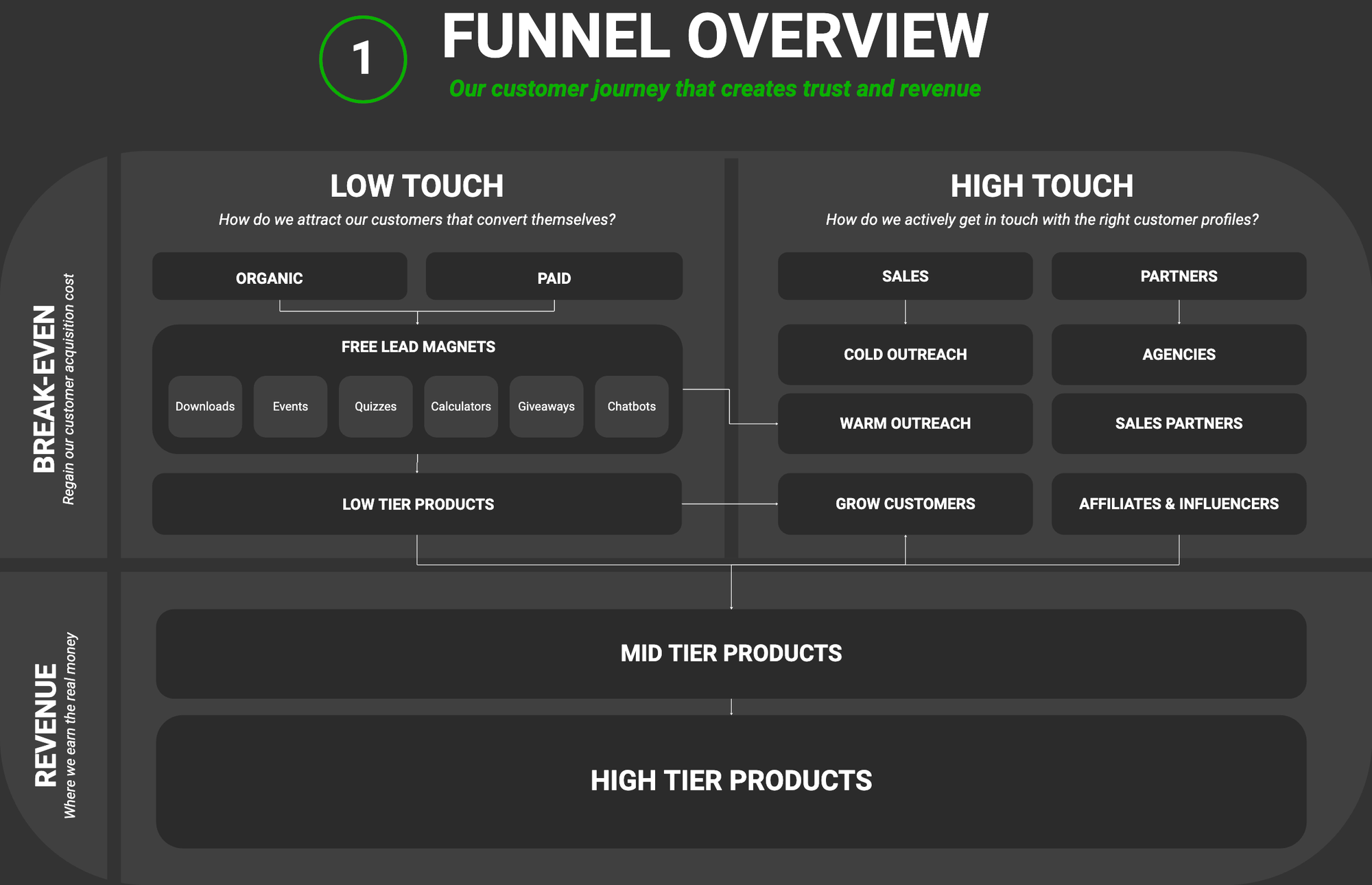
Where You're Building From
In the Content & Story level, you created the foundation for organic, low-touch customer acquisition: your content strategy, story framework, and the systems to attract people naturally through valuable content. You've built the backbone – now it's time to activate it.
What You're Deciding Here
This lesson helps you make a critical strategic decision: How will you generate and convert leads? There are two primary approaches, and understanding them will shape everything that follows:
Low Touch (Marketing-Oriented)
Self-service customer journeys where people discover you through content, engage with your materials, and convert themselves with minimal direct interaction. This works beautifully for lower-priced products and scales efficiently once built. If you're marketing-oriented, this is likely your natural starting point.
High Touch (Sales-Oriented)
Personalized outreach and relationship building where you or your team directly engage prospects through calls, demos, and consultations. This is essential for higher-priced products or complex solutions, and natural territory for sales-oriented founders.
You Don't Need to Do Both (Yet)
Most founders should focus on one approach first – usually the one that matches their strengths and product pricing. Marketing people lean toward low touch. Sales people lean toward high touch. Both work. Both can scale. And they work beautifully together when the time is right.
The Path Forward
You already have the content foundation for low-touch lead generation. Now you'll learn how to:
- Convert your audience into leads with free lead magnets (guides, templates, webinars)
- Nurture those leads through automated email sequences
- Build a break-even funnel that recovers your customer acquisition costs
- Guide customers into your core revenue-generating products or higher tiers
- (Optional) Layer on paid advertising, sales outreach, or partnerships to scale
Understanding the Three-Tier SaaS Structure
Most successful SaaS businesses use a three-tier structure that naturally guides customers from entry to premium:
- Low-Tier (Break-Even Tier): $50-$300 one-time purchase - Recovers your acquisition cost, delivers quick value
- Mid-Tier (Main Revenue Tier): $30-$300/month subscription - Your core recurring revenue generator
- High-Tier (Premium Tier): $10k-$50k/year contracts - Premium customers, may involve sales assistance
Beyond $50k/year, you're in Enterprise territory, which requires dedicated high-touch sales.
What Should You Focus On First?
Your starting point depends on your pricing structure:
For Self-Serve SaaS (Most founders)
Start with an organic, low-touch funnel that moves customers through your tiers: Free trial/lead magnet → Low-tier one-time offer (break-even) → Mid-tier subscription ($30-300/month, main revenue). This builds on your content foundation and scales efficiently. Once working, layer on paid marketing where the low-tier offer recoups your ad spend.
For High-Tier/Enterprise SaaS
Start with organic content + sales outreach for deals above $10k/year. Use content to build credibility, then add personalized outreach to qualified prospects. Once your sales process is solid, add sales partners to scale.
The Beautiful Part
Both approaches work together. Self-serve businesses naturally graduate some customers to high-tier/enterprise (requiring sales support). Enterprise-focused businesses add self-serve mid-tier options for smaller customers. But start with one approach that matches your primary offering.
Your Decision
By the end of this lesson, you'll have clarity on your starting point and a visual map of your complete customer journey.
2. Low Touch - How we attract customers that convert themselves
Building on Your Organic Foundation
You already have the foundation: your content strategy and story framework from the Content & Story level. Now it's time to convert that audience into paying customers through your three-tier self-service system.
The Three-Tier Low-Touch Progression
The low-touch funnel naturally moves customers up your value ladder:
Entry Points: Two Paths
You have two primary ways to convert your organic audience:
Path 1: Free Trial → Mid-Tier Subscription (Direct)
- Offer 14-30 days of your mid-tier product for free
- User experiences full value
- Convert directly to paid subscription
- Best for: Users ready to evaluate your core product
Path 2: Lead Magnet → Low-Tier Offer → Mid-Tier Subscription (Recommended for paid acquisition)
- Start with free lead magnet: guide, template, assessment tool, webinar, or online event
- Captures contact information without product access
- Follow with low-tier one-time offer
- Then upsell to mid-tier subscription (often with discount)
- Best for: Building email list and recovering acquisition costs
Note: We generally don't recommend freemium tiers – they attract users who never intend to pay and create ongoing support costs without revenue.
Tier 1: Low-Tier One-Time Offer ($50-$300)
This tier works AFTER a lead magnet, not after a free trial. If someone downloads your guide or attends your webinar, you offer them a valuable one-time purchase:
- Setup service - Help them implement or configure something specific
- Premium templates or resources - High-quality assets they can use immediately
- Mini course - Focused training on a specific skill or outcome
This is your break-even tier – it recovers acquisition costs (especially from paid ads) while delivering genuine value. It's priced as a one-time purchase, not a subscription.
Pro tip: After someone buys your low-tier offer, offer them a discount on the mid-tier subscription. They've already paid you once and experienced value – they're warm leads.
Tier 2: Mid-Tier Subscription ($30-$300/month)
Your main revenue generator. Customers arrive here through two paths:
- Direct from free trial (immediate conversion)
- From low-tier offer (bought one-time product, now ready for subscription)
Your mid-tier options:
- Starter plan: $30-$100/month
- Professional plan: $100-$200/month
- Team plan: $200-$300/month
This is where most customers stay long-term.
Tier 3: High-Tier Annual Contracts ($10k-$50k/year)
Some mid-tier customers will naturally graduate to premium offerings:
- Enterprise features
- Dedicated support
- Custom integrations
- Consulting/services
At this level, you may add sales assistance, but the customer often upgrades themselves first.
Two Stages of Implementation
Stage 1: Organic (Start Here)
Choose one path based on your goal:
- Free trial path: Free trial → Mid-tier subscription (fastest to revenue)
- Lead magnet path: Lead magnet (webinar, guide, etc.) → Low-tier one-time → Mid-tier subscription with discount (builds email list)
Start with organic traffic from your content foundation. No paid ads yet.
Stage 2: Paid Acquisition (When Ready)
Add Google Ads, LinkedIn Ads, or Meta Ads. Here's where the lead magnet path becomes critical:
- Paid ad → Lead magnet → Low-tier one-time offer → Mid-tier subscription
- The low-tier offer ($50-$300) must recover your ad costs ($50-$300 per customer)
- Without this, paid ads lose money until month 2-3 of subscription
(We'll design this break-even math in Section 4.)
Why This Structure Works
- Two clear paths: Free trial (direct to subscription) OR lead magnet (build list + recover costs)
- Natural progression: Lead magnet → Low-tier → Mid-tier builds trust at each step
- Scalable: Once built, handles unlimited traffic
- Sustainable: Low-tier recovers acquisition costs, mid-tier generates recurring revenue
- Flexible: Free trial for ready buyers, lead magnet for building audience
3. Break-Even - Regain our customer acquisition cost
Why This Matters
When you run paid ads, you need to recover your acquisition cost quickly – otherwise, you can't scale profitably. The break-even funnel uses your low-tier one-time offer to recover ad spend immediately, while your mid-tier subscription generates the real recurring revenue.
Without a break-even strategy, you're waiting 2-3 months to recover costs from subscriptions alone. With a low-tier offer, you break even in days.
How It Works: Paid Acquisition Example
Let's say you run Meta Ads to a free webinar:
The Investment:
- Ad spend: $1,000
- Result: 100 webinar attendees
- Cost per attendee: $10
Three-Tier Conversion Path:
- Lead Magnet (Free Webinar): 100 attendees
- Low-Tier Offer ($100 mini course): 10 people buy (10% conversion)
- Revenue: $1,000
- Break-even achieved ✓
- Mid-Tier Subscription ($50/month): 5 of those 10 upgrade (50% conversion)
- Month 1 revenue: $250
- Recurring: $250/month going forward
- Pure profit from here
Unit Economics:
- Ad spend: $1,000
- Low-tier revenue: $1,000 (break-even)
- Mid-tier revenue: $250/month (profit + recurring)
- First month total: Break-even + $250 profit
The Key Insight: Your low-tier offer recovers acquisition costs immediately, so every mid-tier subscription is pure profit from day one. This is how you scale paid ads without burning cash.
What to Offer at Each Tier:
- Low-Tier ($50-$300 one-time): Setup service, premium templates, mini course
- Mid-Tier ($30-$300/month): Your core SaaS product with monthly billing
- High-Tier ($10k-$50k/year): Enterprise features with annual contracts
Your low-tier must deliver genuine value – if it feels like a cash grab, conversions tank and you damage trust.
4. High Touch - How we actively get in touch with the right customer profiles
What High Touch Means
High touch means actively reaching out to prospects and customers rather than waiting for them to take action. This applies across your entire funnel:
- Following up with lead magnet subscribers who haven't purchased yet
- Reaching out to free trial users who didn't convert
- Checking in with low-tier buyers to offer subscription upgrades
- Working with mid-tier customers ready for enterprise deals
It's not exclusively for big enterprise sales – it's any personalized, proactive engagement to move people forward.
Sales-Assisted for High-Tier and Enterprise
High touch becomes essential when you're selling annual contracts above $10k/year, particularly in the $10k-$50k range and especially for enterprise deals above $50k/year. At these price points, customers expect – and need – dedicated sales support, custom solutions, and personalized engagement.
When High Touch Becomes Necessary
For self-serve SaaS, most customers in the low and mid-tiers ($50-$300/month) convert themselves. But as customers consider high-tier options:
- $10k-$50k/year contracts: May start self-serve but need sales assistance to finalize
- $50k+/year enterprise: Requires dedicated sales from first contact
- Custom integrations: Need technical discussions and scoping
- Multiple stakeholders: Require demos, presentations, and relationship building across teams
The Two High-Touch Approaches
Warm Outreach (People Who've Already Engaged)
Warm outreach targets people who have already interacted with your business in some way. This includes:
- Lead magnet subscribers who downloaded your guide or attended your webinar but haven't purchased yet
- Free trial users who tried your product but didn't convert to paid
- Low-tier buyers who purchased your one-time offer but haven't upgraded to subscription
- Mid-tier customers signaling interest in upgrading (hitting usage limits, asking about enterprise features, expanding teams)
These are warm because they already know you and have shown interest. Your outreach is personalized follow-up, not cold prospecting. This applies to both low-touch (converting free users to paid) and high-touch (upgrading customers to enterprise).
Cold Outreach (Direct to High-Value Prospects)
For high-tier and enterprise deals, you also identify ideal customer profiles (ICPs) who've never heard of you and reach out proactively:
- LinkedIn outreach to decision-makers
- Personalized email sequences
- Industry event networking
- Multiple touchpoints across channels
This is exclusively for high-touch sales – you're not cold calling people to buy a $50/month subscription.
Integrating Marketing and Sales
The key is seamless handoff:
- Marketing generates and warms leads through content, webinars, and trials
- Sales takes qualified prospects through demos, custom proposals, and negotiations
- Both teams share visibility in your CRM – who's engaged, what they've viewed, where they're stuck
When High Touch Makes Sense:
- Annual contracts $10k-$50k/year (sales-assisted)
- Enterprise deals $50k+/year (dedicated sales required)
- Complex implementations requiring customization
- Multiple decision-makers and stakeholders
- Strategic partnerships
High touch doesn't replace low touch – it complements it. Many SaaS companies serve both self-serve mid-tier customers and enterprise customers simultaneously.
5. Revenue - Where we earn the real money
Your Mid-Tier Is Your Revenue Engine
While your low-tier offer recovers acquisition costs, your mid-tier subscription ($30-$300/month) is where you actually make money. This is your core recurring revenue that compounds month after month as you retain customers and add new ones.
The Power of Recurring Revenue
Let's compare two scenarios:
Scenario A: One-time sales only
- 100 customers × $200 one-time = $20,000 revenue
- Next month: Start over, need 100 new customers
- Revenue is unpredictable and requires constant new acquisition
Scenario B: Subscription model (mid-tier)
- Month 1: 100 customers × $100/month = $10,000 MRR
- Month 2: Keep 95 customers + 100 new = 195 customers × $100 = $19,500 MRR
- Month 3: Keep 185 + 100 new = 285 customers × $100 = $28,500 MRR
- Month 6: ~500 customers × $100 = $50,000 MRR
- Result: Predictable, compounding revenue that scales over time
This is why SaaS companies are so valuable – recurring revenue compounds.
Optimizing Your Mid-Tier for Revenue
Multiple price points ($30-$300/month):
- Starter: $30-$50/month - Entry point for solo users
- Professional: $100-$150/month - Where most customers land
- Team: $200-$300/month - For growing teams
Key metrics to track:
- MRR (Monthly Recurring Revenue): Total predictable monthly revenue
- Churn rate: What % of customers cancel each month (target: under 5%)
- Expansion revenue: Customers upgrading from Starter → Pro → Team
- Net MRR retention: Are you growing revenue from existing customers?
Price Anchoring Effect
The three-tier structure creates psychological anchoring. When customers see:
- Starter at $50/month
- Professional at $150/month
- Team at $300/month
The Professional tier looks like the "smart choice" (not too basic, not too expensive). Most customers will choose the middle tier, while price-sensitive users pick Starter and teams with budget pick Team. This maximizes revenue across your customer base.
High-Tier Expansion Revenue
Your high-tier annual contracts ($10k-$50k/year) provide significant expansion revenue from existing mid-tier customers who:
- Hit usage limits and need more capacity
- Grow their team size
- Need enterprise features (SSO, advanced security, compliance)
- Want dedicated support and account management
B2B SaaS Revenue Examples
Example 1: Project Management Tool
- Low-tier: Setup service $200 one-time (breaks even on acquisition)
- Mid-tier Starter: $50/month - 5 users, basic features
- Mid-tier Professional: $150/month - 15 users, advanced features
- Mid-tier Team: $300/month - unlimited users, full features
- High-tier Enterprise: $20k/year - custom implementation, dedicated support
Example 2: Marketing Automation Platform
- Low-tier: Template library $150 one-time (breaks even)
- Mid-tier Starter: $100/month - 5,000 contacts
- Mid-tier Professional: $200/month - 25,000 contacts, automations
- Mid-tier Team: $300/month - 100,000 contacts, full features
- High-tier Enterprise: $30k/year - unlimited contacts, API access, dedicated CSM
The Path to $10k MRR, Then $100k MRR
Start with your mid-tier subscription as the foundation:
- Get to $10k MRR: ~100 customers at $100/month average
- Scale to $50k MRR: ~500 customers
- Reach $100k MRR: ~1,000 customers + high-tier expansion
Each milestone becomes easier as you:
- Reduce churn (keep more customers)
- Improve conversion (free trial → paid)
- Drive upgrades (Starter → Pro → Team → Enterprise)
- Add customers consistently through your funnel
Your mid-tier recurring revenue is the foundation. Everything else – low-tier, high-tier, upsells – builds on top of this base.
6. Your Complete Funnel Strategy
The Big Picture
You've now designed your complete customer acquisition and revenue funnel. You have clarity on how prospects discover you, how they convert, and how they grow in value over time.
What You've Decided:
Entry Point & Lead Generation:
- Your lead magnet choice and how it connects to your content strategy
- Free trial or lead magnet path (or both)
- How you'll convert organic audience into leads
Three-Tier Revenue Structure:
- Low-Tier ($50-$300 one-time): Your break-even offer that recovers acquisition costs
- Mid-Tier ($30-$300/month): Your core subscription that generates recurring revenue
- High-Tier ($10k-$50k/year): Your premium/enterprise tier for expansion revenue
Acquisition Strategy:
- Organic (building on content foundation): Lead magnet → conversion
- Paid (when ready for scale): Meta/LinkedIn Ads → lead magnet → break-even → profit
High-Touch Outreach (If Applicable):
- Your ideal customer profile for LinkedIn outreach
- Warm outreach strategy for non-converting leads
- Cold outreach strategy for enterprise prospects
Implementation Path:
You don't need everything built on day one. Here's the recommended sequence:
- Start with mid-tier subscription + organic traffic from your content foundation
- Add lead magnet once you're ready to build an email list
- Add low-tier break-even offer when you're ready for paid acquisition
- Add high-tier once you have mid-tier customers showing upgrade signals
What's Coming Next:
The following lessons will help you build each component:
Lesson 3 - Landing Pages: Create the actual pages for your funnel
Lesson 4 - Messages: Craft email sequences that move people through tiers
Lesson 5 - CRM Workflows: Automate lead tracking and tier progression
Create Your Funnel Overview Document
Now let's consolidate all your funnel decisions into one comprehensive reference document.