
How we talk about it

Packaging and delivering our message in style

1. Goal

Let's define how to package and deliver your content across different stages of the customer journey. This isn't just about creating content–it's about strategically matching your message, format, and channel to where your audience is in their journey.
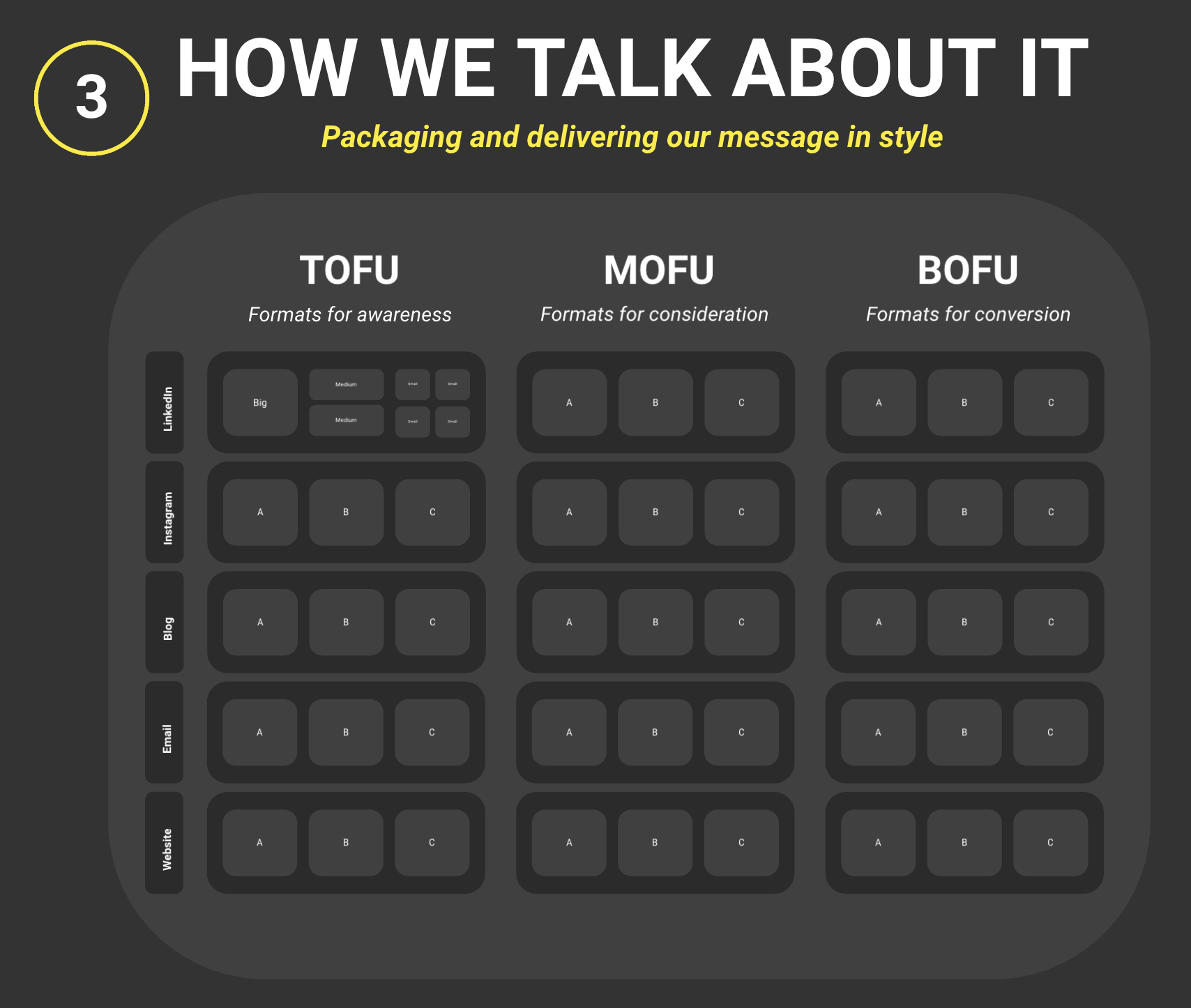
How we talk about it Template

2. Choosing Your Core Content Channels

Before we dive into funnel stages and formats, let's identify your core content channels–the primary platforms where you'll focus your content efforts. This helps you optimize formats and strategies for channels that actually matter to your audience.

Continue in the same Claude conversation. We're building on the themes and topics we identified in the previous lesson.

Focus on What Matters

Rather than trying to be everywhere, focus on:

  • One primary social media channel - Where your audience actively engages
  • One owned channel - A channel you control (ideally a long-form content channel like blog + newsletter)

The ideal setup is a pair: one long-form owned channel (like a blog) that you can distribute through a newsletter, which then gets broken down into smaller posts for your social media channel, or transformed into videos for YouTube.

Choose your core content channels
We're continuing our content strategy work. You have all our context: business, story framework, themes, topics, and our audience. Now let's identify the core content channels we should focus on.
Before I make recommendations, I need your input. Please ask me questions to understand:
1.**What type of business are we?**
- Are we B2B or B2C?
- What's our primary business model?
- How does this affect where our audience spends time?
2.**Where does our audience engage?**
- What social media platforms does our target audience actively use?
- Where do they go to discover new information or solutions?
- What platforms align with our audience's professional vs. personal time?
- Are there any platforms we're already active on with good engagement?
3.**What owned channels do we have or want?**
- Do we have a blog or website?
- Do we have an email list or newsletter?
- What long-form content channels make sense for us?
- What's realistic for us to maintain consistently?
4.**What's our content production capacity?**
- How much time/resources can we dedicate to content?
- What formats are we comfortable creating?
- What's our team's strengths (writing, video, design, etc.)?
Ask me these questions and wait for my answers.
Once you have my input, use it as a starting point for deeper research and thinking:
- Research which social media channels work best for B2B vs B2C businesses in our industry
- Analyze channel effectiveness for our specific audience type
- Consider owned channel strategies (blog + newsletter combos, long-form content)
- Think about content repurposing workflows (long-form → social → video)
- Evaluate what's realistic and sustainable for our resources
Then provide a comprehensive summary that includes:
- What I told you (my business type, audience preferences, current channels, capacity)
- What you researched (channel effectiveness for B2B/B2C, owned channel best practices, repurposing strategies)
- **Clear recommendation for ONE primary social media channel** with rationale
- **Clear recommendation for ONE owned channel** (ideally blog + newsletter combo) with rationale
- How these channels work together (repurposing workflow)
- Strategic implications for how we'll optimize formats in the following sections

Outcome: You have identified your core content channels–one primary social media channel and one owned channel–that will be your focus for content distribution.

Choose your core content channels

3. Understanding the Funnel Stages

Before diving into specific formats and channels, let's understand what each funnel stage represents and what your audience needs at each point.

The Content Marketing Funnel

The content marketing funnel is divided into three stages, often abbreviated as:

  • ToFu = Top of Funnel (Awareness)
  • MoFu = Middle of Funnel (Consideration)
  • BoFu = Bottom of Funnel (Conversion)

Content serves different purposes at each stage:

  • ToFu (Awareness): Your audience is problem-aware but not solution-aware. They're discovering they have a problem and starting to research.

  • MoFu (Consideration): Your audience is solution-aware and comparing options. They're evaluating different approaches and providers.

  • BoFu (Conversion): Your audience is ready to choose. They need final validation and want to minimize risk.

Key Principles for Funnel Content

  1. Embrace the importance of packaging: Make sure your content is not only valuable but also presented with a polished aesthetic that resonates with your audience.

  2. Develop tailored content for each stage: Light and engaging for ToFu, detailed and informative for MoFu, and conversion-driven for BoFu.

  3. Choose channels strategically: Like YouTube for lasting brand value and LinkedIn for immediate engagement, with content crafted to suit each platform's unique strengths.

  4. Remain flexible and experimental: Navigate the ever-changing landscape of digital marketing, ensuring your content strategy evolves to stay ahead of the curve.

4. ToFu - Formats and channels for awareness

Top of funnel content is about getting discovered. Your goal is to create content that captures attention, provides immediate value, and makes people want to learn more. This content should be easy to consume and widely shareable.

Continue in the same Claude conversation. We're building on the story framework, themes, topics, and core content channels we've identified in previous steps.

The Goal: Format + Topic Combinations

The magic happens when you combine the formats that work best for your channels with the topics your audience cares about. You'll end up with a curated list of highly valuable, engaging ToFu content formats that you can turn into concrete posts by applying your preferred topics.

Generate ToFu content formats and examples
We're continuing our content strategy work. You have all our context: business, story framework, themes, topics, and most importantly - the core content channels we selected (our primary social media channel and owned channel).
Now let's generate ToFu content format ideas specifically tailored to our focus channels and audience.
Based on everything we know:
- Our story framework and differentiation
- Our target audience and their challenges
- Our themes and topics
- Our primary social media channel (from our earlier channel selection conversation)
- Our owned channel (from our earlier channel selection conversation)
Pull the specific channel information from our previous conversation where we selected our core content channels.
Generate a comprehensive list of top-of-funnel content formats that would work exceptionally well for our specific channels and audience. For each format, consider:
- How it fits our story and themes
- How it works on our specific channels
- Why it would resonate with our audience at the awareness stage
- What makes it shareable and engaging
Create a diverse list of 10-15 format ideas, organized by our focus channels. For each format, include:
- Format name and description
- Why it works for our audience/channels
- Difficulty level (Easy/Medium/Hard)
- Potential impact (High/Medium/Low)
- One brief example showing how we could apply one of our topics to this format
Present this complete list to me now. I will review it and tell you which formats I want to focus on.
Once I've made my selection and told you which formats I prefer, THEN create a comprehensive summary that includes:
- My selected formats (the ones I chose)
- For each selected format: 2-3 detailed concrete content examples using different topics from our list
- How these formats work together across our channels
- A simple workflow for creating content: Topic + Format = Concrete Post

Outcome: You have a curated list of highly valuable, engaging ToFu content formats with concrete examples showing how to combine formats with your topics into publishable content.

Define your ToFu content strategy

5. MoFu - Formats and channels for consideration

Middle of funnel content is about building trust and demonstrating expertise. Your goal is to help prospects evaluate whether you're the right solution while deepening the relationship. This content should be more detailed and educational.

Continue in the same Claude conversation. We're building on the ToFu strategy we just defined, along with our story framework, themes, topics, and core content channels.

The Goal: Format + Topic Combinations for Trust-Building

Just like ToFu, the magic happens when you combine formats that work for your channels with topics that help prospects evaluate. You'll end up with a curated list of MoFu content formats that build trust and demonstrate expertise, with concrete examples showing how to apply your topics.

Generate MoFu content formats and examples
We're continuing our funnel content strategy. You have our ToFu strategy we just created, plus all our previous context: business, story framework, themes, topics, and our core content channels (primary social media channel and owned channel).
Now let's generate middle-of-funnel content format ideas specifically tailored to our focus channels and audience.
Based on everything we know:
- Our story framework and differentiation
- Our target audience and their challenges
- Our themes and topics
- Our ToFu content strategy (what we're doing for awareness)
- Our primary social media channel (from our earlier channel selection conversation)
- Our owned channel (from our earlier channel selection conversation)
Pull the specific channel information from our previous conversation where we selected our core content channels.
Generate a comprehensive list of middle-of-funnel content formats that would work exceptionally well for building trust and helping prospects evaluate our solution. For each format, consider:
- How it demonstrates our expertise and unique approach
- How it works on our specific channels
- Why it would resonate with our audience at the consideration stage
- How it bridges from ToFu awareness to BoFu decision
Create a diverse list of 10-15 format ideas, organized by our focus channels. For each format, include:
- Format name and description
- Why it works for building trust with our audience/channels
- Difficulty level (Easy/Medium/Hard)
- Potential impact (High/Medium/Low)
- One brief example showing how we could apply one of our topics to this format
Present this complete list to me now. I will review it and tell you which formats I want to focus on.
Once I've made my selection and told you which formats I prefer, THEN create a comprehensive summary that includes:
- My selected formats (the ones I chose)
- For each selected format: 2-3 detailed concrete content examples using different topics from our list
- How these formats work together across our channels
- How MoFu formats connect to our ToFu strategy and lead toward BoFu
- A simple workflow for creating content: Topic + Format = Concrete Trust-Building Content

Outcome: You have a curated list of highly valuable MoFu content formats with concrete examples showing how to combine formats with your topics into trust-building content.

Define your MoFu content strategy

6. BoFu - Formats and channels for conversion

Bottom of funnel content is about driving decisions. Your goal is to address final objections, provide proof, and make it easy to take the next step. This content should be highly specific and conversion-focused.

Continue in the same Claude conversation. We're building on the ToFu and MoFu strategies we've defined, along with our story framework, themes, topics, and core content channels.

The Goal: Format + Topic Combinations for Conversion

Just like ToFu and MoFu, combine conversion-focused formats with your topics to create content that addresses objections and drives decisions. You'll end up with a curated list of BoFu content formats with concrete examples showing how to turn prospects into customers.

Generate BoFu content formats and examples
We're completing our funnel content strategy. You have our ToFu and MoFu strategies we've already created, plus all our context: business, story framework, themes, topics, solutions, pricing, target outcomes, and our core content channels (primary social media channel and owned channel).
Now let's generate bottom-of-funnel content format ideas specifically tailored to our focus channels and audience.
Based on everything we know:
- Our story framework and differentiation
- Our target audience and their challenges
- Our themes and topics
- Our ToFu and MoFu content strategies (what we're doing for awareness and consideration)
- Our primary social media channel (from our earlier channel selection conversation)
- Our owned channel (from our earlier channel selection conversation)
- Our solutions and how we help customers achieve outcomes
Pull the specific channel information from our previous conversation where we selected our core content channels.
Generate a comprehensive list of bottom-of-funnel content formats that would work exceptionally well for driving conversions and addressing final objections. For each format, consider:
- How it addresses common objections and reduces risk
- How it provides proof and validation
- How it works on our specific channels
- Why it would resonate with our audience at the decision stage
- How it completes the journey from ToFu → MoFu → BoFu
Create a diverse list of 10-15 format ideas, organized by our focus channels. For each format, include:
- Format name and description
- Why it works for conversion with our audience/channels
- Difficulty level (Easy/Medium/Hard)
- Potential impact (High/Medium/Low)
- One brief example showing how we could apply one of our topics or solutions to this format
Present this complete list to me now. I will review it and tell you which formats I want to focus on.
Once I've made my selection and told you which formats I prefer, THEN create a comprehensive summary that includes:
- My selected formats (the ones I chose)
- For each selected format: 2-3 detailed concrete content examples using different topics or solutions from our list
- How these formats work together across our channels
- How BoFu formats complete the funnel journey (ToFu → MoFu → BoFu → Customer)
- A conversion path map showing how prospects move through our funnel
- A simple workflow for creating content: Topic/Solution + Format = Concrete Conversion Content

Outcome: You have a curated list of highly valuable BoFu content formats with concrete examples showing how to combine formats with your topics and solutions into conversion-focused content.

Define your BoFu content strategy

7. Summary

You've now defined how to talk about your content across the funnel:

  1. Core content channels - Identified your primary social media channel and owned channel for focused content distribution
  2. ToFu strategy - Formats and channels for creating awareness and attracting your audience
  3. MoFu strategy - Content for building trust and helping prospects evaluate your solution
  4. BoFu strategy - Conversion-focused content that addresses objections and drives decisions

Continue in the same Claude conversation. Let's create a comprehensive summary of everything we've defined in this lesson.

Create comprehensive summary of content format strategy
We've completed our "How We Talk About It" content strategy. You have all the context from our conversation:
- Our core content channels (primary social media channel and owned channel)
- Our ToFu content strategy (selected formats and examples)
- Our MoFu content strategy (selected formats and examples)
- Our BoFu content strategy (selected formats and examples)
Create a clear, comprehensive summary that consolidates everything we've defined. The summary should include:
1.**Core Content Channels**
- Our primary social media channel and why we chose it
- Our owned channel and how it works with our social channel
- How these channels work together (repurposing workflow)
2.**ToFu Content Strategy**
- Our selected ToFu formats
- Key examples of how we combine formats with topics
- How ToFu content works across our channels
3.**MoFu Content Strategy**
- Our selected MoFu formats
- Key examples of how we combine formats with topics
- How MoFu content builds trust and bridges to BoFu
4.**BoFu Content Strategy**
- Our selected BoFu formats
- Key examples of how we combine formats with topics/solutions
- How BoFu content drives conversions
5.**Complete Funnel Overview**
- How ToFu → MoFu → BoFu works together
- The content journey from awareness to conversion
- How formats work across channels throughout the funnel
Make this summary clear and concise - something I can store or screenshot for easy reference. This is for my own documentation, not for integration with other documents yet.

Outcome: You have a comprehensive summary of your content format strategy including channels, ToFu, MoFu, and BoFu strategies.

Create comprehensive summary of how we talk about it

This gives you a complete framework for packaging your message. In the next lesson, we'll tackle when to publish what–creating a content calendar that makes your audience go AARRR every month.

Further Resources

Dig deeper into content formats and channels

Books:

Online:

Tools: