
Why we do this
The story that deeply resonates with our core audience
1. Goal
Let's craft the foundational story that makes your audience choose you over everyone else. This isn't about your company's "why"–it's about understanding the transformation you create for your customers and articulating it in a way that deeply resonates.
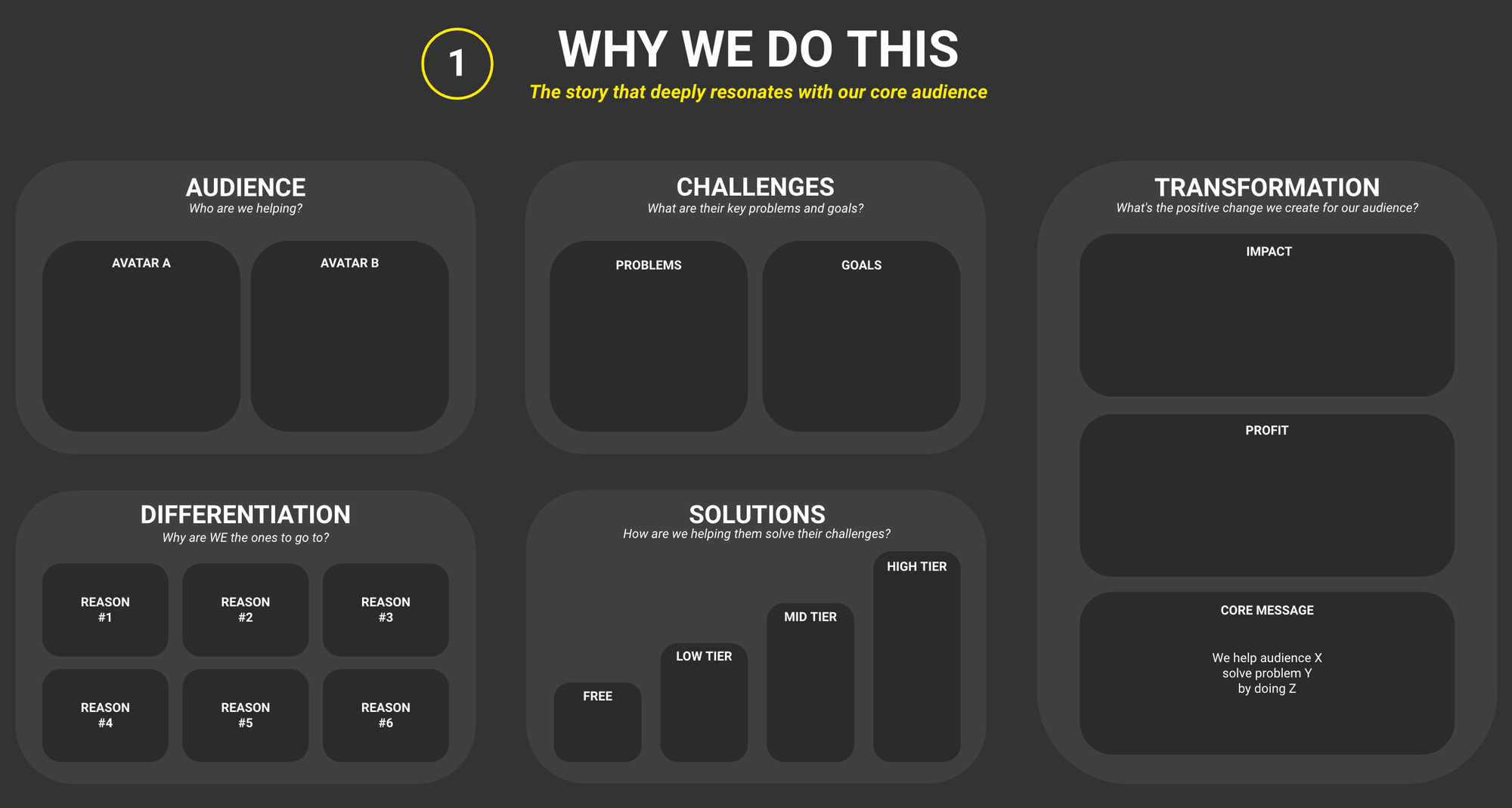
2. Audience - Who are we helping?
Understanding your audience is the foundation of every great story. You need to know who they are, what situation they're in, and what's driving their decisions. This isn't about creating fictional personas–it's about deeply understanding the real people you're here to serve.
Continue in the same Claude conversation you started in the overview lesson. We're building on the business context and content state you've already established.
Define Your Core Audience
Start by getting specific about who you're helping. What's their role? What stage are they at in their journey? What keeps them up at night? The more specific you can be, the more your story will resonate.
Understand Their Context
Your audience isn't just a list of characteristics–they exist in a specific context. What pressures are they facing? What constraints are they working within? What aspirations are driving them forward?
Outcome: You have a crystal-clear definition of your core audience and the context they operate in.
3. Challenges - What are their key problems and goals?
Now that you know who you're serving, you need to understand what they're struggling with and what they're striving for. These challenges and goals are the foundation of your story–they're what make your audience care.
Continue in the same Claude conversation. We're building on the audience definition we just established.
Identify Key Problems
What are the specific pain points your audience faces? Don't just list surface-level issues–dig into the real, underlying problems that keep them stuck.
Understand Their Goals
What are they trying to achieve? What does success look like for them? Understanding their end goal helps you position your solution as the bridge from where they are to where they want to be.
For example, considering Pirate Skills' own audience:
-
Impact: Our members want to leave a mark, to see their products and services genuinely solving problems.
-
Profitability: At the end of the day, the numbers need to make sense. Members aim for a model where the customer acquisition cost is dwarfed by the lifetime value.
-
Self-Reliance: There's a strong drive to internalize skills, to be less dependent on external agencies and more in command of their own marketing destiny.
Outcome: You have documented the specific challenges and goals that drive your audience's decisions.
4. Differentiation - Why are WE the ones to go to?
This is where you define what makes you uniquely qualified to help your audience. It's not about being better at everything–it's about being the right fit for your specific audience facing their specific challenges.
Continue in the same Claude conversation. We're building on the audience and challenges we've already defined.
Articulate Your Unique Position
What do you bring to the table that others don't? This could be your approach, your experience, your values, your methodology, or your commitment. Be specific and honest.
For example, at Pirate Skills, differentiation comes from:
-
Founder's Commitment: Our life's work is building and nurturing this community. This isn't just a job; it's our calling.
-
Zero Tolerance for Fluff: Our marketing has to cut through the noise because our survival depends on it. We pass on that efficiency to you.
-
Teaching Prowess: Expertise alone doesn't translate into effective teaching. Our patience and clarity in instruction set us apart.
-
Proven Impact: We don't just talk; we have a track record of real, impactful case studies that demonstrate our prowess.
-
Empirical Method: Our geeky fascination with numbers and data means we're all about what's measurable and actionable.
-
Independence: Without an agency's bias, our advice and strategies are untainted by the need to upsell unnecessary services.
-
Innate Problem-Solving: Our instinct is to confront challenges head-on, offering solutions that genuinely address customer pain points.
Outcome: You have articulated what makes you uniquely qualified to serve your audience.
5. Solutions - How are we helping them solve their challenges?
Now that you've established the problems and your unique position, it's time to clearly articulate your solutions. This isn't just a list of features–it's about showing how you specifically address each challenge your audience faces.
Continue in the same Claude conversation. We're building on everything we've established so far.
Map Solutions to Challenges
For each major challenge you've identified, explain how your offering addresses it. Be specific about the mechanism–how does your solution actually work to solve their problem?
Focus on Outcomes
Don't just describe what you do–describe what your audience gets. What changes when they work with you? What becomes possible that wasn't before?
Outcome: You have mapped how your solutions specifically address audience challenges and the outcomes they create.
6. Transformation - What's the positive change we create for our audience?
This is the heart of your story–the transformation you enable. You're not just solving problems; you're helping people move from one state to a better state. This transformation is what makes your story compelling and memorable.
Continue in the same Claude conversation. This is the final piece of our story framework, building on everything we've established.
Define the "Before" State
What is life like for your audience before they engage with you? What struggles are they facing? What limitations are holding them back? Be specific and honest about the challenges.
Paint the "After" Picture
What does life look like after they've worked with you? What has changed? What's now possible that wasn't before? What do they feel that they didn't feel before?
Tell the Journey
The transformation isn't just about before and after–it's about the journey between them. How do you guide them through that transformation? What milestones do they hit along the way?
Outcome: You have defined the complete transformation journey your customers experience from before to after.
7. Create Your Story Document
Now that you've completed all the foundational story work, let's compile everything into a comprehensive story document that you can reference throughout your content strategy work.
Outcome: You have a comprehensive story document that consolidates all your foundational story work.
8. Summary
You've now completed the foundational story work for your content:
- Defined your audience - You know exactly who you're serving and their context
- Identified challenges and goals - You understand what they're struggling with and striving for
- Articulated your differentiation - You're clear on why you're uniquely qualified to help
- Mapped your solutions - You've connected your offerings to their specific challenges
- Defined the transformation - You can clearly describe the journey from before to after
- Created your story document - You have a comprehensive reference document saved in your Claude project
This foundation sets you up perfectly for the next step: defining what you talk about. In the next lesson, we'll identify the themes, topics, and content that position you as the go-to problem solver.
Further Resources
Dig deeper into story and positioning
Books:
- Building a StoryBrand by Donald Miller
- This is Marketing by Seth Godin
- Start with Why by Simon Sinek
- Obviously Awesome by April Dunford
- The Mom Test by Rob Fitzpatrick
- Value Proposition Design by Alexander Osterwalder
Online:
Tools: