
Where we AARRR
An honest analysis of our current situation
GOAL
Let's conduct a comprehensive, data-driven analysis of our current marketing strategies and operations. This analysis aims to identify pivotal areas of strength and weakness within our existing growth funnel.
OBJECTIVES
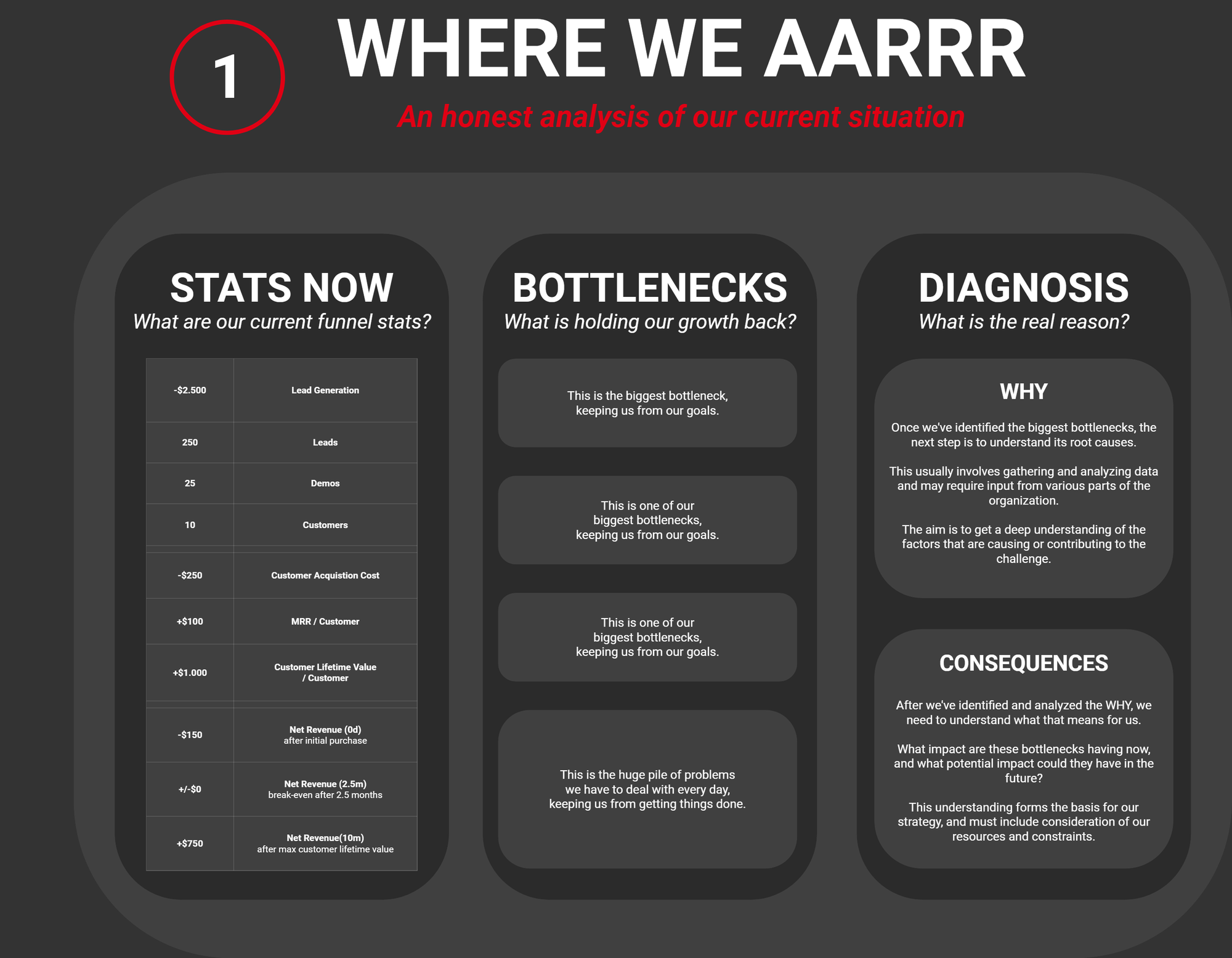
Stats Now - What are our current funnel stats?
We need to understand and calculate key metrics in our current growth funnel, such as traffic, conversion rates, and customer acquisition costs.
We can't aim for growth if we don't know where we currently stand. These metrics will be our starting line.
Bottlenecks - What is holding our growth back?
Our task is to identify any bottlenecks in our current operations that may be holding back growth, whether it's in customer acquisition, retention, or revenue generation.
We want to make sure our resources are allocated where they can make the most impact. Identifying bottlenecks helps us do that.
Diagnosis - What is the real reason?
Our goal here is to pinpoint the root causes behind the bottlenecks and other issues we've identified in our growth strategy.
Addressing symptoms without understanding the root cause won't get us far. We need a clear diagnosis to take effective action.
1.1 Stats Now - What are our current funnel stats?
Understanding metrics is foundational for scaling growth effectively. The process starts with meticulously mapping out every step of the customer journey, from the first click to the final purchase. Collect real, actionable data on how many users reach each phase, and then hone in on conversion rates and associated costs. This data serves as a navigational guide, allowing teams to identify strengths and weaknesses, thereby setting the stage for informed growth strategies.
Customer Journey Map
First up, we need to map out every single step of our customer journey. And no shortcuts allowed here. Whether it's a click on an ad, a filled-out form, or sealing the deal with a subscription–every single action is a data point that tells us a part of the story. So, if you haven't sketched out the entire journey, from first contact to purchase, now's the time. We're all going to do it.
Do the Research
Next, we've got to get into the numbers. How many users reach each step in a given week or month? Don't give me guesstimates; we need as close to real data as we can get. If it's a new venture or if you're pivoting, educated assumptions will have to do for now. But make it a priority to replace those with real data ASAP. We can't be shooting in the dark here; we need to know what's actually happening if we're going to improve it.
Map out your complete customer journey from first touchpoint to purchase and beyond. Include every interaction point, no matter how small.
For each step in your customer journey, estimate the number of users who reach it. Use real data if available, or make educated assumptions if you're just starting out.
Calculate the conversion rate between each step and identify the costs associated with moving users through each stage of the funnel.
1.2 Bottlenecks - What is holding our growth back?
To maximize growth, it's crucial to identify and prioritize bottlenecks within your customer journey, from acquisition to conversion and beyond. Whether it's low web traffic, costly leads, or a mismatch between Customer Lifetime Value (CLV) and Customer Acquisition Cost (CAC), understanding these pinch points allows you to target solutions effectively. The key is to not just recognize problems, but to know which ones to tackle first to make the most impact.
Identifying Bottlenecks
Look at your customer journey map and identify where the flow slows down or gets stuck. These are your bottlenecks. They could be in your customer journey (like low conversion rates) or in your operational processes (like slow response times).
Prioritization
Not all bottlenecks are created equal. Some will have a bigger impact on growth than others. We need to prioritize the top 3 bottlenecks for this quarter–the ones that, if solved, would move the needle the most.
Review your customer journey map and identify where users drop off or conversion rates are lowest. These are your customer journey bottlenecks.
Look beyond the customer journey. Are there operational issues slowing down your growth? Slow response times, inefficient processes, or resource constraints?
From all the bottlenecks you've identified, choose the top 3 that would have the biggest impact on growth if solved. Focus on these for the next quarter.
1.3 Diagnosis - What is the real reason?
Diagnosing bottlenecks is a crucial yet often overlooked step in problem-solving. Rather than jumping to solutions, it's essential to separate issue identification from root cause analysis, keeping the focus on data. Techniques like the 'Five Why's' is useful for digging deeper into problems, and team involvement brings different perspectives, leading to more effective solutions. Understanding the consequences of not addressing bottlenecks adds urgency and focus to the diagnostic process.
One step at a time
We've already done the legwork in identifying the bottlenecks. Now, don't go jumping to solutions just yet. Think about it: a chess player doesn't make the first available move; they strategize.
There are three key steps in problem-solving:
- Identifying the issue
- Diagnosing the root cause
- Crafting a solution
The mistake most people make? Mashing steps one and two together. By separating the identification from the diagnosis, we keep things objective, focusing on data instead of getting bogged down by blame games.
Five Why's
The 'Five Why's' technique is an absolute gem for this phase. Ask "Why" five times to dig deep into the issue. For example:
- Why is our Customer Acquisition Cost too high?
- Because people aren't converting during the free trial.
- Why aren't they converting?
- Because the product isn't relevant enough for them.
- Why isn't it relevant?
- ...and so on.
The goal here is to understand the real reason behind each bottleneck.
Involve your team
Don't just make this a solo effort. Involve sales, customer success, marketing, heck, even the agency you're working with. A well-rounded diagnosis often leads to a more effective solution. But remember to focus on what you can control, instead of getting lost in what others should do.
What happens if we fail
Motivation dips when we don't understand the gravity of our bottlenecks. So, ask: What happens if we don't solve this issue? Maybe we won't be able to pay ourselves or our teams what we deserve. On the flip side, solving it could bring us closer to the dream startup life we all envision.
Use the Five Why's technique to dig deeper into each of your top 3 bottlenecks. Don't stop at the surface-level symptoms–find the root causes.
For each bottleneck, clearly articulate what will happen if you don't solve it. This adds urgency and helps prioritize your efforts.
Summary
You've now completed a comprehensive analysis of your current situation:
- Mapped your customer journey - You know every step from first touch to purchase
- Collected your metrics - You have data on conversion rates and costs at each stage
- Identified bottlenecks - You know what's holding back your growth
- Diagnosed root causes - You understand the real reasons behind your bottlenecks
This foundation sets you up perfectly for the next step: defining where you want to go. In the next lesson, we'll set challenging growth goals that align with your company's vision.
Further Resources
Dig deeper into situational analysis
Books:
- Principles: Life and Work - Ray Dalio
- Good Strategy Bad Strategy - Richard Rumelt
- The Lean Startup - Eric Ries
- The ONE Thing - Gary Keller
- Rocket Fuel - Gina Wickman
- Lean Analytics - Alistair Croll, Benjamin Yoskovitz
Online:
- Startup Metrics from Pirate by Dave McClure
- Claude - Use AI to help analyze your metrics