
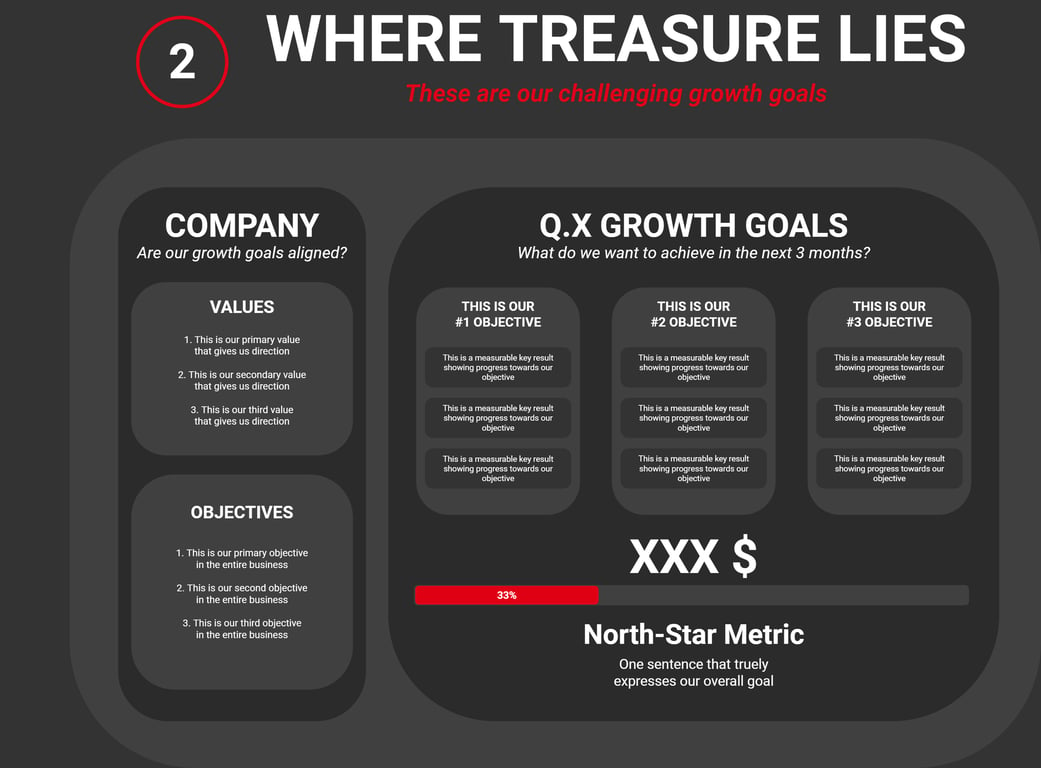
Where the treasure lies
These are our challenging growth goals
GOAL
Define challenging growth goals that align with your company's vision and break them down into measurable objectives and key results that fit into a 13-week cycle.
OBJECTIVES
Company Alignment - Are my growth goals aligned with my company?
Before setting growth goals, we need to ensure they align with the company's overall vision and strategy. Growth goals shouldn't exist in a vacuum–they need to support the bigger picture.
Setting Goals with OKRs
We'll use the Objectives and Key Results (OKRs) framework to structure our goals. Objectives are qualitative goals that inspire, while Key Results are quantifiable outcomes that indicate success.
Long-term vs Short-term Goal Setting
We need to balance long-term vision with short-term execution. Long-term goals provide direction, while short-term goals (13-week cycles) provide focus and momentum.
2.1 Company - Are my growth goals aligned with my company?
Before we dive into setting growth goals, we need to ensure they align with your company's overall vision and strategy. Growth goals shouldn't exist in a vacuum–they need to support the bigger picture.
Understanding Company Vision
What is your company trying to achieve in the long term? What problem are you solving? Who are you serving? Your growth goals should directly support this vision.
Alignment Check
Ask yourself: Do these growth goals move us closer to our company vision? If the answer isn't a resounding yes, you need to realign. Growth for growth's sake isn't sustainable–it needs purpose.
Growth Team's Role
We're not just any team; we're the growth team, and our moves can make or break the company's future. Every goal we set should be strategic, not just tactical.
Take time to understand your company's vision. What are you trying to achieve? How does growth support this vision?
For each growth goal you're considering, explicitly connect it to how it advances your company's vision.
Verify that your growth goals don't conflict with other company priorities. They should work together, not compete.
2.2 Setting your goals with objectives and key results
OKRs are our framework for turning ambitious goals into actionable, measurable outcomes. Like a well-aimed cannon, we've got to hit the mark every quarter.
What are OKRs?
Objectives are qualitative, inspirational goals. They answer "What do we want to achieve?" They should be ambitious and motivating.
Key Results are quantifiable outcomes that measure progress toward the objective. They answer "How will we know we've achieved it?" They should be specific, measurable, and time-bound.
Structure Your OKRs
For each objective, define 2-4 key results. These key results should be:
- Specific and measurable
- Achievable but challenging
- Time-bound (aligned with your 13-week cycle)
- Directly tied to the objective
Example OKR Structure
Objective: Increase customer acquisition by 50% this quarter
Key Results:
- Increase website traffic by 40%
- Improve conversion rate from 2% to 3%
- Reduce customer acquisition cost by 20%
Set ambitious but achievable objectives that align with your company vision. These should inspire your team.
For each objective, define specific, measurable key results that will indicate success. Make them quantifiable and time-bound.
Review each key result. Can you measure it? Is it achievable but challenging? Does it directly support the objective?
2.3 Long-term vs short-term goal setting
We need to balance long-term vision with short-term execution. Long-term goals provide direction, while short-term goals (13-week cycles) provide focus and momentum.
Long-term Goals
These are your North Star–the big picture goals that guide everything you do. They might span 1-3 years and should align with your company vision.
Short-term Goals (13-Week Cycles)
These are your quarterly objectives–the focused goals that move you toward your long-term vision. They're specific, measurable, and achievable within 13 weeks.
The Balance
Your short-term goals should be stepping stones toward your long-term goals. Each 13-week cycle should make meaningful progress toward your North Star.
Quarterly Planning
Every quarter, review your progress, adjust your goals, and set new OKRs for the next 13 weeks. This keeps you agile while maintaining long-term direction.
Set your North Star goals. Where do you want to be in 1-3 years? What does success look like?
Identify the key milestones you need to hit each quarter to reach your long-term goals.
Create your first set of quarterly OKRs that move you toward your long-term goals. Make them specific and measurable.
Summary
You've now set challenging growth goals that:
- Align with your company vision - Your growth goals support the bigger picture
- Are structured with OKRs - Clear objectives with measurable key results
- Balance long and short-term - North Star vision with quarterly execution
This foundation sets you up perfectly for the next step: turning these goals into actionable projects. In the next lesson, we'll create a battle plan to achieve these goals.
Further Resources
Dig deeper into goal setting
Books:
- Measure What Matters - John Doerr
- The 4 Disciplines of Execution - Chris McChesney
- Good Strategy Bad Strategy - Richard Rumelt
Online: