
Traffic Generation
Drive more profitable traffic
1. What is Traffic Generation
Traffic generation is the practice of driving people to your business through a mix of owned, borrowed, rented, and allied channels. It's about moving from "I hope people find us" to "I know exactly where our best customers come from and how to reach more of them." Without intentional traffic generation, even the best funnel sits empty.
In this level, you'll build a complete traffic generation system that balances immediate impact with long-term growth. You'll learn to prioritize channels, structure campaigns for learning, create compelling ad creatives, and scale what works–all while staying profitable.
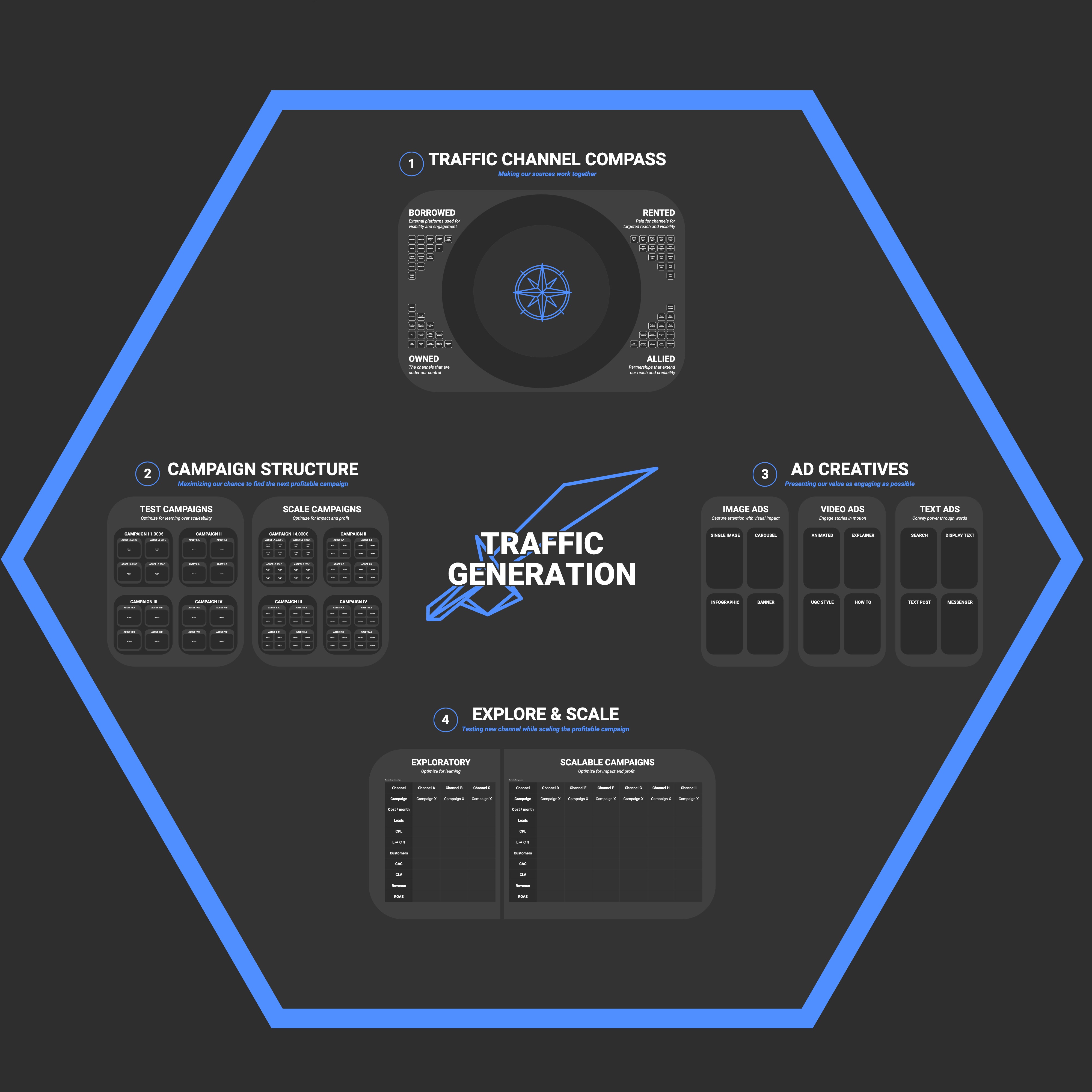
Throughout this level, you'll master four essential components:
- Traffic Channel Compass: Map and prioritize your owned, borrowed, rented, and allied channels
- Campaign Structure: Design test campaigns that learn fast and scale campaigns that stay profitable
- Ad Creatives: Create image, video, and text ads that capture attention and convert
- Explore & Scale: Test new channels boldly while scaling your winners with guardrails
2. The Four Steps of Traffic Generation
This Traffic Generation level is structured into four core steps:
Step 1: Traffic Channel Compass
A traffic channel is any platform or method you use to reach potential customers. Channels fall into four categories:
- Owned channels: Platforms you control (website, email list, community)
- Borrowed channels: External platforms where you build presence (LinkedIn, YouTube, SEO)
- Rented channels: Paid advertising (Google Ads, Meta Ads, LinkedIn Ads)
- Allied channels: Partnerships that extend your reach (affiliates, co-marketing, events)
You'll map your current channels, decide which to prioritize, and create a plan for how they work together.
Step 2: Campaign Structure
Campaigns are organized sets of ads, targeting, and budgets designed to achieve specific goals. You'll learn to structure:
- Test campaigns: Small-budget experiments optimized for learning
- Scale campaigns: Larger-budget campaigns optimized for profit
The key is knowing when to test, when to scale, and when to cut losses.
Step 3: Ad Creatives
Creatives are the actual ads people see–images, videos, and text. You'll create:
- Image ads: Static visuals and carousels that capture attention
- Video ads: Motion content that tells stories and demonstrates value
- Text ads: Headlines and copy that drive clicks and conversions
Step 4: Explore & Scale
The final step balances exploration (finding new profitable campaigns) with exploitation (scaling what works). You'll build a system for continuous testing while maximizing returns from proven campaigns.
3. Why Traffic Generation Matters
Traffic generation transforms your funnel from a static system into a growth engine. It's the difference between "waiting for customers to find us" and "systematically reaching the right people at scale."
The Foundation: Your Funnel and Analytics
Your funnel building work created the systems that convert leads into customers. Your analytics work ensures you can measure what's working. Traffic generation is the amplifier–it fills your funnel with the right people and scales what converts.
From Guesswork to Precision
Before intentional traffic generation, you rely on hope and organic discovery. After building your traffic system, you have:
- Clear visibility into which channels drive the best customers
- Data-driven decisions about where to invest time and money
- Ability to scale profitable campaigns with confidence
- Diversified traffic sources that reduce single-channel risk
Be Bold in the Black
The mantra of traffic generation is "be bold in the black"–meaning once you find profitable campaigns, invest aggressively. But boldness requires data. You need to know your numbers (CAC, ROAS, conversion rates) before scaling. Without analytics, scaling is gambling. With analytics, scaling is strategic investment.
Continuous Adaptation
Traffic channels change constantly. What works today may fade tomorrow. Your survival depends on:
- Always testing new channels and creatives
- Not over-relying on any single source
- Quickly adapting when performance shifts
- Building owned channels as your stable foundation
4. Setting Up Your Claude Chat
We're building on top of the Claude strategy project you already set up. If you haven't set that up yet, check out the Growth Roadmap overview to get started.
Step-by-Step Setup Guide
-
Open Claude (claude.ai or the Claude desktop app, or another AI chat you prefer) and navigate to your existing strategy project (it should have "strategy" in the project name).
-
Create a new chat:
- Click "New Chat" within your existing strategy project
- Make sure you're in the right project–this chat will build on the foundational context you already established
- This new conversation will focus specifically on Traffic Generation work
-
Verify your project context:
- Your existing project already has your Strategy document (business context and growth goals), Story Framework document (audience, story, and content strategy), Funnel Overview document (customer journey and funnel structure), and Metrics document (data analytics setup)
- This new chat will add traffic generation context on top of that foundation
- All conversations in this project can reference your business context, story framework, funnel strategy, analytics, and now your traffic approach
Outcome: You have a new chat ready in your existing Claude strategy project for Traffic Generation work.
-
Copy and paste the AI prompt below into this new conversation. This prompt will gather information about your current traffic situation and goals.
-
Answer Claude's questions as thoroughly as possible. The more context you provide, the better guidance you'll receive in subsequent lessons.
-
Save important information that Claude summarizes, as you may want to reference it later or share it with your team.
Why This Matters
Having traffic generation context in your Claude project means:
- Claude understands your current channels and can recommend improvements
- Recommendations are tailored to your funnel structure and business model
- You don't have to repeat traffic information in every conversation
- The AI can connect insights across your entire growth system
Outcome: You have documented foundational context that Claude can reference throughout your traffic generation work.
Ready to Begin?
Once you've completed the Claude setup and gathered your foundational context, start with Step 1: Traffic Channel Compass to map and prioritize your channels. Each step builds on the previous one, so follow them in order for the best results.