
Traffic Channel Compass
Making our sources work together
1. Goal - Map and prioritize your traffic channels
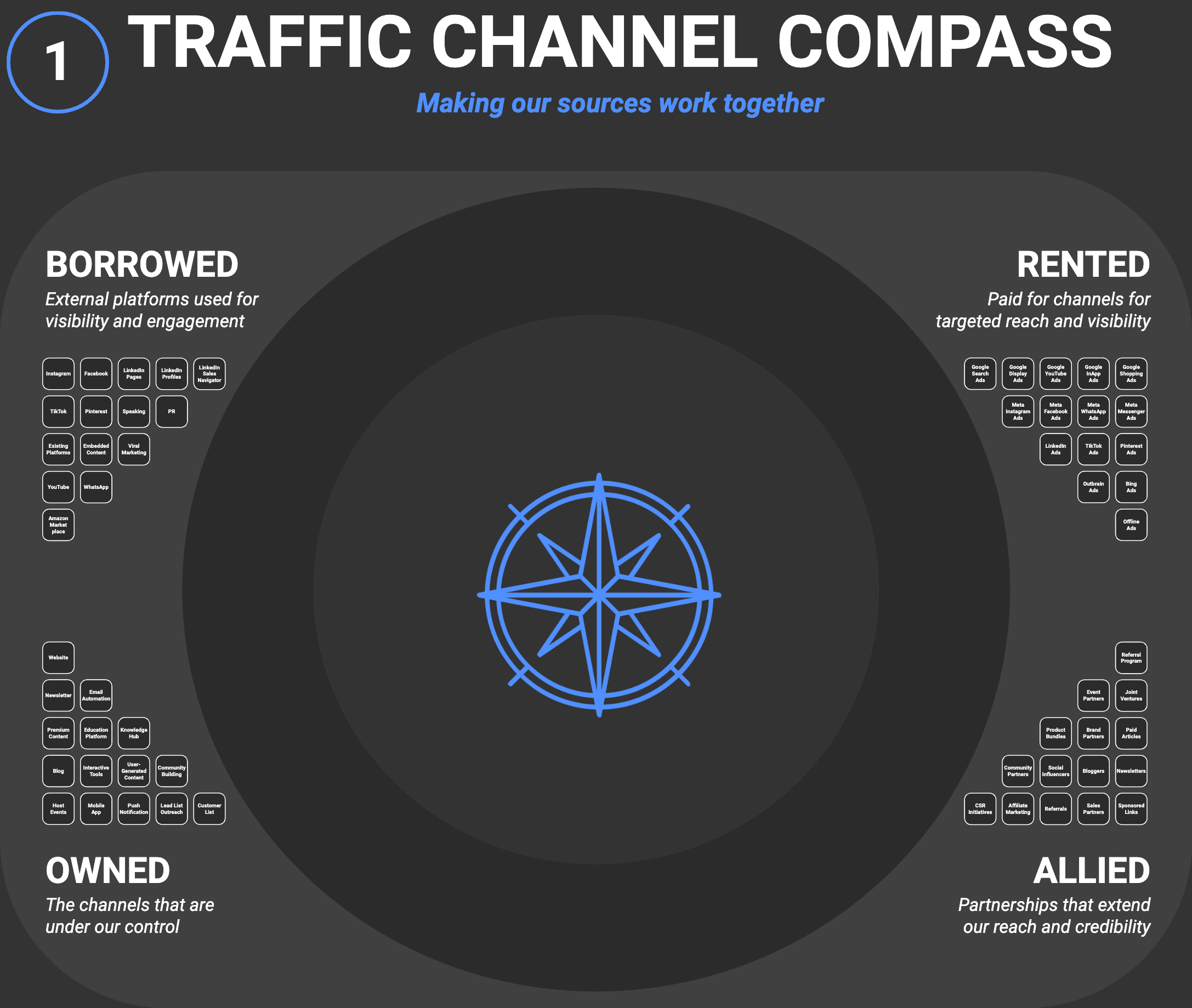
What You've Already Built
In the previous levels, you created your Strategy (business context and goals), Story Framework (audience and messaging), Funnel (customer journey and conversion paths), and Metrics (tracking and analytics). Now it's time to drive traffic to that funnel–but not randomly. You need a clear map of which channels to use, how much to invest in each, and how they work together.
What You're Deciding Here
This lesson helps you make a critical strategic decision: Which traffic channels should you prioritize and how should they work together?
Traffic channels fall into four categories:
- Owned: Channels you control (website, email list, community, events)
- Borrowed: External platforms where you build presence (LinkedIn, YouTube, SEO)
- Rented: Paid advertising (Google Ads, Meta Ads, LinkedIn Ads)
- Allied: Partnerships that extend your reach (affiliates, co-marketing, referrals)
The goal isn't to be everywhere–it's to choose the right mix for your situation and ensure all channels ultimately feed into your owned properties.
What Should You Focus On First?
Your starting point depends on your budget, team, and funnel maturity:
If You're Bootstrapped or Early-Stage (under €1,000/month for traffic)
Focus on owned + borrowed channels first. Build your email list, publish content on 1-2 borrowed platforms where your audience lives, and only add paid once you have a converting funnel. Your owned channels are your foundation–everything else should drive people there.
If You Have Budget to Invest (€1,000-10,000/month)
Add rented channels strategically. Test one paid platform (Google or Meta usually) with small budgets, measure CAC/ROAS, and scale what works. Keep investing in owned channels–they're your insurance against ad platform changes.
If You're Ready to Scale (€10,000+/month)
Diversify across all four channel types. Run multiple paid campaigns, build allied partnerships, and continuously test new channels. Your risk is over-reliance on any single source.
Your Decision
By the end of this lesson, you'll have a clear Traffic Channel Compass–a prioritized list of channels to focus on, how much to invest in each, and how they hand off traffic to each other.
Outcome: You have a prioritized channel mix with sequencing, budget guardrails, and rationale.
2. Owned Channels - Build your foundation
Owned channels are platforms you control completely–your website, email list, community, and events. They're the backbone of your traffic strategy because they can't be taken away by algorithm changes or platform policy shifts.
Why Owned Channels Come First
Every other channel type should ultimately drive people to your owned properties:
- Borrowed channels (social media, SEO) build audience that converts to email subscribers
- Rented channels (ads) drive traffic to landing pages that capture leads
- Allied channels (partnerships) introduce you to audiences who then join your list
If you build an audience only on rented or borrowed platforms, you're at their mercy. One algorithm change can tank your reach overnight. Your owned channels are your insurance policy.
Core Owned Channels
Website & Landing Pages
Your home base for conversions. Every traffic source should ultimately land here. Optimize for:
- Clear value proposition above the fold
- Strong calls-to-action for lead capture
- Fast load times (especially on mobile)
- Conversion tracking in place
Email List
Your most valuable owned asset. Unlike social followers, email subscribers:
- See your messages directly (no algorithm)
- Can be segmented and personalized
- Convert at higher rates than social traffic
- Stay with you regardless of platform changes
Community & Events
If you build a community (forum, Slack, Discord) or run events (webinars, workshops, meetups), these become powerful owned channels. They create deeper engagement and stronger relationships than broadcast channels.
The Priority
Before investing heavily in other channels, ask: "How will this drive people to my owned properties?" If the answer isn't clear, reconsider the investment.
Outcome: You know the top fixes to make your owned channels conversion-ready.
3. Borrowed Channels - Expand your visibility
Borrowed channels are external platforms where you build presence without paying for ads–social media profiles, SEO content, YouTube channels, podcast appearances. They offer massive reach but come with a catch: you don't control them.
The Opportunity and Risk
Borrowed channels can grow your audience exponentially:
- LinkedIn can put your content in front of thousands in your industry
- SEO can drive consistent traffic for years from a single piece of content
- YouTube videos can generate leads while you sleep
But these platforms can change the rules anytime:
- Algorithm shifts can tank your reach overnight
- Account suspensions can wipe out years of work
- Platform policies can restrict what you can do
Strategy: Convert Borrowed to Owned
The goal isn't to build an audience on borrowed platforms–it's to use borrowed platforms to build your owned audience. Every piece of content should have a path to your email list:
- LinkedIn posts → Lead magnet → Email list
- Blog posts → Content upgrade → Email list
- YouTube videos → Free resource → Email list
Choosing Your Borrowed Channels
Don't try to be everywhere. Pick 1-2 borrowed channels where:
- Your target audience already spends time
- The format matches your strengths (writing, video, audio)
- You can maintain consistent presence with your capacity
For most B2B businesses, LinkedIn + SEO is a strong combination. For B2C, consider Instagram, YouTube, or TikTok depending on your audience.
Outcome: You have a focused borrowed-channel plan with formats, cadence, and success signals.
4. Rented Channels - Paid traffic with guardrails
Rented channels are paid advertising–Google Ads, Meta (Facebook/Instagram) Ads, LinkedIn Ads, and other platforms where you pay for visibility. They offer immediate impact but stop the moment you stop paying.
When to Use Paid Traffic
Paid traffic makes sense when:
- Your funnel converts (you know your conversion rates)
- Your economics work (CAC is lower than customer value)
- You need speed (organic takes months, ads work in days)
- You want to test offers before investing in organic
Paid traffic doesn't make sense when:
- Your funnel isn't converting yet (you'll waste money)
- You don't have tracking in place (you won't know what works)
- Your economics are unclear (you might be losing money on every customer)
The Two Main Platforms
Google Ads: Best for high-intent traffic
People actively searching for solutions are ready to buy. Search ads capture this intent. Display and YouTube ads build awareness.
Meta Ads (Facebook/Instagram): Best for interest-based targeting
People aren't searching, but you can target by interests, behaviors, and demographics. Great for awareness and consideration stages.
Both platforms have steep learning curves. Start with one, master it, then expand.
The Approach: Test Small, Scale Winners
Never launch paid campaigns with large budgets. Instead:
- Start with small test budgets (€10-50/day)
- Test multiple variations (audiences, creatives, offers)
- Measure what matters (CAC, ROAS, not just clicks)
- Kill losers fast, scale winners gradually
We'll cover campaign structure in detail in the next lesson.
Outcome: You have a tightly scoped paid test with guardrails and learning objectives.
5. Allied Channels - Strategic partnerships
Allied channels are partnerships that extend your reach through other people's audiences–affiliates, referral programs, co-marketing, event collaborations, and content partnerships. They offer credibility and access that you can't buy with ads.
Why Partnerships Matter
When you partner with someone your audience trusts:
- You borrow their credibility (the "halo effect")
- You reach people who'd never see your ads
- You often get better conversion rates than cold traffic
- You build relationships that compound over time
Types of Allied Channels
Referral & Affiliate Programs
Pay partners (commission or flat fee) for leads or sales they generate. Works well for:
- Influencers in your niche
- Complementary businesses
- Satisfied customers who become advocates
Content Partnerships
Trade content access for audience exposure:
- Guest posts on industry blogs
- Podcast interviews
- Newsletter features
- Co-created content (webinars, guides)
Event Collaborations
Partner on events to share audiences:
- Co-hosted webinars
- Joint workshops
- Conference partnerships
- Community collaborations
Brand Partnerships
Align with brands that share your values:
- Cross-promotions
- Bundle deals
- Co-branded content
- Mutual endorsements
The Approach: Mutual Value
The best partnerships are genuinely win-win. Before approaching anyone, ask:
- What can I offer them? (content, exposure, commission, access)
- What do I want in return? (audience access, credibility, introductions)
- Is this aligned for both parties?
Outcome: You have a short list of partner outreach actions with clear asks and next steps.
6. Your Traffic Channel Compass Library
Creating Your Traffic Channel Compass Document
Throughout this lesson, you've made decisions about all four channel types: owned, borrowed, rented, and allied. Now it's time to consolidate everything into a single reference document that captures your traffic strategy.
The Goal: A Complete Channel Strategy in One Place
This Traffic Channel Compass document will serve as your:
- Strategic reference for where to focus time and budget
- Team alignment tool so everyone knows the plan
- Foundation for campaign planning in the next lessons
- Quick reference when deciding where to invest
Having your channel strategy in one place means you can quickly check your priorities, see how channels work together, and avoid getting distracted by shiny new platforms.
Outcome: You have a complete Traffic Channel Compass that captures all your channel decisions and priorities.