
Campaign Structure
Maximizing our chance to find the next profitable campaign
1. Goal - Structure tests and scaling with guardrails
What You've Already Built
In the Traffic Channel Compass lesson, you prioritized your channels and designed your first paid test. Now it's time to build the system for how you'll structure campaigns–both for testing new ideas and scaling what works.
What You're Deciding Here
This lesson helps you answer: How should I structure campaigns to learn fast and scale profitably?
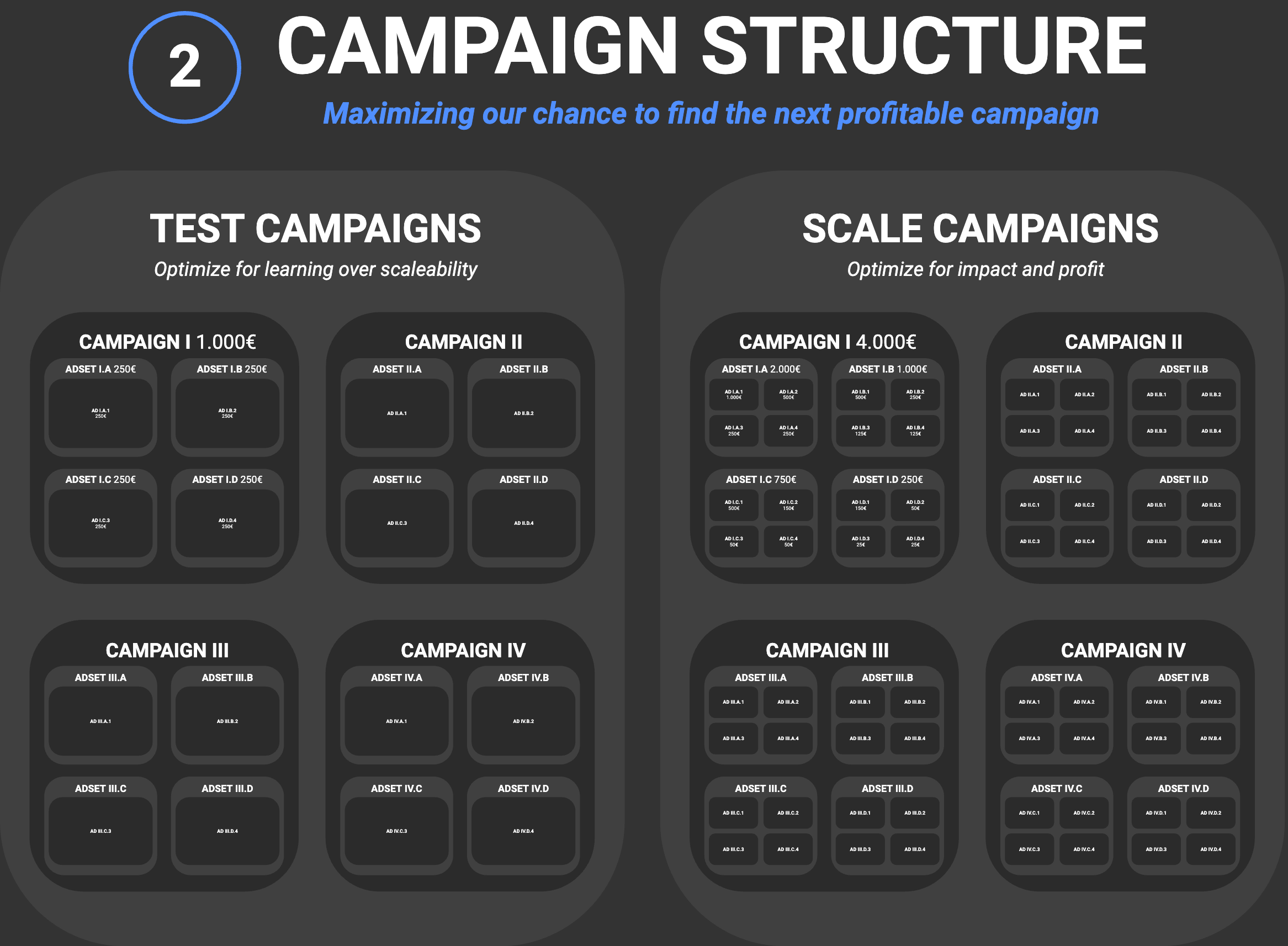
The key insight is that test campaigns and scale campaigns have different goals:
- Test campaigns optimize for learning–you want to discover what works quickly without overspending
- Scale campaigns optimize for profit–you want to maximize returns on proven winners
Mixing these approaches leads to wasted budget and missed opportunities. You need a clear framework for when to test, when to scale, and when to cut losses.
What Should You Focus On First?
Your starting point depends on your campaign history:
If You're New to Paid Advertising
Focus entirely on test campaigns first. You need to discover what works before you can scale. Set aside a learning budget (expect some of it to be lost) and run structured tests to find your first winning combination of audience + offer + creative.
If You Have Some Data
Identify which existing campaigns are actually profitable. Many businesses run campaigns without knowing their true CAC or ROAS. Before scaling anything, verify the numbers. Then structure tests to find new winners while scaling the proven performers.
If You're Ready to Scale
Your job shifts to optimization and expansion. Scale proven campaigns with guardrails (don't let costs creep up), while maintaining a test budget to find the next wave of winners.
Your Decision
By the end of this lesson, you'll have a clear campaign structure with test → scale transitions, budget guardrails, and success/fail criteria.
Outcome: You have a lean test→scale structure with clear signals and guardrails.
2. Test Campaigns - Optimize for learning
Test campaigns are structured experiments designed to answer questions: Does this audience convert? Does this creative resonate? Does this offer work? The goal isn't immediate profit–it's learning what works so you can scale with confidence.
The Testing Mindset
Most businesses waste money on paid ads because they launch campaigns hoping they'll work, rather than designing tests that will teach them something regardless of outcome. Every test should answer a specific question.
Good test questions:
- "Does Audience A or Audience B convert better?"
- "Do video ads or image ads perform better for this offer?"
- "Does messaging about pain points or outcomes drive more clicks?"
Bad test questions:
- "Will this campaign work?" (too vague)
- "Should we do Facebook ads?" (too broad)
Structuring Test Campaigns
1. Isolate Variables
Test one thing at a time. If you change audience AND creative AND offer simultaneously, you won't know what drove the result. Change one variable, keep everything else constant.
2. Force Fair Comparison
Don't let the platform's algorithm pick winners too early. Set budgets to split evenly across variations, at least until you have enough data. Platforms optimize for their definition of success, not yours.
3. Set Clear Success Criteria
Before launching, define what success looks like. "This test succeeds if CPL is under €20 with at least 50 leads" is clear. "Let's see how it goes" is not.
4. Timebox Your Tests
Set a clear end date. Tests that run forever waste money. Typical test duration: 7-14 days or until you hit statistical significance (usually 100+ conversions per variation).
5. Document Everything
Record your hypothesis, what you tested, results, and what you learned. This compounds over time–you'll build institutional knowledge about what works for your audience.
Outcome: You have concrete test campaigns with clear hypotheses, budgets, and success criteria.
3. Scale Campaigns - Optimize for profit
Once you've found winning combinations through testing, scaling is about maximizing profit while maintaining performance. This requires a different mindset and structure than testing.
The Scaling Mindset
Scaling isn't just "spending more money." It's carefully increasing investment while monitoring for diminishing returns. As you scale, you'll often see:
- CPAs creep up (you're exhausting the best audiences)
- Creative fatigue (the same ads become less effective)
- Increased competition (others target the same audiences)
Successful scaling requires constant monitoring and adjustment.
When to Move from Test to Scale
A campaign is ready to scale when:
- It's profitable at test budget (CAC < target, ROAS > threshold)
- You have enough conversions for statistical confidence (usually 50-100+)
- The trend is stable (not just a lucky day or two)
- You understand WHY it's working (audience + offer + creative alignment)
How to Scale
1. Increase Budget Gradually
Don't jump from €50/day to €500/day overnight. Scale 20-30% at a time and let the platform stabilize before increasing again. Sudden jumps often reset the algorithm and tank performance.
2. Set Guardrails
Define the metrics that trigger action:
- "If CAC rises above €X, reduce budget by 20%"
- "If ROAS drops below X, pause and investigate"
- "Never exceed €X/day on any single campaign"
3. Diversify
Don't put all your scaled budget into one campaign. Create variations targeting:
- Different audience segments
- Different creative angles
- Different placements (feed, stories, reels, etc.)
4. Refresh Creative Regularly
Even winning creatives fatigue. Plan to introduce new variations every 2-4 weeks. Keep the winning elements but test new executions.
Continuous vs Time-Bound Campaigns
Continuous campaigns (ongoing lead gen) need:
- Weekly optimization reviews
- Regular creative refreshes
- Long-term budget planning
Time-bound campaigns (launches, events) need:
- Front-loaded budgets
- Countdown-based creative changes
- Post-event analysis for next time
Outcome: You have a scaling playbook with budget ramps, guardrails, and monitoring cadence.
4. Your Campaign Structure Library
Creating Your Campaign Structure Document
Throughout this lesson, you've defined how to structure test campaigns and scale campaigns. Now it's time to consolidate everything into a single reference document that your team can follow.
The Goal: A Campaign Playbook for Consistency
This Campaign Structure document will serve as your:
- Playbook for launching new campaigns correctly
- Reference for test→scale transition criteria
- Guardrails document to prevent overspending
- Learning log to compound your advertising knowledge
Having your campaign structure documented means anyone on your team can follow the same process and make consistent decisions.
Outcome: You have a complete Campaign Structure document that serves as your advertising playbook.