
Ad Creatives
Presenting our value as engaging as possible
1. Goal - Ship creatives that capture attention and convert
What You've Already Built
In the Campaign Structure lesson, you defined how to set up test and scale campaigns. Now it's time to focus on what goes inside those campaigns: the creatives–images, videos, and text that actually capture attention and drive action.
What You're Deciding Here
This lesson helps you answer: What creative formats and angles should I lead with?
Creative is often the biggest lever in advertising performance. The same audience seeing the same offer will respond completely differently based on how it's presented. Great creative can make a mediocre offer work; poor creative can tank an excellent offer.
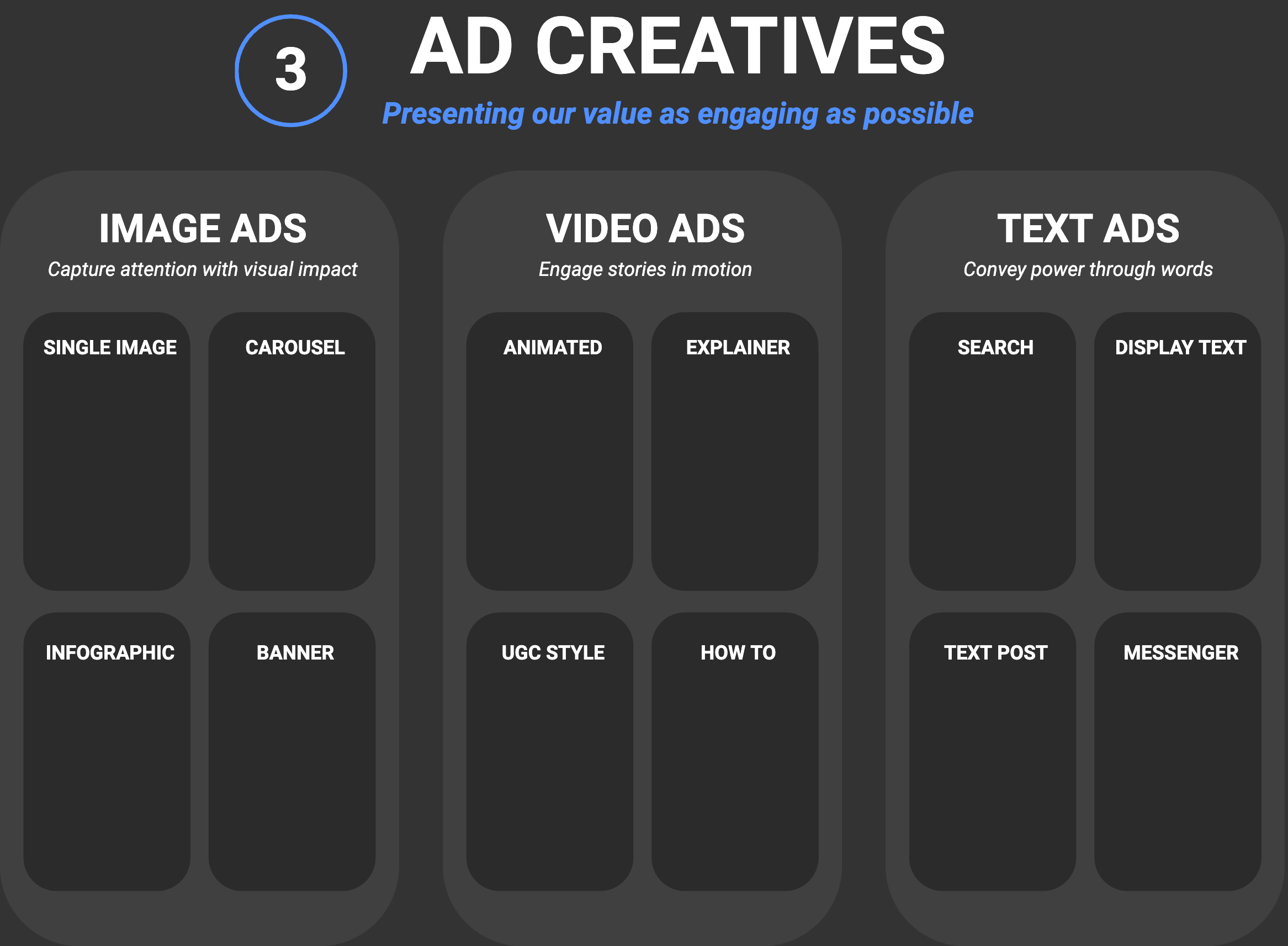
You'll create ads in three formats:
- Image ads: Static visuals that capture attention in the scroll
- Video ads: Motion content that tells stories and demonstrates value
- Text ads: Headlines and copy that drive clicks (especially for search)
What Should You Focus On First?
Your starting point depends on your resources and channels:
If You're Resource-Constrained (solo or small team)
Start with image ads. They're fastest to produce, easiest to iterate, and work across almost every platform. Master image ads first, then add video and text.
If You're Running Search Ads
Text ads are essential for Google Search. Focus on headline variations and compelling descriptions. You can test dozens of text combinations quickly without design resources.
If You Have Video Capability
Video ads often outperform static images, especially on social platforms. Even simple talking-head videos or animated slides can work well. If you can produce video efficiently, prioritize it.
For Most Businesses
Start with image + text, add video once you have winning concepts to adapt. Video is powerful but more expensive to iterate.
Your Decision
By the end of this lesson, you'll have creative briefs for image, video, and text ads–with specific angles, variations, and testing plans ready to produce.
Outcome: You know which creative formats to prioritize and what angles to test.
2. Image Ads - Capture attention with visual impact
Image ads are the workhorse of digital advertising. They're fast to create, easy to iterate, and work across nearly every platform. A well-designed image ad can stop the scroll and communicate your value proposition in seconds.
What Makes an Image Ad Work
1. Stop the Scroll
You have less than a second to capture attention. The image must interrupt whatever the viewer was doing. High contrast, faces, unexpected visuals, and bold text overlays all help.
2. Clear Message
Once you have attention, the viewer should instantly understand:
- What this is about (product/service/offer)
- Why they should care (benefit/transformation)
- What to do next (clear call-to-action)
3. Brand Consistency
Your ads should be recognizable as yours. Consistent colors, fonts, and visual style build brand recognition over time. People who've seen your ads before should immediately know it's you.
Image Ad Formats
Single Image
One static image with optional text overlay. Simple, fast to produce, works everywhere. Start here.
Carousel
Multiple images users swipe through. Great for:
- Showing multiple products
- Walking through a process/story
- Featuring different benefits or testimonials
Infographic/Educational
Dense with information–stats, tips, frameworks. Works well for B2B and educational content. LinkedIn particularly rewards this format.
Creative Angles for Image Ads
Test different angles to see what resonates:
- Problem-focused: Show the pain your audience feels
- Outcome-focused: Show the result they want
- Social proof: Show others who've succeeded
- Direct offer: Show exactly what they get
Outcome: You have focused image ad variations ready to produce and test.
3. Video Ads - Engage with stories in motion
Video ads offer something static images can't: the ability to tell stories, demonstrate products, and build deeper emotional connections. They consistently outperform static ads for engagement and often for conversion.
Why Video Works
Attention Capture
Motion naturally draws the eye. Video stands out in feeds dominated by static content.
Information Density
You can convey much more in 30 seconds of video than in a single image–demos, testimonials, feature walkthroughs, storytelling.
Trust Building
Seeing a real person speak builds trust faster than text and images alone. This is especially powerful for high-consideration purchases.
Video Ad Structures
Hook → Problem → Solution → CTA (15-30 seconds)
The classic direct-response structure:
- Hook: Grab attention in first 3 seconds
- Problem: Agitate the pain they're feeling
- Solution: Show how you solve it
- CTA: Tell them exactly what to do
Story/Testimonial (30-60 seconds)
Customer success stories or personal narratives:
- Before state (the struggle)
- Discovery (finding your solution)
- After state (the transformation)
- Invitation (join them)
Demo/Explainer (15-45 seconds)
Show the product in action:
- What it is (quick intro)
- How it works (demonstration)
- Why it matters (benefit)
- Try it (CTA)
UGC (User-Generated Content) Style
Ads that look like organic content–filmed on phones, casual tone, authentic feel. These often outperform polished productions because they feel native to the platform.
Video Production Tiers
Lo-fi (fastest, cheapest)
- Talking head filmed on phone
- Screen recordings with voiceover
- Animated slides/graphics
Mid-fi (balanced)
- Simple studio setup
- Basic editing and graphics
- Mixed with stock footage
Hi-fi (most polished)
- Professional production
- Multiple shoot locations
- Advanced editing and effects
Start with lo-fi to validate concepts, then invest in higher production for proven winners.
Outcome: You have actionable video ad concepts with scripts and production plans.
4. Text Ads - Convey power through words
Text ads are pure copywriting–headlines, descriptions, and calls-to-action without visual support. They're essential for search advertising (Google Ads) and important supporting elements for image and video ads across all platforms.
Why Text Mastery Matters
Even if you focus on visual ads, text is inescapable:
- Image ads need captions, headlines, and CTAs
- Video ads need scripts and on-screen text
- Landing pages need headlines and copy
Mastering text ads builds skills that improve everything else.
Text Ad Formats
Search Ads (Google)
The original text ad. Users search for something → your ad appears with:
- Headlines (up to 15, Google mixes and matches)
- Descriptions (up to 4)
- Display URL and call-to-action
The challenge: you don't control the combination. Write modular headlines that work in any order.
Responsive Display Ads
Google combines your text with auto-generated images:
- Short headline (30 chars)
- Long headline (90 chars)
- Description (90 chars)
- Business name
Social Media Copy
Text that accompanies image/video ads:
- Primary text (appears above creative)
- Headline (appears below)
- Description (sometimes appears)
- CTA button text
Writing Effective Text Ads
1. Lead with Benefit
What does the user get? Not what you offer–what they achieve.
- ❌ "Marketing automation software"
- ✅ "Save 10 hours/week on marketing"
2. Use Specific Numbers
Specificity creates credibility.
- ❌ "Get more leads"
- ✅ "Get 47% more qualified leads"
3. Match Search Intent
For search ads, mirror the language users search for.
- If they search "best CRM for small business" → your ad should say "Best CRM for Small Business"
4. Create Urgency
Give reasons to act now (when genuine).
- "Limited spots available"
- "Offer ends Friday"
- "Join 5,000+ others"
5. Clear CTA
Tell them exactly what to do.
- "Start free trial"
- "Get the guide"
- "Book a demo"
Outcome: You have modular text ad sets ready to test across channels.
5. Your Ad Creatives Library
Creating Your Ad Creatives Document
Throughout this lesson, you've designed image ads, video ads, and text ads with specific angles and variations. Now it's time to consolidate everything into a creative library your team can produce and iterate from.
The Goal: A Reusable Creative System
This Ad Creatives document will serve as your:
- Brief for designers, videographers, and copywriters
- Reference for which angles and formats to test
- Learning log for what creative approaches work
- Swipe file for future campaigns
Having your creative strategy documented means you can produce new variations quickly and maintain consistency as you scale.
Outcome: You have a complete Ad Creatives library that serves as briefs for creative production.