
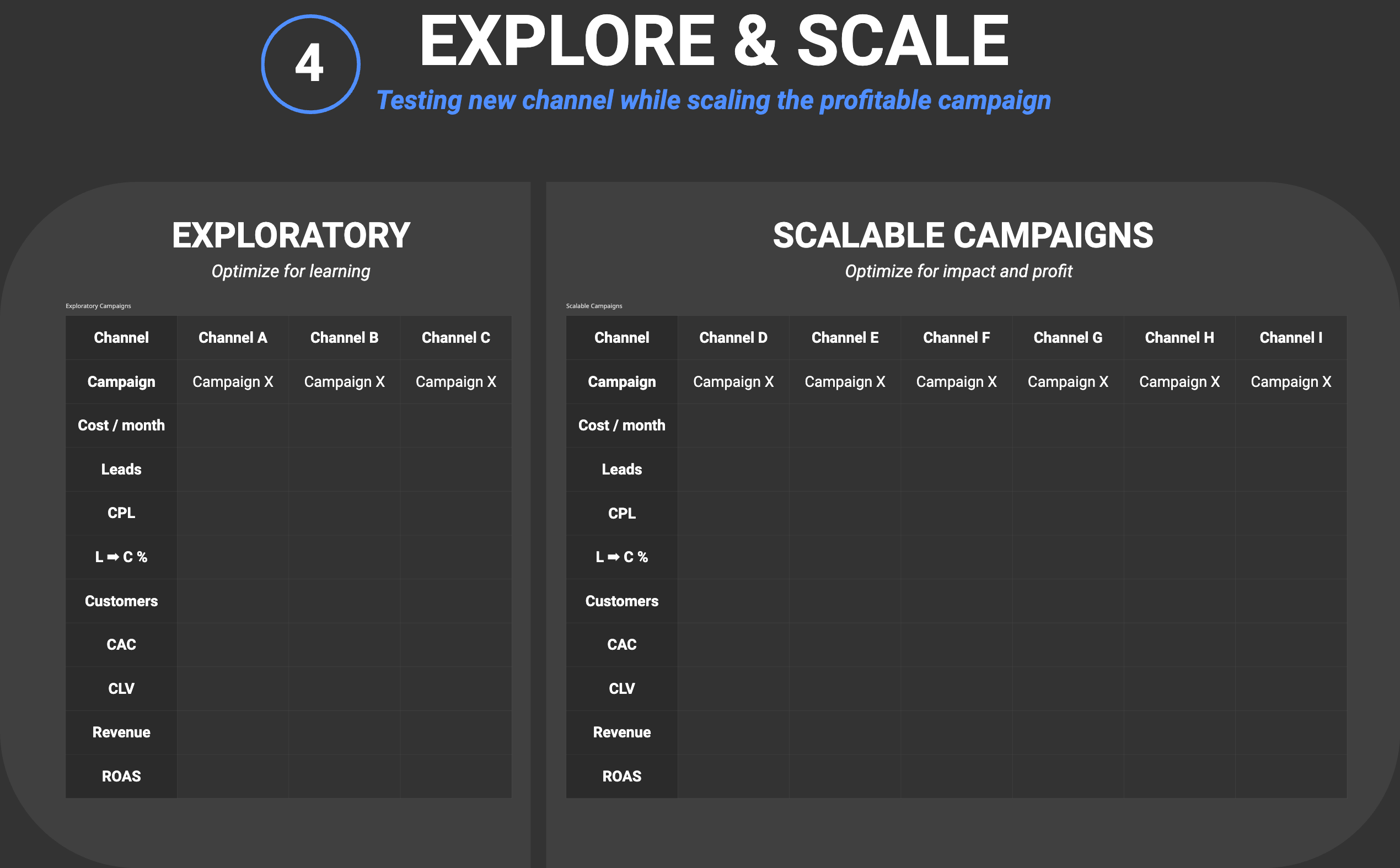
Explore & Scale
Testing new channels while scaling the profitable campaigns
1. Goal - Balance exploration with exploitation
What You've Already Built
You've mapped your channels (Traffic Channel Compass), structured your campaigns (Campaign Structure), and created your ads (Ad Creatives). Now it's time to build the system for running your traffic operation over time: continuously finding new winners while scaling what works.
What You're Deciding Here
This lesson helps you answer: How do I balance testing new ideas with scaling proven winners?
This is the classic "explore vs exploit" tradeoff:
- Explore too much: You never scale, always testing, leaving money on the table
- Exploit too much: You scale winners until they fatigue, then have nothing to replace them
The best traffic operations do both simultaneously: a portion of budget always tests new ideas while the majority scales proven performers.
What Should You Focus On First?
Your starting point depends on where you are:
If You're Still Finding Winners
Focus 70-80% of budget on exploration. Run structured tests, kill losers fast, and find campaigns worth scaling. Your goal is to discover your first 2-3 profitable campaigns.
If You Have Proven Winners
Shift to 60-70% scaling, 30-40% exploring. Most budget goes to scaling winners with guardrails. Reserve a consistent test budget to find the next generation of campaigns before current ones fatigue.
If You're Mature
Maintain a permanent test budget (15-25%) regardless of how well things are working. Today's winners won't work forever. The time to find new channels is when you don't desperately need them.
Your Decision
By the end of this lesson, you'll have a clear system for allocating budget between exploration and scaling, with signals that tell you when to shift resources.
Outcome: You have a clear explore vs. scale system with budget allocation and review cadence.
2. Exploration - Optimize for learning
Exploration is your research and development budget for traffic. Some experiments will fail–that's the point. You're paying for information that helps you find the next profitable channel before you desperately need it.
The Exploration Mindset
Exploration isn't "wasting money on bad campaigns." It's investing in learning that compounds over time. The businesses that dominate traffic acquisition are constantly testing:
- New channels before they're crowded
- New audiences before competitors find them
- New creative angles before current ones fatigue
- New offers before the market shifts
What to Explore
New Channels
Platforms you're not using yet. Is TikTok right for your audience? What about Reddit ads? LinkedIn newsletters? Test with small budgets before competitors crowd the space.
New Audiences
Different targeting within channels you already use. New demographics, interests, lookalikes, custom audiences. Your best audience might be one you haven't tried yet.
New Creatives
Different formats, angles, and messages. Even if your current creative works, test alternatives. You need fresh options when current ads fatigue.
New Offers
Different lead magnets, entry points, and value propositions. Sometimes the same audience converts dramatically better with a different offer.
Structuring Exploration
1. Dedicated Budget
Set aside a specific percentage for exploration. This isn't "leftover" money–it's intentional investment. Typical: 20-40% of total traffic budget.
2. Clear Hypotheses
Every test should answer a specific question. "Let's try TikTok" is vague. "Can we acquire B2B leads on TikTok for under €50 CAC?" is testable.
3. Minimum Viable Tests
Don't over-invest in unproven ideas. Run the smallest test that gives you reliable signal, then scale if it works.
4. Kill Criteria
Define upfront what failure looks like. If a test hits the failure threshold, stop immediately. Don't throw good money after bad.
5. Documentation
Record every test: hypothesis, setup, results, learnings. This compounds over time into institutional knowledge about what works.
Outcome: You have concrete exploration priorities with hypotheses and test plans.
3. Scaling - Optimize for profit
Scaling is where you turn learning into returns. Once you've found winning combinations through exploration, scaling is about maximizing profit while managing diminishing returns and creative fatigue.
The Scaling Mindset
Scaling isn't just spending more money. It's systematic expansion with constant monitoring. As you scale, expect:
- Audience saturation: You'll exhaust the best audiences first
- Creative fatigue: Ads become less effective over time
- Increased competition: Others will eventually find the same audiences
- Cost increases: CPMs and CPCs typically rise as you scale
Successful scaling means expanding deliberately while preparing for these challenges.
When to Scale
Move a campaign from exploration to scaling when:
- Profitable: CAC below target, ROAS above threshold
- Consistent: Results stable over 7-14 days, not just a good day
- Significant data: 50-100+ conversions, enough for statistical confidence
- Understood: You know WHY it's working (audience-offer-creative fit)
How to Scale
1. Gradual Budget Increases
Don't double overnight. Increase 20-30% at a time, let performance stabilize, then increase again. Sudden jumps often reset algorithms and tank performance.
2. Horizontal Expansion
Instead of just increasing budget, expand the campaign:
- Add similar audiences
- Create new creative variations with the same angle
- Test additional placements
3. Maintain Controls
Never rely on a single campaign. Even your best performer needs:
- Backup creative ready to swap in
- Alternative audiences to expand to
- Plan B if performance drops
4. Monitor Closely
Watch for early warning signs:
- Frequency creeping up (same people seeing ad repeatedly)
- CTR declining (creative fatigue)
- CPA increasing (audience saturation)
5. Refresh Proactively
Don't wait for performance to crash. Introduce new creative variations every 2-4 weeks. Keep winning elements, test new executions.
Guardrails for Scaling
Define the metrics that trigger action:
- Max CAC → reduce budget by X%
- Min ROAS → pause campaign
- Frequency above X → refresh creative
- Week-over-week decline of X% → investigate
Outcome: You have a disciplined scaling plan with guardrails, refresh schedules, and monitoring.
4. Your Explore & Scale Playbook
Creating Your Explore & Scale Document
Throughout this lesson, you've designed your system for balancing exploration with scaling. Now it's time to consolidate everything into a single playbook that governs your ongoing traffic operation.
The Goal: A Living Operating System for Traffic
This Explore & Scale document will serve as your:
- Weekly guide for how to allocate budget and attention
- Decision framework for when to test, scale, pause, or kill
- Tracking system for exploration results and learnings
- Reference for guardrails and thresholds
Having your operating system documented means you (and your team) make consistent decisions and compound learning over time.
Outcome: You have a complete Explore & Scale Playbook that governs your ongoing traffic operation.