
Summary
Be bold in the black
1. From Guesswork to Data-Driven Traffic Acquisition
You started this level relying on hope and intuition for traffic. You end it with a complete traffic generation system: prioritized channels, structured campaigns, tested creatives, and an explore/scale playbook that compounds your learning over time.
The Transformation
-
Before: "I hope our ads work"
After: "Campaign A has a €35 CAC and 4.2x ROAS–we're scaling 20% this week" -
Before: "We should probably be on TikTok"
After: "Test Campaign B failed the €50 CAC threshold–killed it after 10 days, documented learnings" -
Before: "Let's just increase the budget and see what happens"
After: "Our exploration budget found a new audience segment converting at 2x the rate" -
Before: "Our competitors are doing X, so we should too"
After: "Owned channels grew 23% from borrowed and rented traffic last quarter"
The Foundation You Built
Throughout this level, you've created four essential documents that form your complete traffic generation system:
- [Business Name] - Traffic Channel Compass.md: Your channel priorities across owned, borrowed, rented, and allied channels–with budget allocation and handoff maps
- [Business Name] - Campaign Structure.md: Your test and scale campaign frameworks–with success/fail criteria, budget ramps, and guardrails
- [Business Name] - Ad Creatives.md: Your image, video, and text ad concepts–with angles, variations, and testing plans
- [Business Name] - Explore & Scale Playbook.md: Your system for balancing exploration with scaling–with budget allocation, review cadence, and learning logs
These documents work together to create a complete traffic acquisition system that drives profitable growth.
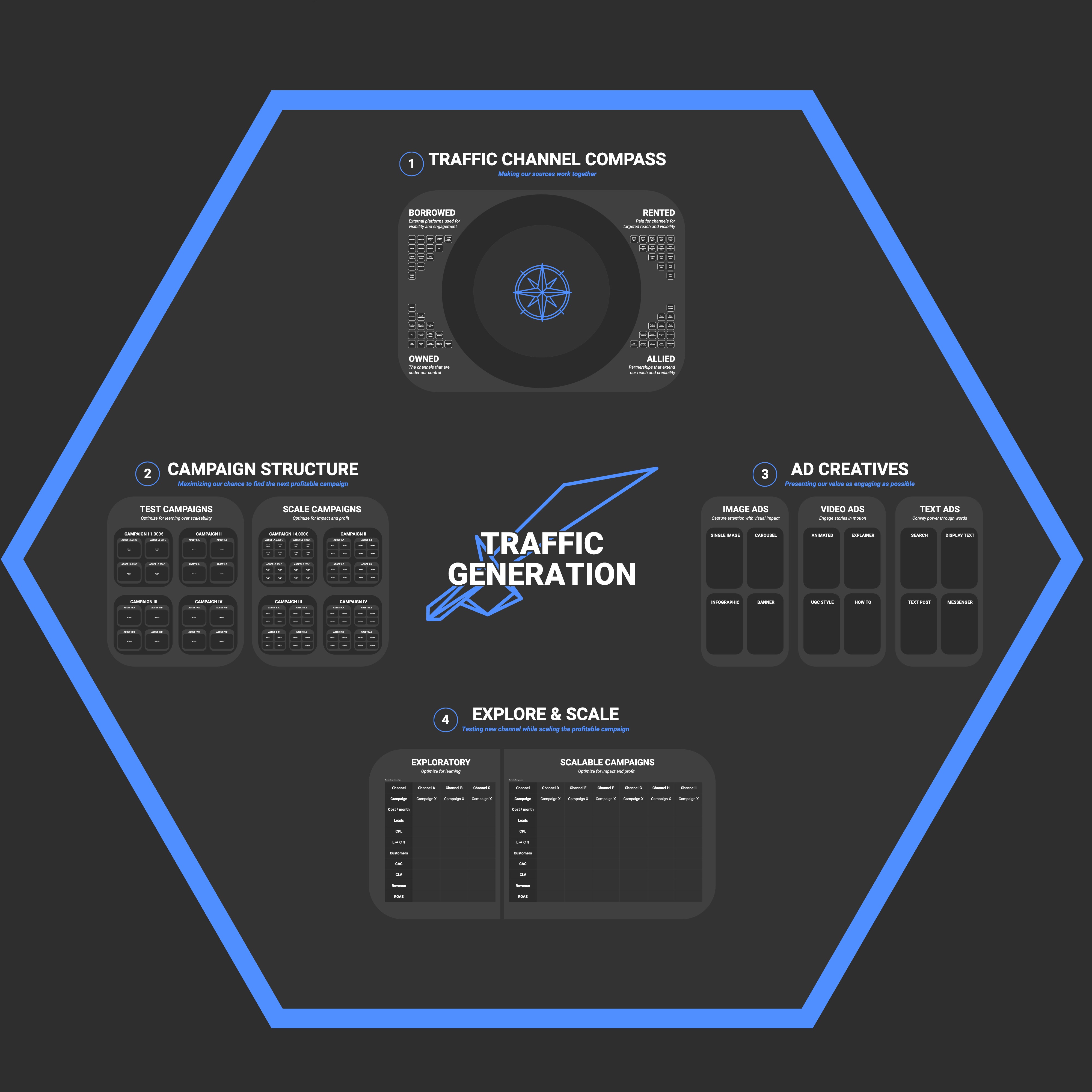
2. The Complete Traffic Generation System
Your traffic generation system has four components that work together:
Where we Drive Traffic → Prioritize channels that work together
In Lesson 2, you mapped your channels across four categories (owned, borrowed, rented, allied) and decided which to prioritize. Your Traffic Channel Compass shows how all channels feed into your owned properties.
How we Structure Campaigns → Test fast, scale winners
In Lesson 3, you built frameworks for test campaigns (optimized for learning) and scale campaigns (optimized for profit). Your Campaign Structure document shows when to test, when to scale, and when to cut losses.
What we Show → Creatives that capture and convert
In Lesson 4, you designed image, video, and text ads with specific angles and variations. Your Ad Creatives document serves as briefs for production and a learning log for what works.
How we Operate → Balance exploration with exploitation
In Lesson 5, you created a system for continuously finding new winners while maximizing returns from proven performers. Your Explore & Scale Playbook governs your ongoing traffic operation.
How They Work Together
Each component builds on the previous one:
- Channels define where to invest time and budget
- Campaigns structure how you test and scale on each channel
- Creatives determine what people see and how they respond
- Explore & Scale ensures you're always improving and never over-reliant
The Continuous Cycle
Traffic generation isn't a one-time setup–it's an ongoing practice:
- Explore new channels, audiences, creatives, and offers
- Test with structured campaigns and clear success criteria
- Analyze results and document learnings
- Scale winners with guardrails and monitoring
- Repeat the cycle to continuously find new profitable campaigns
This cycle ensures you're always optimizing, always learning, always growing your traffic profitably.
3. What You've Accomplished
Lesson 1: Overview
You learned what traffic generation is and why it matters. You understood the four components: channels, campaigns, creatives, and explore/scale. You set up a new Claude chat with your traffic baseline context.
Lesson 2: Traffic Channel Compass
You mapped your channels across four categories (owned, borrowed, rented, allied) and decided which to prioritize. You created your [Business Name] - Traffic Channel Compass.md document that shows your channel strategy, budget allocation, and how channels work together.
Lesson 3: Campaign Structure
You built frameworks for test campaigns and scale campaigns. You created your [Business Name] - Campaign Structure.md document that shows when to test, when to scale, budget ramps, guardrails, and decision triggers.
Lesson 4: Ad Creatives
You designed image, video, and text ads with specific angles and variations. You created your [Business Name] - Ad Creatives.md document that serves as creative briefs, testing plans, and a learning log.
Lesson 5: Explore & Scale
You created a system for balancing exploration with scaling. You created your [Business Name] - Explore & Scale Playbook.md document that governs your ongoing traffic operation with budget allocation, review cadence, and guardrails.
The Complete System
Together, these four documents create a complete traffic generation system:
- Traffic Channel Compass tells you where to focus
- Campaign Structure tells you how to test and scale
- Ad Creatives tells you what to show people
- Explore & Scale Playbook tells you how to operate week after week
All working together to drive profitable traffic to your business.
4. Best Practices for Sustaining Traffic Performance
Review Weekly, Not Daily
Daily fluctuations are noise. Weekly trends are signal. Set a weekly review cadence and stick to it. Track changes week-over-week, not day-over-day.
Maintain Your Exploration Budget
Even when everything is working, keep testing. Today's winners won't last forever. The time to find new channels is when you don't desperately need them. A permanent 15-25% exploration budget protects you.
Refresh Creative Proactively
Don't wait for creative to fatigue. Introduce new variations every 2-4 weeks. Keep winning elements, test new executions. Have backup creative ready before you need it.
Document Everything
Record your tests, results, and learnings. What worked, what failed, and why. This compounds over time into institutional knowledge that makes every decision better.
Diversify Deliberately
Never over-rely on a single channel. Platforms change algorithms, costs rise, accounts get suspended. Spread your traffic acquisition across multiple channels and continuously build your owned properties.
Connect Back to Revenue
Traffic metrics (CPM, CTR, CPC) are means, not ends. Always connect to business metrics (CAC, ROAS, revenue). A cheap click that doesn't convert is worthless.
5. Your Complete Traffic Generation Master Document
Creating Your Master Traffic Generation Document
Throughout this level, you've created four essential documents that form your complete traffic generation system. Now it's time to consolidate everything into a single master document that you can reference in the future–a document that contains all the important information an AI assistant might need to help you with your traffic strategy.
The Goal: Single Master Document for All Traffic Generation Knowledge
This master document will serve as your complete reference for:
- Your complete traffic generation system
- All channels, campaigns, creatives, and operating procedures
- How everything works together to drive profitable traffic
- Future AI assistants understanding your traffic setup
Having all your traffic knowledge in one place means you can quickly reference your system, onboard new team members, and ensure AI assistants have complete context when helping you optimize your traffic.
Outcome: You have a complete Traffic Generation master document that consolidates all your traffic knowledge into one reference document for future use.
🎉 Congratulations! You've completed the Traffic Generation topic. You now have a complete, data-driven system for acquiring traffic profitably. Time to put it into action–and when you're ready, continue to the next level to optimize how that traffic converts.