
Conversion Optimization
Increase Impact and Profit
1. What is Conversion Optimization
Conversion optimization is the practice of systematically improving how effectively your marketing converts prospects into customers. It's about moving from "I hope this works" to "I know exactly where prospects drop off and how to fix it." Without intentional optimization, even great traffic hits a leaky funnel.
In this level, you'll build a complete conversion optimization system that turns experimentation into a competitive advantage. You'll learn to generate and prioritize improvement ideas, design rigorous tests, and optimize across your three key conversion surfaces: websites, emails, and ads.
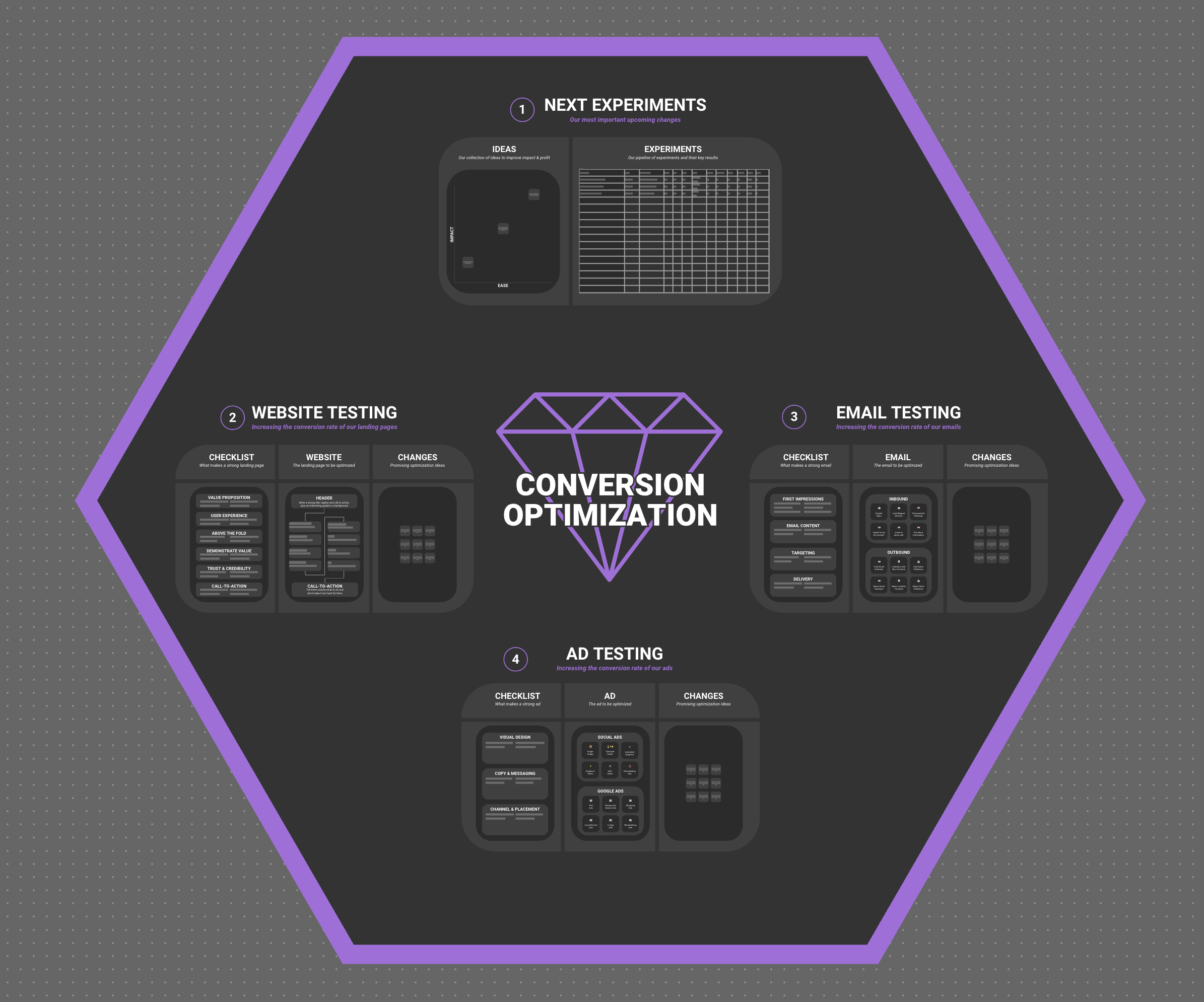
Throughout this level, you'll master four essential components:
- Next Experiments: Build a pipeline of prioritized improvement ideas and track experiment results
- Website Testing: Systematically improve landing page conversion rates
- Email Testing: Optimize email open rates, click rates, and conversions
- Ad Testing: Increase ad engagement while reducing cost per conversion
2. The Four Steps of Conversion Optimization
This Conversion Optimization level is structured into four core steps:
Step 1: Next Experiments
An experiment is a structured test designed to learn whether a specific change improves results. You'll build a system for:
- Generating ideas: Brainstorming potential improvements across your funnel
- Prioritizing: Scoring ideas by impact and ease of implementation
- Tracking: Recording experiments, results, and learnings
The goal isn't to test everything–it's to test the right things in the right order.
Step 2: Website Testing
Landing pages are where traffic becomes leads and customers. You'll learn to optimize:
- Value proposition: Does the page clearly communicate why visitors should act?
- User experience: Is the path to conversion frictionless?
- Trust elements: Do testimonials, social proof, and design build credibility?
Step 3: Email Testing
Emails are your direct line to prospects and customers. You'll optimize:
- Subject lines: What gets opens?
- Content and CTAs: What drives clicks and conversions?
- Deliverability: Are your emails reaching the inbox?
Step 4: Ad Testing
Ads are often your first impression. You'll improve:
- Creative elements: What visuals and copy capture attention?
- Targeting alignment: Is the message reaching the right audience?
- Cost efficiency: How do you maximize conversions while minimizing spend?
3. Why Conversion Optimization Matters
Conversion optimization transforms your funnel from a static system into a continuously improving machine. It's the difference between "hoping for results" and "engineering better results."
The Foundation: Your Traffic and Analytics
Your traffic generation work brings visitors to your funnel. Your analytics work ensures you can measure what's happening. Conversion optimization is the multiplier–it turns the same traffic into more customers without spending more on acquisition.
From Guesswork to Precision
Before intentional optimization, you rely on best guesses and generic best practices. After building your optimization system, you have:
- Clear visibility into where prospects drop off
- Data-driven hypotheses about what to improve
- Structured experiments that prove what works
- Compounding improvements that multiply your results
The Power of Small Improvements
A 10% improvement in landing page conversion × 10% improvement in email conversion × 10% improvement in ad conversion = 33% more customers from the same traffic. Conversion optimization creates multiplicative gains.
Continuous Improvement
Markets change. Competitors evolve. What works today may fade tomorrow. Your survival depends on:
- Always testing new approaches
- Learning from both successes and failures
- Building institutional knowledge about what works
- Never assuming you've "figured it out"
4. Setting Up Your Claude Chat
We're building on top of the Claude strategy project you already set up. If you haven't set that up yet, check out the Growth Roadmap overview to get started.
Step-by-Step Setup Guide
-
Open Claude (claude.ai or the Claude desktop app) and navigate to your existing strategy project (it should have "strategy" in the project name).
-
Create a new chat:
- Click "New Chat" within your existing strategy project
- Make sure you're in the right project–this chat will build on the foundational context you already established
- This new conversation will focus specifically on Conversion Optimization work
-
Verify your project context:
- Your existing project already has your Strategy document (business context and growth goals), Story Framework document (audience, story, and content strategy), Funnel Overview document (customer journey and funnel structure), Metrics document (data analytics setup), and Traffic Generation document (channel and campaign strategy)
- This new chat will add conversion optimization context on top of that foundation
- All conversations in this project can reference your business context, funnel strategy, analytics, traffic approach, and now your optimization experiments
Outcome: You have a new chat ready in your existing Claude strategy project for Conversion Optimization work.
-
Copy and paste the AI prompt below into this new conversation. This prompt will gather information about your current optimization situation and goals.
-
Answer Claude's questions as thoroughly as possible. The more context you provide, the better guidance you'll receive in subsequent lessons.
-
Save important information that Claude summarizes, as you may want to reference it later or share it with your team.
Why This Matters
Having conversion optimization context in your Claude project means:
- Claude understands your current conversion rates and can identify opportunities
- Recommendations are tailored to your funnel structure and traffic sources
- You don't have to repeat conversion information in every conversation
- The AI can connect insights across your entire growth system
Outcome: You have documented foundational context that Claude can reference throughout your conversion optimization work.
Ready to Begin?
Once you've completed the Claude setup and gathered your foundational context, start with Step 1: Next Experiments to build your experiment pipeline. Each step builds on the previous one, so follow them in order for the best results.