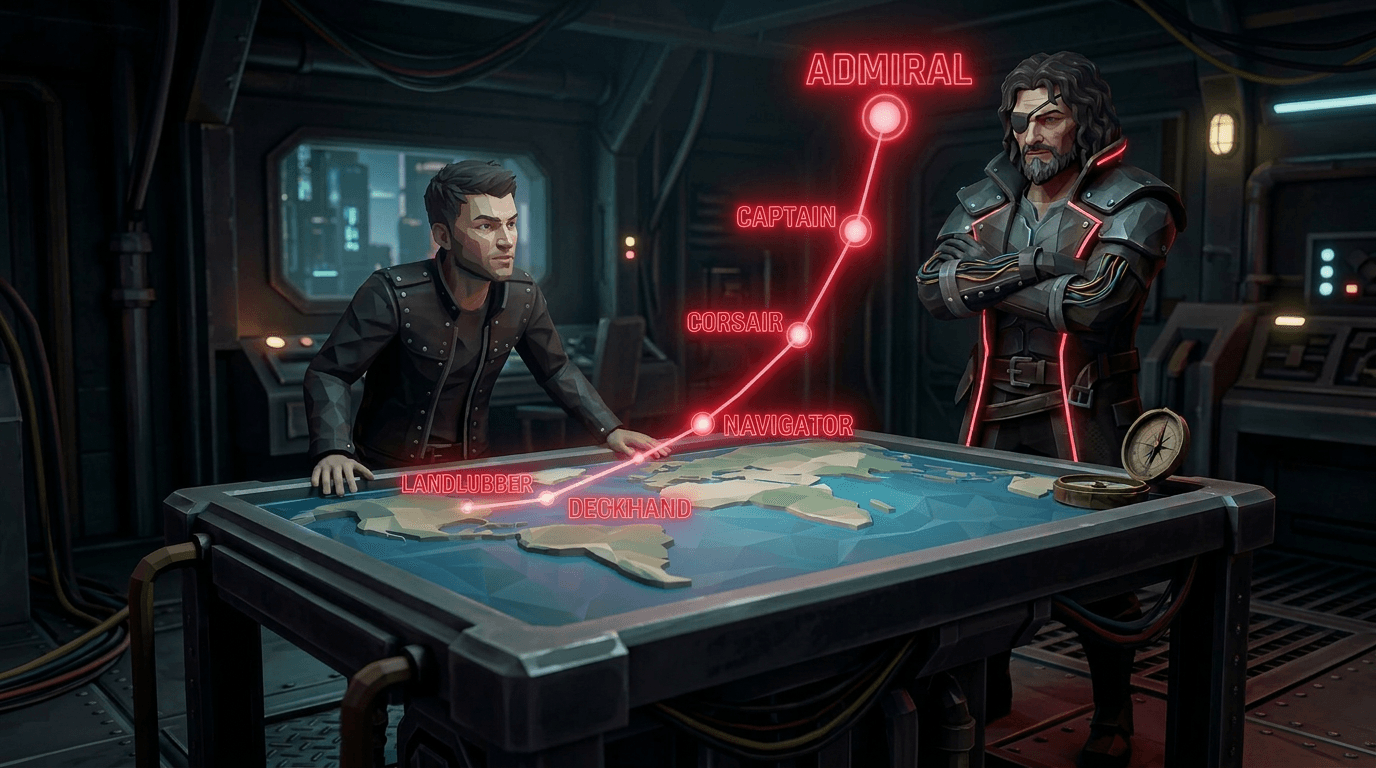
The AI Skill Path
for Founders
Find your level, see what it already unlocks, and follow a clear path to the next one.
The Map
Nobody Drew
The anxiety most founders feel about AI isn't really about being behind. It's a different question, harder to name: will this even matter in six months?
Everything keeps changing below your feet. A tool you finally master gets replaced by something better. A skill that felt advanced last quarter is table stakes today. The proactive founders — the ones who are actually trying — don't lack motivation. They lack a map. Not “where is AI going?” — that question is unanswerable. But “where am I right now, and what's actually worth doing next?” — that one has a clear answer.
Underneath every level in the AI Skill Path, one thing changes: your relationship to initiation. At the bottom, you go to AI. At the top, AI comes to you. In between, you build things together — tools, workflows, products — that keep running once you close the laptop.
Reactive
Levels 1–2
You go to AI.
- Every session starts from scratch or from a saved system prompt.
- You initiate every interaction. Nothing runs without you.
- The value you create scales with your time – not AI's capability.
Active
Levels 3–4
You and AI interact.
- What you create outlives the session – real products, real users.
- Tools and workflows keep running after you close the laptop.
- You're still the bottleneck, but for fewer and fewer things.
Proactive
Levels 5–6
AI comes to you.
- Agents act on schedules, triggers, and events – without you starting them.
- You review output instead of producing it.
- The number of people you serve is no longer limited by your hours.
This progression maps to something concrete. At the reactive levels, you are the bottleneck. The value you deliver to customers scales with your time and attention — not with the AI's capability. At the proactive levels, that constraint is removed. AI acts on schedules, on triggers, on events. The number of people you can serve is no longer limited by how many hours you have.
AI Skill Path:
Landlubber to Admiral
Each level is a genuine shift in what you can do — not just a tool upgrade. The general description applies to both tracks. The Build and Grow sections show what it looks like in each domain.
Landlubber
ReactiveYou go to AI. One question, one answer, one session.
Build
You turn AI into a smarter search engine – explaining contracts, breaking down topics, and answering questions you'd otherwise Google. Every session starts from scratch: no saved context, no system.
Grow
You use AI to shortcut the blank page – drafting captions, post ideas, and cold emails in seconds. Output is always generic until you find a prompt that clicks, and you still rewrite most of it before it goes out.
 ChatGPT
 Claude
 Gemini
 Perplexity
Deckhand
ReactiveYou go to AI with structure and context. Your system, not just a session.
Build
You load AI with your stack, goals, and conventions once – and every session after that starts informed. No more re-explaining. You still can't ship anything real, but the thinking-to-building gap closes fast.
Grow
You build a master prompt locking in your voice, ICP, and CTA structure – and AI stops sounding generic. Deep research shrinks from a week to hours. Still fully manual; nothing runs without you.
 Notion AI
Navigator
ActiveYou and AI build things together that outlive the session. Real users. Real tools.
Build
You ship real things in natural language – landing pages, internal tools, web apps – without writing a line of code. Iteration speed explodes. The ceiling hits when you need auth, payments, or a database.
Grow
Repetitive tasks stop being manual. Batch twenty ad variants at once and run them all. A podcast episode triggers show notes, social posts, and scheduling automatically. Set it up once, it runs.
 Lovable
 v0
v0 Base44
 n8n
n8n Clay
ClayCorsair
ActiveYou own what you built. Engineering judgment. Production-grade.
Build
You own a real production codebase – database, auth, payments, APIs. The loop: generate with Claude Code → read the diff → catch the mistake → commit. You understand what was built and debug it in production.
Grow
You stop guessing and start knowing. Custom queries answer your business questions, your funnel instrumentation tracks every step, and A/B tests give you statistical confidence. Intuition becomes evidence.
 Claude Code
 Codex
Codex Cursor
 Anti-Gravity
 Vercel
 Supabase
 PostHog
 Linear
 Clerk
Clerk Stripe
 Resend
 GitHub
Captain
ProactiveAI comes to you. Agents act on schedules and events without you triggering them.
Build
You give OpenClaw access to Claude Code – it codes, opens PRs, and monitors logs for anomalies while you sleep. Trigger a coding session from Telegram mid-commute. You review outcomes, not raw diffs.
Grow
Content drafts appear in your queue on schedule. New CRM contacts get researched automatically. Every morning a briefing covers analytics and inbound leads. You review outcomes instead of triggering tasks.
 OpenClaw
 Agent Zero
 Relevance AI
Admiral
ProactiveAI acts in coordination. Multiple agents, shared goals, closed loops. You are not the bottleneck.
Build
Agents coordinate like a team. Feature agent opens a PR → test agent writes tests → security agent scans → only then it surfaces to you. Self-healing catches production anomalies before you even notice.
Grow
Research, brief, copy, schedule, measure, iterate – all running without you. Performance data flows back automatically: underperforming angles drop, strong hooks multiply. The loop improves itself.
 CrewAI
Do You Need to Go
All the Way?
Not everyone needs to be an Admiral. That's not a failure — it's a strategic decision. The question is whether the level you're at is the right floor for your business model, or whether you're leaving real leverage on the table by staying where you are.
Every business type has a minimum. Below that floor, the cost compounds quietly — in margins, in speed, in the gap between what you can promise and what you can deliver. Above it, every level you climb is optional but compounding.
| Business Type | Minimum Level | Cost of staying below |
|---|---|---|
| Service Business | Navigator | You scale by adding hours, not systems. Custom client tools, automated delivery, and on-demand pages are what make a one-person operation look like a team — and they stay out of reach below this level. |
| Info Product | Navigator | Batch creative, automated content workflows, and prompt-to-website are the engine of this model. Without them, content is produced manually at a pace that can't compound. The distribution machine doesn't exist. |
| Classic Agency | Navigator | Every deliverable eats into margin when tooling stays manual. Workflow automation and batch creative are the difference between an agency that scales and one that just gets busier. Below this floor, growth means hiring. |
| Agency as a Service | Captain | You can't sell access to agents running on a schedule if you don't have agents running on a schedule. Autonomous content loops, CRM enrichment, and briefing agents are the product. Below this level, you're pitching something you haven't built. |
| B2C or B2B SaaS | Captain | Owning the codebase is the entry point, not the ceiling. Below Captain, production breaks demand your full attention, monitoring is reactive, and nothing runs unless you trigger it. A SaaS without proactive agents is competing on manual execution speed. |
The AI Skill Path for Founders doesn't tell you to become an Admiral. It tells you where the floor is for your situation — and what it actually costs to stay below it. The levels aren't achievements to chase. They're a map of capability gaps that show up quietly: as margin erosion, speed disadvantage, or dependence on people and agencies you shouldn't need.
Most founders operating below their floor don't know it. Not from lack of ambition — they simply never had the map. Now you do. Use your two numbers as a compass, not a verdict. A Build 3, Grow 3 who knows their gap is worth more than a Build 5, Grow 2 who doesn't. The next level is always closer than it looks. And it's always the same move: one capability at a time.
Cheers,
Ben

Founder from Cologne with 15 years of startup experience across 9 ventures. After helping thousands master growth marketing, Ben learned vibe coding from scratch and launched CaptAIn within three months. He leads the Vibe Coding Cologne community, blending real founder experience with teaching clarity.