
Build Better Pitch Decks
with AI
The full process behind our pre-seed deck – investor research, honest slides and a cohort financial model – built and steered in one Claude Code conversation.
Start in the Repo,
Not a Slide Tool
Two weeks ago, a pitch deck was not on my agenda. Then a spot opened at the Cologne Startup Summer Night – an investor evening with ~15-minute slots – and the price of admission was a deck. So Christina and I decided to raise a small pre-seed for Bridesmaid, our agentic wedding planner, and I built the whole thing the way I now do most of my work: in one Claude Code conversation on the left of my screen, with the deck rendering live on the right.
Research, strategy, the slides, original imagery, a full 12-month financial model, and a print-clean PDF – all in one unbroken session. Work that used to mean a designer, an analyst, a couple of tools and several days.
Here's the part I want you to take away, because it's the opposite of most “AI makes your deck” advice: the agent will happily one-shot you a beautiful, generic, wildly over-optimistic deck – and that deck loses you the meeting. The value isn't the generation. It's the steering. Building companies to be investment-worthy has been my bread and butter for the last ten years, and this piece is really about where a founder's judgment does the work the agent can't.
- ✗ A designer for the slides
- ✗ An analyst for the model
- ✗ A separate research pass on investors
- ✗ Days of round-trips between tools
- ✓ Research, slides, model, PDF in one session
- ✓ Design inherited from your codebase
- ✓ The tacit knowledge is already there
- ✓ It stays versioned and iterable
Constraint first: I told the agent to build the deck as HTML, living in the repo, and easy to export to PDF from the browser's print dialog. That one line shaped everything. HTML because it converts cleanly to the PDF you actually send investors – and because the deck inherits the design language already in your codebase, which is why the version on the right looked like Bridesmaid from the first draft.
The bigger reason to start in your own codebase: the tacit knowledge is already there. If you've been setting things up the way I keep suggesting – a folder and a dedicated conversation for each part of the business – your product code already knows what the company is. So I had the conversation that spotted the event write a handover prompt, then opened one fresh thread whose only job is fundraising. Everything it produced now lives under docs/fundraising/. Fundraising became just another folder.
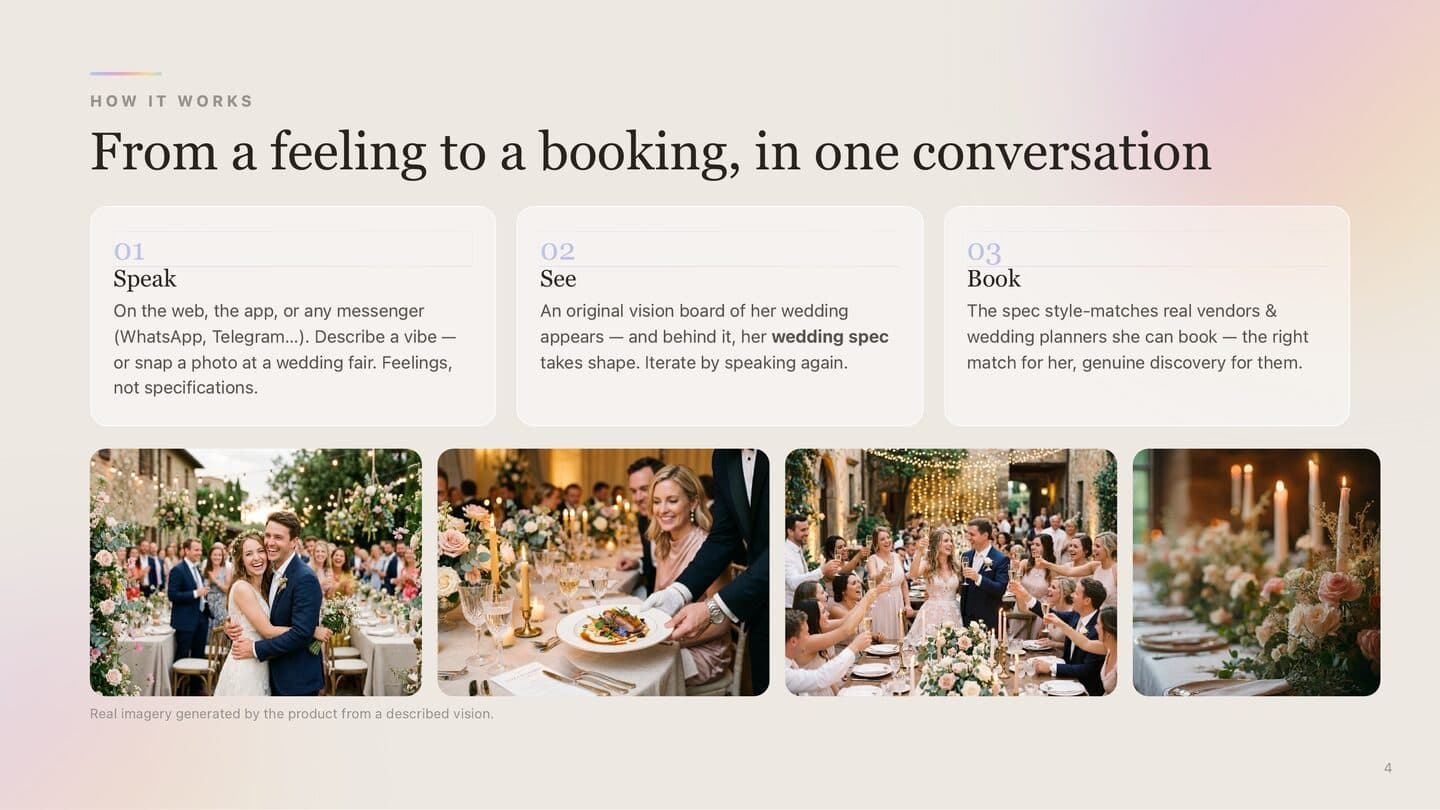
One of fifteen slides – hand-built as HTML in the repo, inheriting the product's own design. No slide tool, no framework.
Make It
Interview You
This is the key move, and the one people skip: you need to ask it to ask you questions.
I didn't let it write a deck. I let it research first – sub-agents dug into the event's investors and their theses, and narrowed a long list down to the small handful whose thesis actually fit ours: a couple of regional early-stage funds I'd genuinely want in the room. Then it interviewed me – round after round of questions, each with a strong default answer baked in that I could confirm or correct. Who do I actually want to talk to? What round size, what geography? What makes Christina and me credible founders?
And here's where the founder has to override the machine. Early on it framed Bridesmaid as a two-sided B2B2C marketplace – partly to fit a B2B investor's thesis. I killed it: I'm very skeptical of two-sided marketplaces, and I'd never force myself into a chicken-and-egg problem. We reframed it as a brides-first B2C product that stands on its own, with vendor placement as an additive second engine. That decision – mine, not the agent's – became the spine of the whole deck.
Fit the investor's thesis – and walked us straight into a chicken-and-egg problem.
Vendor placement as an additive second engine. This became the spine of the deck.
Two things to steal here. One: targeting a specific handful of investors changes how the deck is framed – tech-first, traction-first and growth-first are different decks. Two: finding an investor is a lot like getting married. It's a relationship that can make or break the thing you're building. You're not looking for someone to change your idea – you want someone who will challenge it and then back it with their wallet.
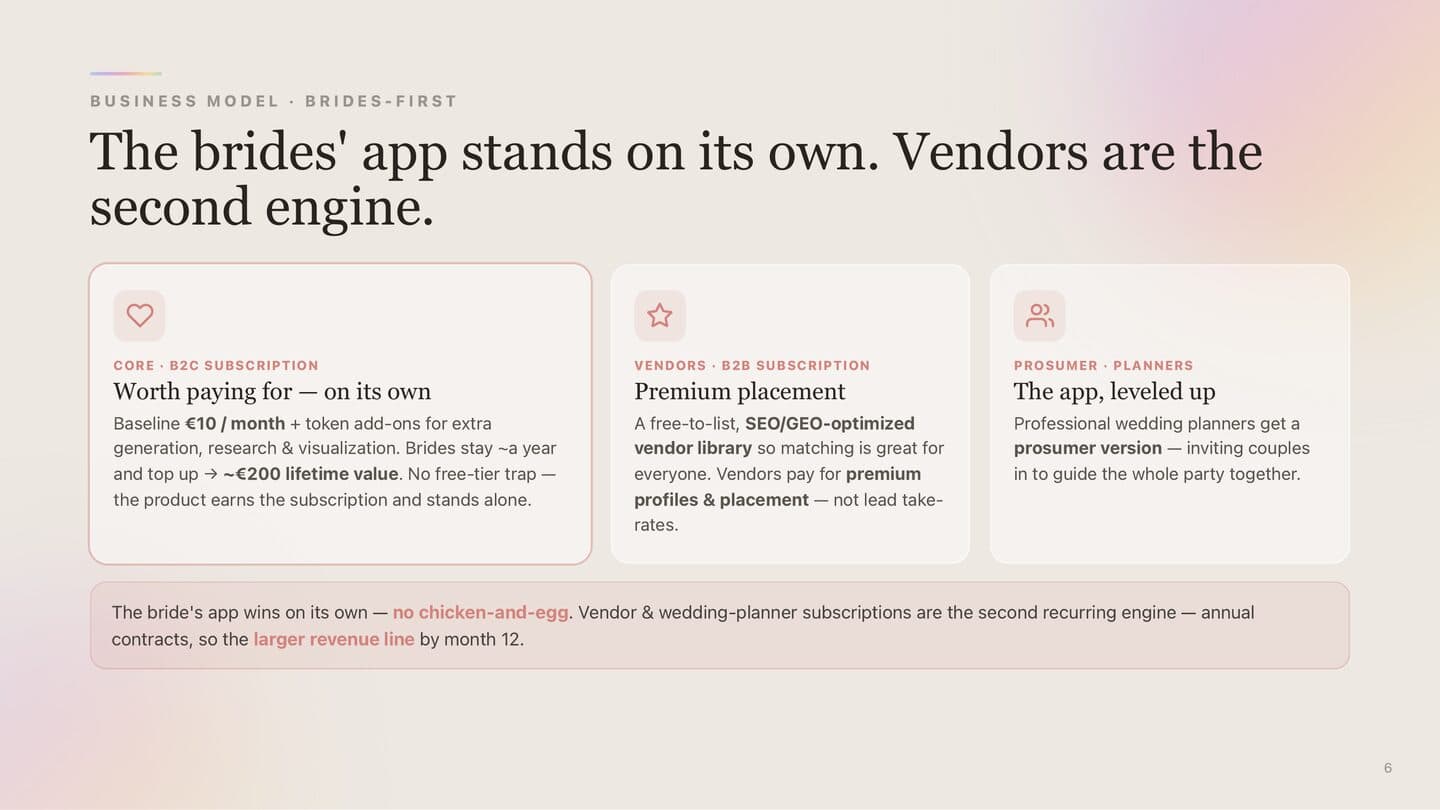
The reframed model that came out of the override – the brides' app stands on its own; vendors are the additive second engine.
Steer the Slides,
Cut the Bullshit
Once the framing was locked, the deck came together fast – fixed 1920×1080 slides, our fonts and palette, auto page numbers, one self-contained file. But the first pass wasn't strong. The details were thin, and worse, it was flattering us.
So I made it attack the deck from the investor's side: research the fund's portfolio, then tell me whether you'd invest – and hammer it. It found real problems. And on each one, I did the opposite of trusting it.
- ✗ Proprietary AI breakthroughs
- ✗ RAG this, novel-architecture that
- ✗ A competition matrix that flattered us
- ✓ An open, model-independent agentic harness
- ✓ A swappable image model, no US lock-in
- ✓ “Image gen is a commodity we'll all share”
On the tech slide it had inflated claims. I cut them – that felt a bit bullshitty, and none of it was true for us. Don't mention RAG. What's left is honest: an open, model-independent agentic harness (Vercel AI SDK + Chat SDK), a swappable image model, live vendor search via the Google Maps Platform – and no lock-in to a US hyperscaler, which happens to matter to one of the investors I'm meeting. On competition, it was too negative to make us look good. I pushed back: image generation is a commodity we'll all share – so say so. The honest matrix is more convincing than the flattering one.
This is the whole discipline: you are standing there with your name on this. Exactly like you double-check the AI's code before you ship it, you double-check every assertion in a deck before you send it – because in the room, you are the one defending it.
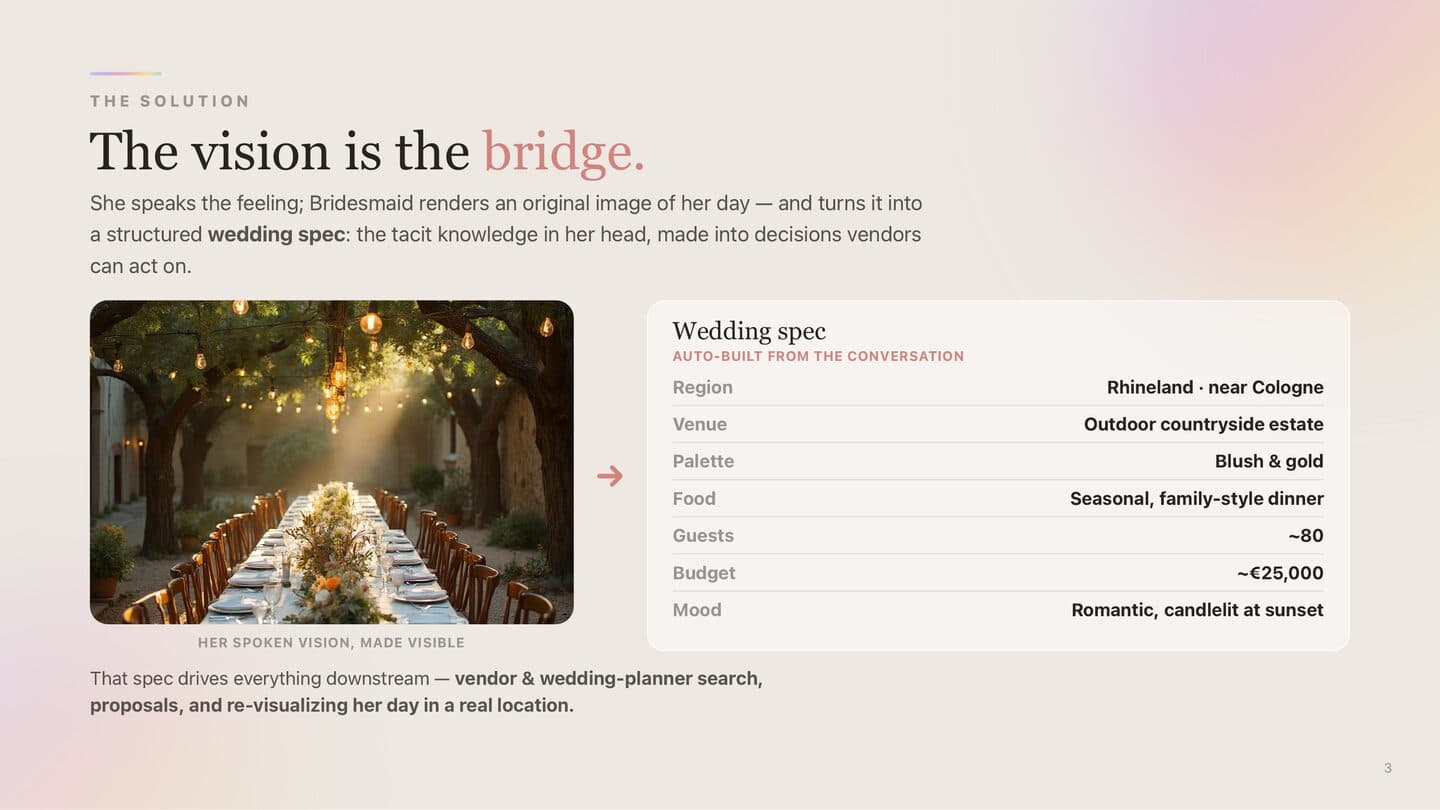
A real slide from the shipped deck – the product told straight: a spoken vision becomes an image and a structured wedding spec.
(The original imagery was generated with nano-banana in the same session. One small war story: the image API key was stored with quotes in the env file, the first read grabbed the quotes, and it threw a 401. Stripped the quotes, done. The kind of thing that eats ten minutes and teaches you to look at the actual output.)
Educated
Fantasy Land
Investors don't fall in love with your UI. They fall in love with the business model. And this is where the agent needed the most steering.
I had it build the financial model programmatically in Google Sheets – through the same Google Workspace CLI (gog) Peter Steinberger opened up for OpenClaw – driving the cells from generated JSON instead of hand-entry, so the whole thing is auditable and re-runnable. A cohort-based, churn-aware, 12-month model: what a bride pays, the token cost per active user, a CAC that starts bad and improves, VAT drag, B2B contract value, salaries, tools, office, legal – all of it.
The first version? The bank balance never went down. We just made money, every month, forever. I told it: this might be a bit overly optimistic. “Yes, of course, you're absolutely right.” Then we went line by line and dragged it into what I call educated fantasy land – you're still guessing about the future, but it has to be an educated guess an investor can pull apart. New-customer numbers that rise every month (an earlier version dipped – that should be a progression up). A rebalance to roughly 60/40 B2B/B2C by month 12.
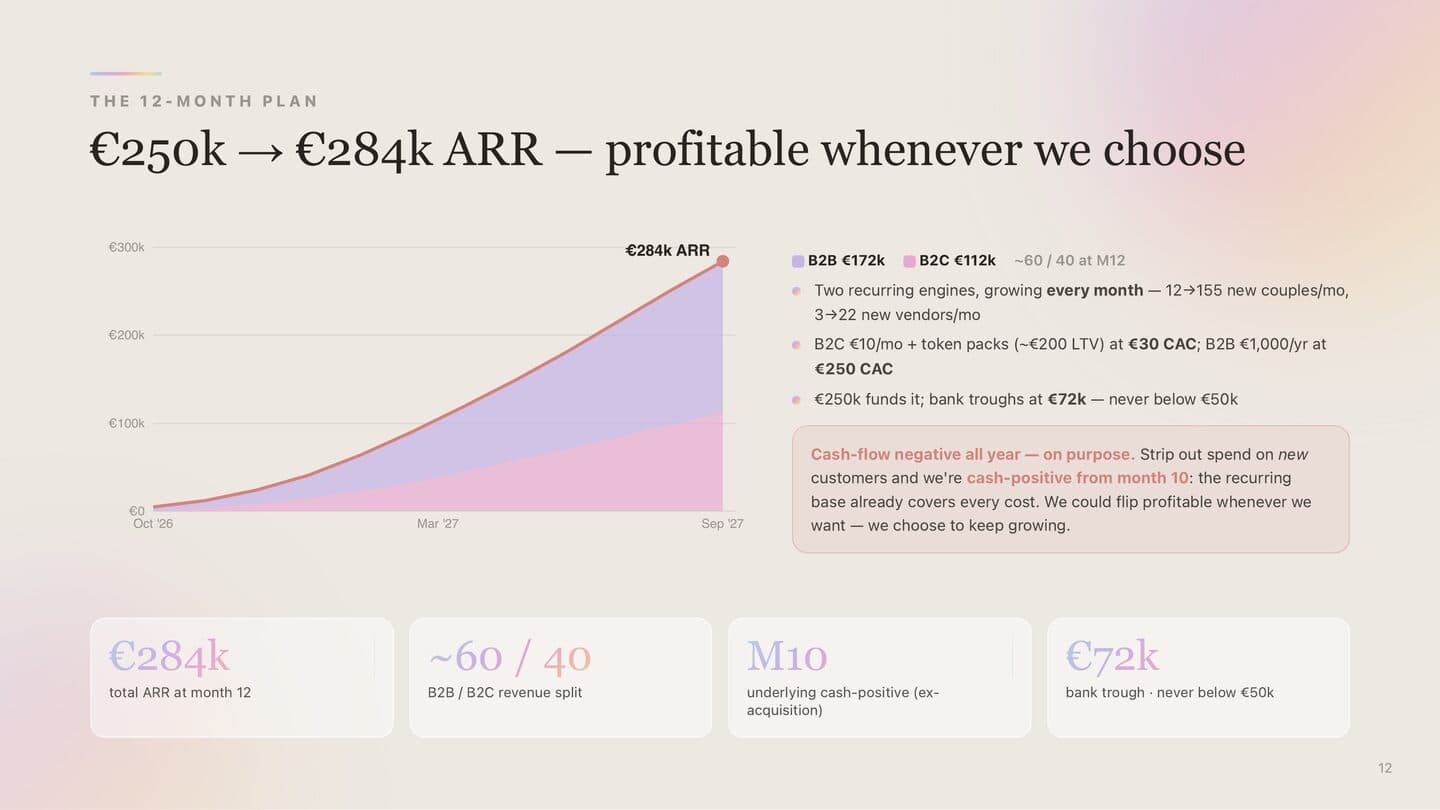
The money slide, rebuilt straight from the model's actual rows – not a number the agent invented on a slide.
The story the model tells: €250k in, ~€284k ARR by month 12, split about €112k B2C and €172k B2B. The bank troughs around €72k and never drops below €50k. And the line I'm proudest of – we're cash-flow negative all year on purpose. Strip out the spend on acquiring new customers and we're cash-positive from month 10: the recurring base already covers every cost. We could flip profitable whenever we want. We choose to keep growing.
That's not a spreadsheet an AI can hand you. That's a story you decide on and then make the numbers honestly support. And this sheet goes to the investors when they ask for it – so make sure you trust it.
Ship It,
and Keep It
Two things at the end are worth your time.
On export, some images had ugly solid grey rectangles behind them – but only in the printed PDF. The cause is genuinely non-obvious: Chrome renders a CSS box-shadow as a solid grey fill when the shadowed element sits inside a transform: scale() container – which the entire deck is. The fix is to strip image shadows inside @media print. Then the agent re-rendered the PDF headlessly and read the pages back as images to confirm they were clean.
That closed loop – render, look at the actual pixels, fix – separates “the code looks right” from “the output is right.” It's the same habit that keeps the whole build honest.
Then we shipped it: about twenty commits, merged to main. The deck isn't a dead PDF in a Downloads folder. It's HTML in the repo, and the conversation that built it is still open. When an investor or a co-founder hammers it – and they will – I update the strategy where it lives and re-export. Your fundraising becomes iterable, versioned, and wired into the rest of the business, the same way everything else runs.
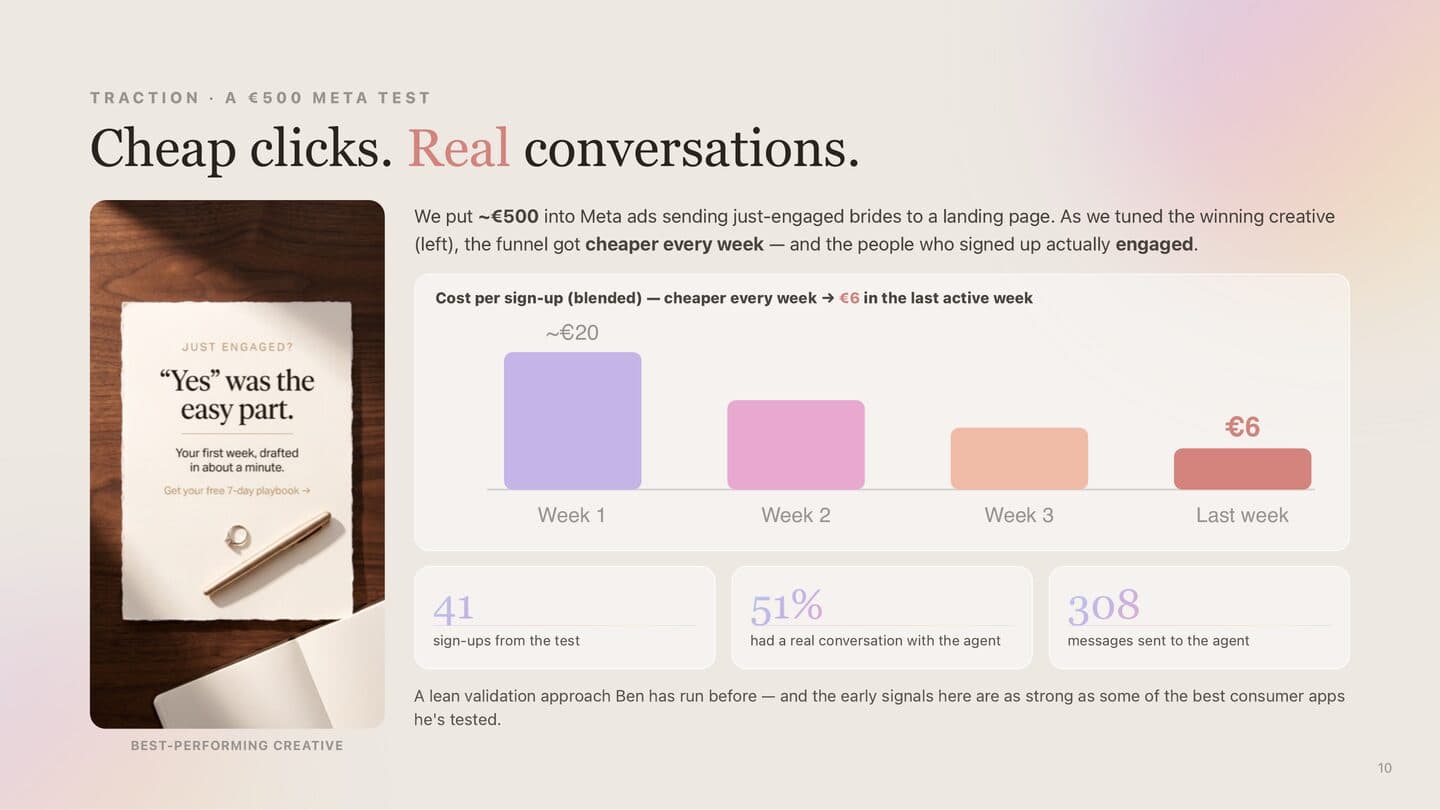
The traction slide – little to show yet, and we don't hide it: a ~€500 test, cost per sign-up down from ~€20 to €6, and real conversations with the agent.
None of this went seamlessly. I was, once again, shouting at the agent about how stupid it was, more times than I'd like to admit. But a few hours of steering got us a deck and a model I'd actually defend in a room – the kind of thing that used to take a week and three people.
If there's one line to keep: don't let it one-shot your deck. Make it research, make it interview you, override its framing, and put your name on every number. The agent is fast. The judgment is yours.
We've been having more of these founder conversations in the community lately – if that's your thing, join one of the upcoming events and you'll get pulled into the group.
Cheers,
Ben
Ready to Go Deeper?
Don't miss the next Insight
Join the crew and get fresh perspectives delivered weekly.
Free account. No spam. Unsubscribe anytime.
Questions & Answers
Won't the AI just invent the financial numbers?
Is this a Claude Code–only thing?
Do I need to know finance or design to pull this off?
Won't investors dismiss a deck an AI helped build?

Founder from Cologne with 15 years of startup experience across 9 ventures. After helping thousands master growth marketing, Ben learned vibe coding from scratch and launched CaptAIn within three months. He leads the Vibe Coding Cologne community, blending real founder experience with teaching clarity.