
Messages

Develop a comprehensive messaging strategy that guides prospects through each stage of the customer journey, from initial awareness to expansion, using the right message at the right time.

1. Goal - Crafting messages for every stage
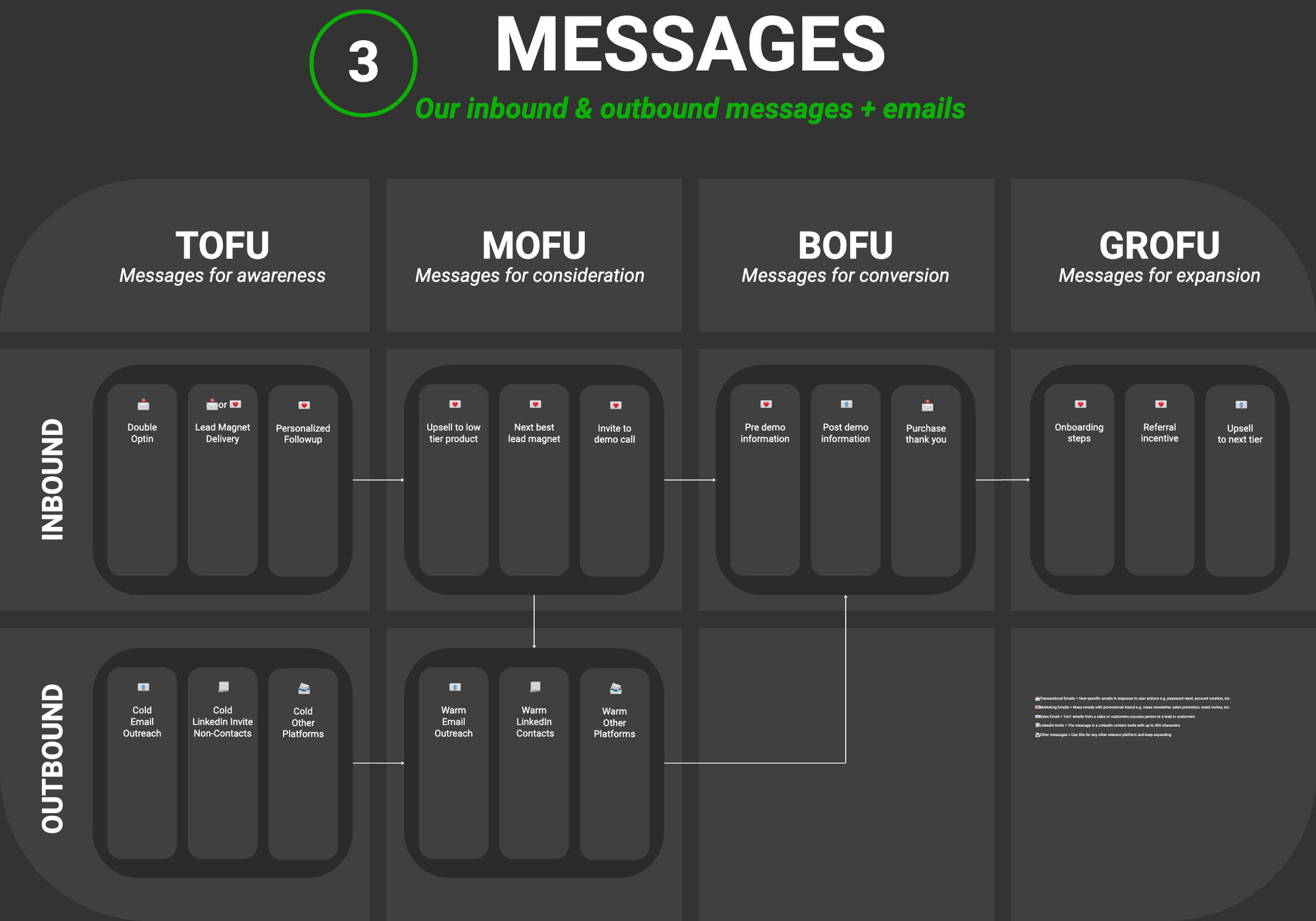
Messages Template

Where You're Building From

In the Landing Pages lesson, you created the copy and structure for all your landing pages – your lead magnet page and your sales pages (low-tier, mid-tier, and potentially high-tier). Now you need the messages that drive people to those pages and guide them through your funnel.

What You're Deciding Here

This lesson helps you create the email sequences and messages that power your funnel at four critical stages:

  1. ToFu (Top of Funnel - Awareness): Welcome sequences after someone opts in for your lead magnet
  2. MoFu (Middle of Funnel - Consideration): Nurture sequences that build trust and move people toward purchase
  3. BoFu (Bottom of Funnel - Conversion): Conversion sequences for demos, trials, and purchases
  4. GroFu (Growth Funnel - Expansion): Onboarding, upsell, and referral sequences for existing customers

What Should You Create First?

Your message creation order should follow your funnel priorities:

Start with ToFu (Everyone Needs This)
Begin with your lead magnet delivery and welcome sequence. This is the first touchpoint after someone joins your list – it sets the tone for everything that follows. Get this right first.

Next: BoFu (For Active Selling)
If you're actively selling, create your conversion sequences next – purchase thank you emails, onboarding messages, and follow-ups after demos or trials. These directly impact revenue.

Then: MoFu (For Nurturing)
Once you have ToFu and BoFu working, add your nurture sequences. These keep leads warm between awareness and conversion, promoting additional lead magnets, sharing case studies, and moving people toward demos.

Finally: GroFu (For Growth)
Once customers are converting consistently, build your expansion sequences – customer onboarding, upsell campaigns, and referral requests. These maximize customer lifetime value.

Choosing Your Email Marketing Tool

You'll need an email marketing platform to send these sequences:

Decide on message priorities and email marketing tool
You have access to my Strategy document, Story Framework document, Funnel Overview, and Landing Page documents in this project.
Before making recommendations, please ask me these questions and wait for my answers:
1.**What's your current email marketing situation?**
- Do you already have an email marketing tool (if so, which one)?
- How many email subscribers do you have currently?
- Are you currently sending any email sequences?
2.**What's your immediate priority?**
- Just started and need to set up lead magnet delivery (ToFu)?
- Actively selling and need conversion sequences (BoFu)?
- Have customers and need to improve onboarding/upsells (GroFu)?
- Need everything but want to start with the most important?
Once you have my answers, provide:
1.**Email Tool Recommendation:**
- ONE specific email marketing tool recommendation
- Why this fits my situation and subscriber count
- Approximate cost for my list size
- Key features I'll need (automation, segmentation, integrations)
2.**Message Creation Priority:**
- Based on my Funnel Overview, list the exact message sequences I need
- In priority order (ToFu → BoFu → MoFu → GroFu)
- Why this sequence makes sense for my business
- Estimated time to create each sequence
3.**Quick Win:**
- ONE message sequence I can create this week
- Why this will have the biggest immediate impact
- What I need to set up in my email tool
4.**Next 3 Steps:**
- Step 1: [Specific first action]
- Step 2: [Second action]
- Step 3: [Third action]
Keep this recommendation in the project for reference as we create the message sequences.

Outcome: You have a clear plan for which message sequences to create first and which email tool to use.

Decide on message priorities and email marketing tool

2. ToFu - Messages for Awareness

Top of Funnel: Creating First Impressions

At the awareness stage, prospects are just discovering your brand. They've opted in for a lead magnet, attended a webinar, or downloaded a resource. Your messaging here sets the tone for the entire relationship.

Immediate Value Delivery

The first message after an opt-in is critical. Deliver the promised value immediately – no delays, no extra hoops to jump through. If they signed up for an ebook, the download link should be in their inbox within seconds.

The Success Landing Page Strategy

After delivering the lead magnet, redirect users to a success page that:

  • Confirms they'll receive what they requested
  • Suggests the next logical step (follow on social media, join a community, book a call)
  • Sets expectations for what's coming next

Follow-Up Email Sequence

Over the next few days to weeks, send a series of trust-building emails:

  • Email 1 (Immediate): Deliver the lead magnet with clear instructions
  • Email 2 (Day 1-2): Check if they found it valuable, offer to answer questions
  • Email 3 (Day 3-5): Share related content that builds on the lead magnet topic
  • Email 4 (Day 7): Introduce your next tier offering (soft sell)
  • Email 5+ (Weekly): Continue providing value while warming them to your offers

Key Principles for ToFu Messages:

  • Focus on education, not selling
  • Build trust through consistent value
  • Set clear expectations for the relationship
  • Be personal and conversational
  • Guide them toward the next small commitment
Create your ToFu welcome sequence
You have access to my Strategy document, Story Framework document, Lead Magnet Plan, and Lead Magnet Page Copy in this project.
Based on that context, create a complete 5-email welcome sequence for people who opt in for my lead magnet.
Provide:
**Email 1: Immediate Delivery (Sent immediately after opt-in)**
- Subject line (2-3 options to test)
- Email body:
- Brief welcome and thank you
- Deliver the lead magnet (download link or access instructions)
- What to do next / how to use it
- Set expectations for future emails
- CTA: Direct them to consume the lead magnet
- Tone: Warm, helpful, excited
**Email 2: Check-In (Day 1-2)**
- Subject line options
- Email body:
- Check if they found the lead magnet valuable
- Offer to answer questions
- Share one quick tip related to the lead magnet
- Introduce yourself/your story briefly
- CTA: Reply with questions or share a related resource
- Tone: Personal, conversational
**Email 3: Related Content (Day 3-5)**
- Subject line options
- Email body:
- Build on the lead magnet topic
- Share related content (blog post, video, case study)
- Provide additional value without asking for anything
- Connect to their broader goals
- CTA: Consume the additional content
- Tone: Educational, valuable
**Email 4: Soft Introduction to Offer (Day 7)**
- Subject line options
- Email body:
- Acknowledge where they might be in their journey
- Introduce your low-tier or mid-tier offer naturally
- Focus on transformation, not features
- Share why you created this offer
- No hard sell – just awareness
- CTA: Learn more about the offer (link to sales page)
- Tone: Helpful, not pushy
**Email 5: Continue the Journey (Day 10-14)**
- Subject line options
- Email body:
- Provide more value
- Set expectations for ongoing emails (weekly tips, updates, offers)
- Invite them to connect on social media or join community
- Remind them you're here to help
- CTA: Follow on social or join community
- Tone: Relationship-building, welcoming
**Success Landing Page Copy:**
- Headline for page they see after opt-in
- Confirmation message
- What to expect next
- Suggested next step (follow social, join community, book call)
**Email Sequence Settings:**
- Recommended send times
- Segmentation suggestions (if they click/don't click)
- When to move them to MoFu nurture sequence
Save this as "[Business Name] - ToFu Message Sequence.md" in the project.
Make it comprehensive enough that I can copy/paste these emails into my email marketing tool and just customize the final details.

Outcome: You have a complete 5-email welcome sequence ready to implement in your email marketing tool.

Create ToFu awareness message sequence

3. MoFu - Messages for Consideration

Middle of Funnel: Nurturing Consideration

At this stage, prospects know who you are and what you offer. They're considering whether your solution is right for them. Your messaging shifts from pure education to demonstrating value and relevance.

Promoting Your Best Lead Magnets

If someone has consumed one lead magnet, introduce them to your next-best resource. This multi-touch approach helps prospects self-select into deeper engagement. The more value they receive, the more trust builds.

The Balance of Give and Ask

A core principle for MoFu messaging is "give, give, give, ask." For every sales-focused message, provide 2-3 purely valuable pieces of content. This maintains goodwill while still moving prospects toward a purchase decision.

Email Strategies for Engagement:

  • Content Variety: Mix email lengths and styles – sometimes a short tip, sometimes a detailed case study
  • Story-Driven: Share customer success stories that resonate with their situation
  • Problem-Solving: Address specific challenges your prospects face
  • Social Proof: Include testimonials, results, and evidence of your expertise
  • Demo Invitations: Focus messaging on getting prospects to book an exploratory call or demo

Personalization at Scale

Use your CRM to segment based on:

  • Which lead magnets they've downloaded
  • What content they've engaged with
  • Their industry or role (if known)
  • Their stage in the buying journey

This allows you to send more targeted, relevant messages even as your list grows.

Create your MoFu nurture sequence
You have access to my Strategy document, Story Framework document, Funnel Overview, and all Landing Page copy in this project.
Based on that context, create a nurture sequence for people who have completed the ToFu welcome sequence but haven't purchased yet.
Provide:
**Nurture Email 1: Additional Lead Magnet Promotion**
- Subject line options
- Email body:
- If you have multiple lead magnets, promote the next best one
- Why this resource complements what they already downloaded
- What they'll learn or gain
- CTA: Download/access the additional lead magnet
- Send timing: Week 2-3
**Nurture Email 2: Customer Success Story**
- Subject line options
- Email body:
- Share a relevant customer success story or case study
- Focus on transformation and results
- Connect to their situation (from Strategy document)
- Show what's possible
- CTA: Read full case study or similar success stories
- Send timing: Week 3-4
**Nurture Email 3: Problem-Solving Content**
- Subject line options
- Email body:
- Address a specific challenge your audience faces
- Provide actionable solution or framework
- Demonstrate your expertise
- No ask – pure value
- CTA: Consume additional content (blog, video, resource)
- Send timing: Week 4-5
**Nurture Email 4: Social Proof & Results**
- Subject line options
- Email body:
- Share testimonials, reviews, or results
- Include specific numbers or outcomes if possible
- Build credibility and trust
- Address common objections indirectly
- CTA: See more testimonials or book a demo
- Send timing: Week 5-6
**Nurture Email 5: Demo/Call Invitation (Give, Give, Give, Ask)**
- Subject line options
- Email body:
- Recap the value they've received so far
- Acknowledge where they might be in their journey
- Invite them to book a demo, consultation, or trial
- Make it about helping them, not selling
- Clear value of the demo/call
- CTA: Book demo/call or start free trial
- Send timing: Week 6-7
**Segmentation Strategy:**
- How to segment based on engagement (opens, clicks)
- When to send more frequent vs. less frequent emails
- How to identify "hot" leads ready for BoFu sequence
**Ongoing Nurture (Weekly):**
- Template for ongoing weekly value emails
- Mix of content types (tips, stories, insights)
- How often to include soft sells vs. pure value
Save this as "[Business Name] - MoFu Message Sequence.md" in the project.
These emails should work together to build trust and demonstrate value over time, moving people naturally toward a purchase decision.

Outcome: You have a complete MoFu nurture sequence that builds trust and moves leads toward conversion.

Create MoFu consideration message sequence

4. BoFu - Messages for Conversion

Bottom of Funnel: Facilitating Decision-Making

At this stage, prospects are seriously considering a purchase. They may have booked a demo, asked detailed questions, or spent significant time on your pricing page. Your messaging here should remove friction and facilitate the decision.

Four Key Conversion Sequences:

  1. Pre-Demo Sequence – Prepare prospects before sales calls (for high-touch sales)
  2. Post-Demo Sequence – Follow up after demos to close deals (for high-touch sales)
  3. Purchase Thank You – Confirm purchases and start onboarding (for all tiers)
  4. Free Trial Sequences – Guide trial users to conversion (for SaaS with trials)

Key Elements for BoFu Messages:

  • Remove objections and friction
  • Be specific about next steps
  • Personalize based on their expressed needs
  • Create urgency where appropriate (limited spots, bonuses ending)
  • Make it easy to say yes

Build What You Need Right Now

Not every business needs all four sequences. Choose based on your funnel:

  • High-touch sales model? Start with Pre-Demo and Post-Demo sequences
  • Self-serve SaaS? Start with Purchase Thank You and Free Trial sequences
  • Low-touch one-time products? Focus on Purchase Thank You sequences only

Pre-Demo Sequence (For High-Touch Sales)

Before a sales demo or consultation, send materials that help prospects understand what to expect, prepare relevant questions, and get excited about the potential transformation. This preparation makes demos more productive and increases conversion rates.

Create your pre-demo sequence
You have access to my Strategy document, Story Framework document, ICP & Outreach Strategy, and High-Tier Sales Page copy in this project.
Based on that context, create a pre-demo email sequence that prepares prospects for productive sales conversations.
Provide:
**Email 1: Demo Confirmation (Immediately after booking)**
- Subject line (2-3 options)
- Email body:
- Confirm demo date, time, and timezone
- What to expect in the demo (agenda overview)
- How to prepare (questions to think about, info to have ready)
- Who will be on the call (your name/role)
- Link to add to calendar
- Any materials to review beforehand
- CTA: Confirm attendance or reschedule if needed
- Tone: Professional, organized, helpful
**Email 2: Pre-Demo Prep (1-2 days before)**
- Subject line (2-3 options)
- Email body:
- Reminder of upcoming demo (date, time)
- Share relevant case study or success story
- Highlight 2-3 specific things you'll show them
- Get them excited about what's possible
- Confirm any prep they should do
- Your contact info if they need to reach you
- CTA: Review case study or confirm they're ready
- Tone: Excited, building anticipation
**Email 3: Day-Of Reminder (Morning of demo, optional)**
- Subject line (2-3 options)
- Email body:
- Quick reminder (time, meeting link)
- "Looking forward to showing you [specific benefit]"
- One-click join link prominent
- CTA: Join the demo
- Tone: Brief, friendly, easy
**Calendar Invite Details:**
- What to include in calendar description
- Meeting link placement
- Pre-demo prep checklist
**No-Show Follow-Up:**
- Email to send if they don't attend
- How to reschedule gracefully
- Keep the relationship warm
Save this as "[Business Name] - Pre-Demo Sequence.md" in the project.
Make these emails ready to customize with specific demo times and prospect names.

Outcome: You have a complete pre-demo sequence that prepares prospects for productive sales calls.

Create pre-demo email sequence

Post-Demo Sequence (For High-Touch Sales)

After a demo or consultation, send personalized communication with a concise summary of what was discussed, clear next steps, answers to any questions, and a timeline for decision-making. These follow-ups are critical for closing deals.

Create your post-demo sequence
You have access to my Strategy document, Story Framework document, ICP & Outreach Strategy, and High-Tier Sales Page copy in this project.
Based on that context, create a post-demo follow-up sequence that moves prospects to decision.
Provide:
**Email 1: Post-Demo Follow-Up (Same day or within 24 hours)**
- Subject line (2-3 options)
- Email body:
- Thank them for their time
- Recap what was discussed (key points, their goals)
- Answer any questions that came up during call
- Clear next steps (proposal attached, trial access, contract to review)
- Timeline for decision ("I'll follow up in X days")
- Your availability for questions
- CTA: Review proposal or schedule follow-up call
- Tone: Professional, helpful, recapping value
- Attachments: Proposal template, pricing sheet, etc.
**Email 2: Check-In (2-3 days after demo)**
- Subject line (2-3 options)
- Email body:
- Check if they've had a chance to review materials
- Ask if they have any questions or concerns
- Address 1-2 common objections proactively
- Share additional resource or proof point
- Gentle nudge on timeline
- Offer to schedule another call if needed
- CTA: Reply with questions, concerns, or decision
- Tone: Helpful, not pushy, collaborative
**Email 3: Value Reminder (5-7 days after demo)**
- Subject line (2-3 options)
- Email body:
- Reiterate the specific value for their situation
- Reference their goals from the demo
- Share relevant case study or ROI example
- Address timeline or decision process
- Make it easy to move forward
- CTA: Confirm decision or schedule final call
- Tone: Value-focused, understanding
**Email 4: Decision Deadline (If appropriate - 7-10 days after demo)**
- Subject line (2-3 options)
- Email body:
- Reminder of any limited-time bonuses or pricing
- Reiterate specific outcomes they're looking for
- What they'll miss out on by delaying
- Clear urgency if authentic (pricing change, limited spots, bonus expiring)
- Make saying yes as easy as possible
- CTA: Confirm decision, sign contract, or schedule call
- Tone: Urgent but helpful, not desperate
**Post-Demo Templates:**
- Proposal email template structure
- Handling objections via email
- Pricing negotiation response templates
- How to gracefully handle "not right now" responses
Save this as "[Business Name] - Post-Demo Sequence.md" in the project.
These emails should be templates that can be quickly personalized with specific details from each demo call.

Outcome: You have a complete post-demo sequence that moves prospects from interested to committed.

Create post-demo follow-up sequence

Purchase Thank You Sequences (All Tiers)

When someone purchases, immediately confirm their purchase, set clear expectations for delivery or onboarding, reinforce they made the right decision (reduce buyer's remorse), and provide immediate access or next steps.

Create your purchase thank you sequences
You have access to my Strategy document, Story Framework document, and all Sales Page copy (Low-Tier, Mid-Tier, High-Tier) in this project.
Based on that context, create purchase thank you emails for each of your product tiers.
Provide:
**LOW-TIER PURCHASE ($50-$300 one-time)**
**Email: Purchase Confirmation & Access (Immediately after purchase)**
- Subject line (2-3 options)
- Email body:
- Thank them for their purchase
- Confirm what they purchased and amount paid
- How to access the product (download link, login instructions, etc.)
- What they'll receive and when (if physical or delayed delivery)
- Next steps to get value quickly (where to start, first action)
- Reinforce they made the right decision
- Soft mention of mid-tier offer ("Many customers upgrade to [mid-tier] for [benefit]")
- Support contact info
- CTA: Access product, join community, or take first step
- Tone: Excited, welcoming, helpful
---
**MID-TIER PURCHASE ($30-$300/month subscription)**
**Email: Welcome to Subscription (Immediately after purchase)**
- Subject line (2-3 options)
- Email body:
- Welcome to the community/product
- Thank them for subscribing
- Confirm subscription tier and billing details
- How to access everything (dashboard, resources, support)
- Quick-start guide or recommended first steps
- What to expect in first 7 days
- Who to contact for support (with links)
- Celebrate their decision to invest
- Set expectations for billing cycle
- CTA: Get started, complete profile, or book onboarding call
- Tone: Welcoming, community-focused, supportive
---
**HIGH-TIER PURCHASE ($10k-$50k+/year)**
**Email: Personal Welcome (Immediately after contract signed)**
- Subject line (2-3 options)
- Email body:
- Personal welcome from founder, CEO, or executive
- Thank them for choosing to partner
- Confirm contract details and timeline
- Introduce their dedicated account manager or key contacts (with photos/bios)
- What happens in the first 30 days (detailed timeline)
- Onboarding schedule and kickoff call details
- How to reach the team (direct contacts)
- Celebrate the partnership and their commitment
- Express excitement about the results you'll achieve together
- CTA: Schedule kickoff call, complete onboarding form, or meet the team
- Tone: Personal, executive-level, partnership-focused
---
**Additional Elements:**
**Receipt/Invoice Handling:**
- What financial details to include
- Where to access receipts
- Billing support contact
**Buyer's Remorse Prevention:**
- Language that reinforces their decision
- Early wins or quick value to highlight
- Social proof reminders
**Upsell Mentions:**
- When and how to mention next tier
- Soft vs. direct upsell timing
- Discount offers for early upgrade
Save all three as "[Business Name] - Purchase Thank You Sequences.md" in the project.
Organize by tier (Low, Mid, High) with clear separation between each.

Outcome: You have purchase thank you emails for all three product tiers.

Create purchase thank you sequences for all tiers

Free Trial Sequences (For SaaS)

For SaaS products with free trials, guide users through the trial experience, help them get value quickly, and convert them to paying customers before the trial ends.

Create your free trial sequences
You have access to my Strategy document, Story Framework document, and Mid-Tier Sales Page copy in this project.
Based on that context, create a free trial email sequence that maximizes trial-to-paid conversion.
Provide (assume 14-day trial, adjust if different):
**Email 1: Trial Start (Day 0 - Immediately after signup)**
- Subject line (2-3 options)
- Email body:
- Welcome to trial
- Thank them for signing up
- How to access the product (login link prominent)
- What to focus on first (one key action)
- Trial duration clearly stated (14 days)
- What happens at end of trial
- Quick-start resources or video
- Support contact if they get stuck
- CTA: Complete first key action (e.g., "Create your first project")
- Tone: Excited, helpful, action-oriented
**Email 2: Day 1 Check-In**
- Subject line (2-3 options)
- Email body:
- Check if they completed first action
- Share tips for getting more value
- Highlight 2-3 key features to try next
- Address common beginner questions
- Remind them of trial timeline (13 days left)
- CTA: Complete next key actions
- Tone: Encouraging, educational
**Email 3: Mid-Point Value (Day 7 of 14)**
- Subject line (2-3 options)
- Email body:
- Halfway through trial milestone
- Check on their progress
- Share tips for advanced features
- Customer success story relevant to their use case
- Address common questions at this stage
- Remind of time remaining (7 days left)
- Offer to book a call for help
- CTA: Try advanced features, book call, or share feedback
- Tone: Supportive, showing what's possible
**Email 4: Trial Ending Soon (Day 12 of 14 - 2 days before)**
- Subject line (2-3 options)
- Email body:
- Trial ending in 2 days - clear urgency
- Recap value they've received so far
- What they'll lose access to if they don't subscribe
- Clear next steps to subscribe (with pricing)
- Address pricing and plan options
- Limited-time offer if available (e.g., "Subscribe now and get first month 20% off")
- How billing works and what to expect
- Easy cancellation policy (reduce friction)
- CTA: Subscribe now or extend trial (if option exists)
- Tone: Urgent but helpful, value-focused
**Email 5: Trial Ended (Day 14 - If they don't convert)**
- Subject line (2-3 options)
- Email body:
- Trial has ended
- Thank them for trying the product
- What they accomplished during trial
- Special offer to come back (discount, extended trial, etc.)
- Feedback request: "What held you back from subscribing?"
- Keep door open for future
- CTA: Subscribe with special offer or provide feedback
- Tone: Grateful, open, offering help
**In-App Notifications (if applicable):**
- Day 7: "Halfway through trial" banner
- Day 12: "2 days left" reminder
- Day 14: "Trial ending today" alert
**Trial Extension Strategy:**
- When to offer trial extensions
- How to handle extension requests
- Conditions for extensions
Save this as "[Business Name] - Free Trial Sequences.md" in the project.
Adjust timing if your trial period is different (7-day, 30-day, etc.).

Outcome: You have a complete free trial sequence that guides users from signup to paying customer.

Create free trial email sequences

5. GroFu - Messages for Expansion

Growth Funnel: Maximizing Customer Value

Your responsibility doesn't stop at the purchase. In fact, post-purchase messaging is where you build lasting customer relationships and unlock expansion revenue through upsells, cross-sells, and referrals.

Four Key Expansion Sequences:

  1. Onboarding Sequences – Get customers to success quickly (by tier)
  2. Upsell Sequences – Move customers to higher tiers naturally
  3. Referral Sequences – Turn happy customers into advocates
  4. Retention & Engagement – Keep customers active and prevent churn

Build What You Need Right Now

Not every business needs all four sequences immediately. Choose based on your priority:

  • New customers struggling to get value? Start with Onboarding sequences
  • High-value customers ready for more? Start with Upsell sequences
  • Strong product-market fit? Start with Referral sequences
  • High churn or inactive users? Start with Retention & Engagement sequences

Onboarding Sequences (By Tier)

The onboarding process is pivotal. Your messaging should welcome customers personally, clarify their next steps, set expectations for support, and celebrate their decision to invest. Effectively onboarded customers are more likely to succeed, which leads to better retention, testimonials, and referrals.

Create your onboarding sequences
You have access to my Strategy document, Story Framework document, Funnel Overview, and all Purchase Thank You Sequences in this project.
Based on that context, create onboarding email sequences for each of your product tiers that help customers get to success quickly.
Provide:
**LOW-TIER CUSTOMER ONBOARDING ($50-$300 one-time)**
**Email 1 (Day 0): Welcome & Quick-Start**
- Subject line (2-3 options)
- Email body:
- Welcome and thank you
- Confirm access details (download, login, etc.)
- Quick-start guide (first 3 steps to get value)
- What success looks like with this product
- Where to get help if stuck
- CTA: Take first action (download, complete setup, etc.)
- Tone: Excited, action-oriented
**Email 2 (Day 3): Progress Check-In**
- Subject line (2-3 options)
- Email body:
- Check in on their progress
- Share helpful tips or best practices
- Address common questions at this stage
- Offer help or support
- Soft introduction to mid-tier offer
- CTA: Reply with questions or explore mid-tier
- Tone: Supportive, helpful
**Email 3 (Day 7): Success Tip & Next Level**
- Subject line (2-3 options)
- Email body:
- Share advanced tip or success strategy
- Celebrate what they've accomplished
- Introduce mid-tier offer more directly
- Show what's possible with upgrade
- CTA: Upgrade to mid-tier with discount
- Tone: Encouraging, growth-focused
---
**MID-TIER CUSTOMER ONBOARDING ($30-$300/month subscription)**
**Email 1 (Day 0): Welcome to the Community**
- Subject line (2-3 options)
- Email body:
- Welcome to the community/program
- How to access everything (dashboard, resources, support)
- What to expect in first 30 days
- Community guidelines or values
- Your support team contact
- CTA: Explore dashboard or join community
- Tone: Welcoming, community-focused
**Email 2 (Day 1): First Key Action**
- Subject line (2-3 options)
- Email body:
- Encourage completion of first key action
- Why this action is important (quick win)
- Step-by-step guide to complete it
- What happens next after completing
- CTA: Complete first key action
- Tone: Motivating, clear
**Email 3 (Day 7): Week 1 Check-In**
- Subject line (2-3 options)
- Email body:
- Celebrate first week
- Check on progress and offer help
- Share most valuable features to try next
- Offer optional onboarding call
- Community highlights or success stories
- CTA: Book onboarding call or try next feature
- Tone: Supportive, celebratory
**Email 4 (Day 14): Two-Week Milestone**
- Subject line (2-3 options)
- Email body:
- Acknowledge two-week milestone
- Celebrate progress and early wins
- Share advanced tips or strategies
- Address common challenges at this stage
- Reinforce value of subscription
- CTA: Share feedback or continue momentum
- Tone: Encouraging, reinforcing
**Email 5 (Day 30): First Month Complete**
- Subject line (2-3 options)
- Email body:
- Celebrate first month
- Recap what they've accomplished
- What to focus on in month 2
- Advanced features or resources to explore
- How to get even more value
- CTA: Set goals for month 2 or explore advanced features
- Tone: Celebratory, forward-looking
---
**HIGH-TIER CUSTOMER ONBOARDING ($10k-$50k+/year)**
**Email 1 (Day 0): Personal Welcome**
- Subject line (2-3 options)
- Email body:
- Personal welcome from founder, CEO, or executive
- Express excitement about partnership
- Introduce dedicated account manager (with photo/bio)
- Key contacts and how to reach the team
- What to expect in first 30 days (detailed timeline)
- CTA: Meet the team or schedule kickoff call
- Tone: Personal, executive-level, partnership-focused
**Email 2 (Day 1): Kickoff Call Preparation**
- Subject line (2-3 options)
- Email body:
- Confirm kickoff call details
- What to prepare for the call
- Questions to think about
- Team members who will attend
- How to maximize the kickoff call
- CTA: Confirm attendance or complete prep form
- Tone: Professional, organized
**Email 3 (Week 1): First 30 Days Roadmap**
- Subject line (2-3 options)
- Email body:
- Detailed roadmap for first 30 days
- Key milestones and deliverables
- What we'll accomplish together
- Your responsibilities and our responsibilities
- Regular check-in schedule
- CTA: Review roadmap or schedule next check-in
- Tone: Strategic, partnership-focused
**Email 4 (Week 2): Progress Check & Adjustments**
- Subject line (2-3 options)
- Email body:
- Check on progress against week 1 goals
- Celebrate early wins
- Address any concerns or blockers
- Adjust plan if needed
- Preview next two weeks
- CTA: Provide feedback or schedule adjustment call
- Tone: Collaborative, adaptive
**Email 5 (Day 30): 30-Day Review & Next Phase**
- Subject line (2-3 options)
- Email body:
- Comprehensive 30-day review
- What we've accomplished together
- Results and progress metrics
- Learnings and optimizations
- Plan for next 60-90 days
- Celebrate the partnership momentum
- CTA: Schedule 30-day review call or approve next phase plan
- Tone: Results-focused, strategic, celebratory
---
**Additional Elements:**
**Success Indicators:**
- What actions indicate successful onboarding
- When to trigger follow-up sequences
- When customers are ready for upsells
**Support Escalation:**
- When to offer 1-on-1 help
- How to identify at-risk customers
- Re-engagement for inactive users
Save all three tier sequences as "[Business Name] - Onboarding Sequences.md" in the project.
Organize by tier (Low, Mid, High) with clear separation and timing notes.

Outcome: You have complete onboarding sequences for all three product tiers.

Create onboarding sequences for all tiers

Upsell Sequences

Present a clear progression path that celebrates customer progress at their current level and shows what's possible at the next level. Make the transition feel natural and timely, and offer special pricing for existing customers.

Create your upsell sequences
You have access to my Strategy document, Story Framework document, Funnel Overview, Revenue Optimization, and Onboarding Sequences in this project.
Based on that context, create upsell email sequences that move customers naturally from one tier to the next.
Provide:
**LOW-TIER → MID-TIER UPSELL**
**Email 1 (Week 2-3 after purchase): Acknowledge Progress**
- Subject line (2-3 options)
- Email body:
- Acknowledge their progress with low-tier product
- Celebrate what they've accomplished
- Plant seed about what's possible with mid-tier
- Share customer success story (someone who upgraded)
- CTA: Learn more about mid-tier or reply with questions
- Tone: Encouraging, aspirational
- When to send: 2-3 weeks after low-tier purchase, when they've engaged with product
**Email 2 (Week 4): Show What's Possible**
- Subject line (2-3 options)
- Email body:
- Specific benefits of mid-tier for their situation
- What they'll unlock with subscription
- ROI calculation or value comparison
- Address the difference: one-time vs subscription value
- CTA: Explore mid-tier features or book call
- Tone: Value-focused, educational
**Email 3 (Week 5): Social Proof & Transformation**
- Subject line (2-3 options)
- Email body:
- Detailed customer success story of someone who upgraded
- Before and after transformation
- Specific results achieved with mid-tier
- How they used low-tier as foundation
- CTA: See full case study or start upgrade
- Tone: Story-driven, proof-focused
**Email 4 (Week 6): Limited-Time Upgrade Offer**
- Subject line (2-3 options)
- Email body:
- Special upgrade pricing for existing customers
- Time-limited offer (create urgency)
- Full credit for low-tier purchase (if applicable)
- What happens if they upgrade now vs later
- Easy upgrade process
- CTA: Upgrade now with special pricing
- Tone: Urgent but not pushy, rewarding loyalty
**Triggering Conditions:**
- Completed low-tier product/course
- High engagement with low-tier content
- Asking questions about advanced topics
- Downloaded/accessed all low-tier materials
---
**MID-TIER → HIGH-TIER UPSELL**
**Email 1 (Month 3-6): Identify Power Users**
- Subject line (2-3 options)
- Email body:
- Acknowledge their success with mid-tier
- Recognize their high engagement/results
- Introduction to high-tier benefits
- How high-tier accelerates their results
- CTA: Learn about high-tier or book discovery call
- Tone: Recognition, exclusive opportunity
- Who receives: Power users, high engagement, specific usage thresholds
**Email 2 (Follow-up): ROI & Results Analysis**
- Subject line (2-3 options)
- Email body:
- Show ROI they're already getting from mid-tier
- Calculate projected ROI with high-tier
- What additional results are possible
- Personalization and support benefits
- CTA: Review personalized ROI analysis or schedule call
- Tone: Data-driven, strategic
**Email 3: High-Tier Benefits & Personalization**
- Subject line (2-3 options)
- Email body:
- Detailed high-tier benefits
- Dedicated account manager/support
- Custom implementation and strategy
- Priority access and advanced features
- How it differs from mid-tier
- CTA: See full high-tier details or book call
- Tone: Premium, personalized
**Email 4: Invitation to Discovery Call**
- Subject line (2-3 options)
- Email body:
- Personal invitation to discuss their goals
- What we'll cover in discovery call
- No pressure, exploratory conversation
- Custom proposal based on their needs
- Limited high-tier capacity (if true)
- CTA: Schedule discovery call
- Tone: Consultative, partnership-focused
**Criteria for High-Tier Upsell:**
- Consistent usage over 3-6 months
- High engagement or completion rates
- Positive feedback or NPS scores
- Company size or budget indicators
- Asking for features only in high-tier
- Expressing need for more support
---
**FEATURE/USAGE-BASED UPSELLS**
**Plan Limit Reached Email:**
- Subject line (2-3 options)
- Email body:
- You've hit your plan limit (specific metric)
- What this means (can't do X until upgrade)
- Next tier benefits and pricing
- Easy upgrade process
- CTA: Upgrade plan now
- Tone: Helpful, not blocking
**Seasonal/Annual Discount Offer:**
- Subject line (2-3 options)
- Email body:
- Special pricing event (Black Friday, end of year, anniversary)
- Exclusive discount for existing customers
- What they'll get with upgrade
- Time-limited offer
- CTA: Upgrade and save [X]%
- Tone: Rewarding loyalty, time-sensitive
**New Premium Feature Launch:**
- Subject line (2-3 options)
- Email body:
- Announce new premium feature
- How it benefits their specific use case
- Available in higher tier
- Early access for upgraders
- CTA: Upgrade to access new feature
- Tone: Exciting, value-add
Save all sequences as "[Business Name] - Upsell Sequences.md" in the project.
Organize by progression path (Low → Mid, Mid → High) and include triggering conditions for each.

Outcome: You have upsell sequences that move customers naturally to higher tiers.

Create upsell sequences for tier progression

Referral Sequences

Turn satisfied customers into advocates by making referral generation easy with clear referral asks at strategic moments, incentives that benefit both parties, simple sharing mechanisms, and excellent results that make customers want to share.

Create your referral sequences
You have access to my Strategy document, Story Framework document, and Onboarding Sequences in this project.
Based on that context, create referral email sequences that turn happy customers into advocates.
Provide:
**REFERRAL TIMING TRIGGERS:**
Best times to ask for referrals:
- After 30 days of active use (onboarding complete)
- After achieving a milestone or result
- After positive feedback or high NPS score (9-10)
- After customer success story or testimonial
- After upgrade to higher tier
**SOFT REFERRAL ASK (For All Customers)**
**Email: Soft Referral Request**
- Subject line (2-3 options)
- Email body:
- Acknowledge their success/satisfaction
- Mention specific results or progress
- Ask if they know anyone who might benefit
- Make it super easy to share (one-click referral link)
- Explain referral benefits (if any)
- No pressure, just asking
- CTA: Share referral link or forward to a colleague
- Tone: Grateful, casual, friendly
- When to send: 30+ days after purchase, or after positive feedback
---
**STRUCTURED REFERRAL PROGRAM**
**Email 1: Introduce Referral Program**
- Subject line (2-3 options)
- Email body:
- Announce formal referral program
- Explain how it works (simple 3-step process)
- What referrer gets (discount, credit, bonus)
- What referee gets (discount, bonus, free trial)
- Real examples of referral rewards earned
- Community or leaderboard recognition
- CTA: Get your unique referral link
- Tone: Exciting, rewarding, community-focused
- When to send: To engaged customers (30+ days, high usage)
**Email 2: Referral Program Reminder (30 days later)**
- Subject line (2-3 options)
- Email body:
- Reminder about referral program
- Highlight top referrers (social proof)
- What they've earned (anonymized examples)
- Refresh on benefits and process
- Share success stories from referrals
- CTA: Start referring or check referral dashboard
- Tone: Motivating, competitive (in a friendly way)
**Email 3: Referral Milestone Reached**
- Subject line (2-3 options)
- Email body:
- Celebrate their first referral!
- What they've earned
- Impact of their referral (new customer success)
- Keep the momentum going
- What's possible with more referrals
- CTA: Share with more people or claim reward
- Tone: Celebratory, grateful
---
**INTERNAL REFERRAL (For B2B - Department to Department)**
**Email: Internal Expansion Opportunity**
- Subject line (2-3 options)
- Email body:
- Acknowledge great results in their department
- Mention specific success metrics
- Suggest other departments that could benefit
- Examples: If marketing is seeing results, sales/product might too
- Offer to help with internal introduction
- Provide champion enablement resources (case study, ROI deck, internal pitch template)
- Offer special pricing for additional departments
- CTA: Schedule intro call or share case study internally
- Tone: Strategic, partnership-focused, expansion-minded
- When to send: 60-90 days after high engagement, to B2B customers with strong results
**Champion Enablement Kit (Mentioned in Email):**
- One-page results summary (their department)
- ROI calculator for other departments
- Internal pitch deck template
- Frequently asked questions
- Special internal referral pricing
---
**REFERRAL FOLLOW-UP & NURTURE**
**Referee Welcome Email (After Referral Signs Up):**
- Subject line (2-3 options)
- Email body:
- Welcome referred customer
- Mention who referred them (with permission)
- Explain referral discount or bonus
- Personalized onboarding path
- Thank the referrer in CC (optional)
- CTA: Get started or claim bonus
- Tone: Welcoming, community-focused
**Referrer Thank You Email (After Referee Converts):**
- Subject line (2-3 options)
- Email body:
- Thank them for the referral
- Confirm their reward (credit, discount, bonus)
- How to claim/use it
- Celebrate the new community member
- Encourage more referrals
- CTA: Claim reward or refer another person
- Tone: Grateful, rewarding
---
**REFERRAL PROGRAM DESIGN:**
**Incentive Structure Examples:**
- Give $50, Get $50 credit
- Refer 3, get 1 month free
- Tiered rewards (1 referral = X, 5 referrals = Y, 10 referrals = Z)
- Lifetime revenue share for referrals
- Non-monetary (recognition, exclusive access, swag)
**Sharing Mechanisms:**
- Unique referral link
- Pre-written social media posts
- Email templates to forward
- Referral landing page
- One-click share buttons
**Tracking & Attribution:**
- How referrals are tracked
- When rewards are granted
- Referral dashboard access
- Leaderboard visibility (if competitive)
Save all sequences as "[Business Name] - Referral Sequences.md" in the project.
Include timing triggers, referral program design, and champion enablement resources.

Outcome: You have referral sequences that turn customers into advocates.

Create referral email sequences

Retention & Engagement Sequences

Maintain regular communication with customers through product updates, educational content, community highlights, exclusive offers, and feedback requests (showing you value their input). Keep customers active and prevent churn.

Create your retention and engagement sequences
You have access to my Strategy document, Story Framework document, Onboarding Sequences, and Upsell Sequences in this project.
Based on that context, create retention and engagement email sequences that keep customers active and prevent churn.
Provide:
**MONTHLY CHECK-IN EMAIL (Ongoing)**
**Email: Monthly Engagement Check**
- Subject line (2-3 options)
- Email body:
- Check on usage and satisfaction
- Highlight what they've accomplished this month
- Share new features, content, or resources added
- Offer help or advanced training
- Request feedback or feature requests
- Community highlights or success stories
- CTA: Try new feature, share feedback, or book help call
- Tone: Supportive, ongoing partnership
- Frequency: Monthly (adjust based on product type)
---
**WIN-BACK SEQUENCE (For Inactive Customers)**
**Goal:** Re-engage customers who haven't used product in 30+ days
**Email 1 (After 30 days inactive): We've Missed You**
- Subject line (2-3 options)
- Email body:
- Personal note: We've noticed you haven't been active
- No judgment, life gets busy
- What you might be missing (new features, content, value)
- Special re-engagement offer (discount, bonus, extended access)
- Ask if there's anything we can help with
- CTA: Come back and try [specific feature] or reply with concerns
- Tone: Personal, understanding, helpful (not guilt-trippy)
**Email 2 (7 days after Email 1): What Can We Do Better?**
- Subject line (2-3 options)
- Email body:
- Request honest feedback
- What's not working for them?
- What would make the product more valuable?
- 2-minute survey or quick reply
- Show you genuinely want to improve
- Offer to schedule feedback call
- CTA: Share feedback via survey or reply
- Tone: Humble, genuinely curious, improvement-focused
**Email 3 (7 days after Email 2): Special Offer to Come Back**
- Subject line (2-3 options)
- Email body:
- Last email in re-engagement series
- Generous offer to come back (discount, bonus months, free upgrade)
- What they'll lose if they don't return
- Emphasize you'd love to have them back
- Door is always open (even after offer expires)
- CTA: Accept special offer or downgrade/cancel if not right fit
- Tone: Generous, final chance, respectful
---
**CANCELLATION PREVENTION (Triggered Emails)**
**Email 1: Downgrade/Cancel Prevention**
- Subject line (2-3 options)
- Email body:
- Triggered when customer initiates downgrade or cancellation
- Ask what's prompting the change
- Offer to solve their specific problem
- Present alternatives:
* Pause subscription instead of cancel
* Switch to different plan
* Reduce features but keep core value
* Temporary discount if budget issue
- Make it easy to talk to support
- CTA: Tell us why you're leaving or explore alternatives
- Tone: Understanding, solution-focused, not desperate
**Email 2: Gather Exit Feedback**
- Subject line (2-3 options)
- Email body:
- After cancellation is confirmed
- Thank them for being a customer
- Request exit feedback (short survey)
- What went well? What didn't?
- Keep door open for future return
- Offer to maintain limited access to community/resources
- CTA: Complete exit survey or stay in touch
- Tone: Grateful, learning-focused, open door
**Email 3: Win-Back After Cancellation (90 days later)**
- Subject line (2-3 options)
- Email body:
- It's been a few months since they left
- Share what's new/improved since they canceled
- Address common reasons people left (if you've fixed them)
- Special "come back" offer
- Mention any feedback you implemented
- CTA: Reactivate with special offer
- Tone: "We've missed you," improved product
---
**ENGAGEMENT CAMPAIGNS (For All Active Customers)**
**New Feature Announcement:**
- Subject line (2-3 options)
- Email body:
- Announce new feature or major update
- Why we built it (customer feedback, common need)
- How it helps them specifically
- How to use it (with tutorial or video)
- Early access or exclusive benefits
- CTA: Try new feature now
- Tone: Exciting, value-add
**Educational Content Series:**
- Subject line (2-3 options)
- Email body:
- Share advanced tips, strategies, or best practices
- Help them get more value from product
- Customer success stories
- Industry insights or trends
- No sales pitch, pure value
- CTA: Read full guide or watch video
- Tone: Educational, helpful, expert
**Community Highlight:**
- Subject line (2-3 options)
- Email body:
- Highlight community member success
- Share user-generated content or wins
- Upcoming community events or calls
- Exclusive community features or benefits
- Invite participation
- CTA: Join community discussion or event
- Tone: Community-focused, inclusive
**Exclusive Offer/Early Access:**
- Subject line (2-3 options)
- Email body:
- Reward loyal customers with exclusive offer
- Early access to new features
- Special pricing on new products
- VIP treatment or recognition
- Thank them for being a customer
- CTA: Claim exclusive offer
- Tone: Rewarding, appreciative, VIP
---
**RETENTION METRICS & TRIGGERS:**
**When to trigger win-back:**
- 30 days of inactivity (no login, no engagement)
- Declining usage pattern over 60 days
- Low NPS score or negative feedback
**When to trigger cancellation prevention:**
- Customer initiates downgrade or cancel
- Billing failure after multiple attempts
- Support tickets indicating frustration
- Usage drops to near zero
**Engagement campaign frequency:**
- Weekly: Educational content or community highlights
- Bi-weekly: Product updates or tips
- Monthly: Check-ins and feedback requests
- Quarterly: Major feature announcements or surveys
Save all sequences as "[Business Name] - Retention & Engagement Sequences.md" in the project.
Include triggers, timing, and metrics for each sequence type.

Outcome: You have retention and engagement sequences that keep customers active and prevent churn.

Create retention and engagement sequences

6. Your Message Templates Library

Creating Your Reusable Message Library

You've created complete message sequences for all four funnel stages (ToFu, MoFu, BoFu, GroFu). Now it's time to extract and organize all those messages into a reusable templates library – a reference that lets you write effective emails in minutes, not hours.

What This Library Includes

Your Message Templates library will extract and organize:

  • All message types organized by funnel stage
  • Subject line formulas that work
  • Email body templates you can quickly adapt
  • CTA patterns for different goals
  • Send timing and sequence recommendations

Why This Matters

With this templates library, you can:

  • Write new emails in minutes by adapting proven templates
  • Maintain consistent voice and quality across all messages
  • Quickly create sequences for new offers or campaigns
  • Give team members clear templates to follow
  • Reference best practices for each message type

The Goal: Write Effective Emails in Minutes

Next time you need to send an email or create a sequence:

  1. Open your Message Templates library
  2. Find the relevant message type (welcome, nurture, conversion, upsell, etc.)
  3. Copy the template and adapt for your specific situation
  4. Send in minutes with confidence
Create your Message Templates library
You have access to my Strategy document, Story Framework document, and all message sequence documents in this project:
- ToFu Message Sequence
- MoFu Message Sequence
- Pre-Demo Sequence
- Post-Demo Sequence
- Purchase Thank You Sequences
- Free Trial Sequences
- Onboarding Sequences
- Upsell Sequences
- Referral Sequences
- Retention & Engagement Sequences
Extract all the messages from these sequences and organize them into a reusable templates library that I can quickly reference to write effective emails in minutes.
Create a comprehensive markdown document called "[Business Name] - Message Templates.md" organized as follows:
---
**For each funnel stage, extract and organize message templates:**
**TOFU (AWARENESS) TEMPLATES**
**1. Lead Magnet Delivery**
- Purpose: Immediately deliver promised value
- Subject Line Formulas: [Extract 3-5 variations from ToFu sequence]
- Email Body Template: [Extract and genericize the structure]
- CTA Patterns: [Extract CTA approaches]
- Send Timing: Immediately after opt-in
- Customization Notes: What to adapt for different lead magnets
**2. Welcome & Check-In**
- Purpose: Build initial relationship
- Subject Line Formulas: [Extract variations]
- Email Body Template: [Extract structure]
- CTA Patterns: [Extract approaches]
- Send Timing: Day 1-2
- Customization Notes: How to personalize
**3. Value-Add Follow-Up**
- Purpose: Continue providing value without asking
- Subject Line Formulas: [Extract variations]
- Email Body Template: [Extract structure]
- CTA Patterns: [Extract approaches]
- Send Timing: Day 3-5
- Customization Notes: Content types to share
**4. Soft Offer Introduction**
- Purpose: Introduce paid offer naturally
- Subject Line Formulas: [Extract variations]
- Email Body Template: [Extract structure]
- CTA Patterns: [Extract approaches]
- Send Timing: Day 7
- Customization Notes: How to introduce without being pushy
**5. Ongoing Relationship**
- Purpose: Set expectations for future communication
- Subject Line Formulas: [Extract variations]
- Email Body Template: [Extract structure]
- CTA Patterns: [Extract approaches]
- Send Timing: Day 10-14
- Customization Notes: Frequency and content mix
---
**MOFU (CONSIDERATION) TEMPLATES**
**1. Additional Lead Magnet Promotion**
- Purpose: Deepen engagement with more resources
- Subject Line Formulas: [Extract variations]
- Email Body Template: [Extract structure]
- CTA Patterns: [Extract approaches]
- Send Timing: Week 2-3
- Customization Notes: How to connect resources
**2. Customer Success Story**
- Purpose: Show social proof and results
- Subject Line Formulas: [Extract variations]
- Email Body Template: [Extract structure]
- CTA Patterns: [Extract approaches]
- Send Timing: Week 3-4
- Customization Notes: Types of stories that work
**3. Problem-Solving Content**
- Purpose: Demonstrate expertise and build trust
- Subject Line Formulas: [Extract variations]
- Email Body Template: [Extract structure]
- CTA Patterns: [Extract approaches]
- Send Timing: Week 4-5
- Customization Notes: Addressing different challenges
**4. Social Proof & Results**
- Purpose: Build credibility
- Subject Line Formulas: [Extract variations]
- Email Body Template: [Extract structure]
- CTA Patterns: [Extract approaches]
- Send Timing: Week 5-6
- Customization Notes: Types of proof to include
**5. Demo/Call Invitation**
- Purpose: Move to conversion stage
- Subject Line Formulas: [Extract variations]
- Email Body Template: [Extract structure]
- CTA Patterns: [Extract approaches]
- Send Timing: Week 6-7
- Customization Notes: Making the ask feel natural
---
**BOFU (CONVERSION) TEMPLATES**
**1. Demo Confirmation**
- Purpose: Confirm and prepare for demo
- Subject Line Formulas: [Extract variations]
- Email Body Template: [Extract structure]
- CTA Patterns: [Extract approaches]
- Send Timing: Immediately after booking
- Customization Notes: What prep info to include
**2. Pre-Demo Prep**
- Purpose: Get prospects excited and prepared
- Subject Line Formulas: [Extract variations]
- Email Body Template: [Extract structure]
- CTA Patterns: [Extract approaches]
- Send Timing: 1-2 days before demo
- Customization Notes: Resources to share
**3. Post-Demo Follow-Up**
- Purpose: Recap and move to decision
- Subject Line Formulas: [Extract variations]
- Email Body Template: [Extract structure]
- CTA Patterns: [Extract approaches]
- Send Timing: Same day or next day
- Customization Notes: How to personalize recap
**4. Purchase Thank You (by tier)**
- Purpose: Confirm purchase and next steps
- Low-Tier Template: [Extract]
- Mid-Tier Template: [Extract]
- High-Tier Template: [Extract]
- Send Timing: Immediately after purchase
- Customization Notes: Tier-specific elements
**5. Trial Sequences**
- Trial Start Template: [Extract]
- Trial Mid-Point Template: [Extract]
- Trial Ending Template: [Extract]
- Customization Notes: Trial-specific timing
---
**GROFU (EXPANSION) TEMPLATES**
**1. Onboarding Welcome (by tier)**
- Purpose: Start customer journey positively
- Low-Tier Template: [Extract]
- Mid-Tier Template: [Extract]
- High-Tier Template: [Extract]
- Send Timing: Day 0
- Customization Notes: Tier-specific next steps
**2. Onboarding Check-Ins**
- Purpose: Ensure customer success
- Day 3 Template: [Extract]
- Week 1 Template: [Extract]
- Week 2 Template: [Extract]
- Day 30 Template: [Extract]
- Customization Notes: Progress milestones to celebrate
**3. Upsell Invitations**
- Purpose: Introduce next tier naturally
- Low → Mid-Tier Template: [Extract]
- Mid → High-Tier Template: [Extract]
- Feature Upsell Template: [Extract]
- Send Timing: Based on usage/success
- Customization Notes: Triggers and timing
**4. Referral Requests**
- Purpose: Generate word-of-mouth growth
- Soft Ask Template: [Extract]
- Structured Program Template: [Extract]
- Internal Referral Template: [Extract]
- Send Timing: After success/milestone
- Customization Notes: Incentive structures
**5. Retention & Win-Back**
- Purpose: Keep customers engaged and active
- Monthly Check-In Template: [Extract]
- Win-Back Email 1: [Extract]
- Win-Back Email 2: [Extract]
- Cancellation Prevention: [Extract]
- Customization Notes: Re-engagement strategies
---
**QUICK REFERENCE GUIDE**
**Subject Line Formulas That Work:**
- [Extract 10-15 proven subject line patterns from all sequences]
- When to use each type
- A/B testing recommendations
**Email Length Guidelines:**
- ToFu: 150-250 words (quick value)
- MoFu: 200-350 words (storytelling)
- BoFu: 100-200 words (direct, clear)
- GroFu: varies by message type
**CTA Best Practices:**
- Single CTA per email
- Action-oriented language
- Where to place CTAs for each message type
**Send Timing Recommendations:**
- Best days/times for each funnel stage
- Frequency guidelines
- When to send vs. when to wait
---
**HOW TO USE THIS LIBRARY**
**For Claude (or another AI chat):**
"Using my Message Templates library, write a [welcome/nurture/conversion/upsell] email for [situation]. Use the [ToFu/MoFu/BoFu/GroFu] [message type] template and adapt for [specific context]."
**For Your Email Tool:**
1.Find the relevant message type in this library
2.Copy the template
3.Customize the 3-5 variables (name, product, offer, etc.)
4.Review and send in under 10 minutes
---
**THE GOAL: WRITE EMAILS IN MINUTES, NOT HOURS**
With this templates library, you can now:
- Write any email in 5-10 minutes instead of hours
- Maintain consistent quality and voice
- Quickly create new sequences by mixing templates
- Train team members on messaging best practices
- Never stare at a blank email draft again
**Next time you need to write an email:**
1.Open this templates library
2.Find the message type (welcome, nurture, demo, upsell, etc.)
3.Copy the template and customize 3-5 details
4.Send with confidence in minutes
Save this as "[Business Name] - Message Templates.md" in the project.
Provide it with a one-click download option. The user will download it and upload it back to their Claude project for rapid email writing.

Outcome: You have a reusable Message Templates library that enables you to write effective emails in minutes.

Download and upload your Message Templates library to your Claude project