
What we Measure
Define your customer journey steps in measurable metrics
1. Goal - Defining measurable metrics for your customer journey
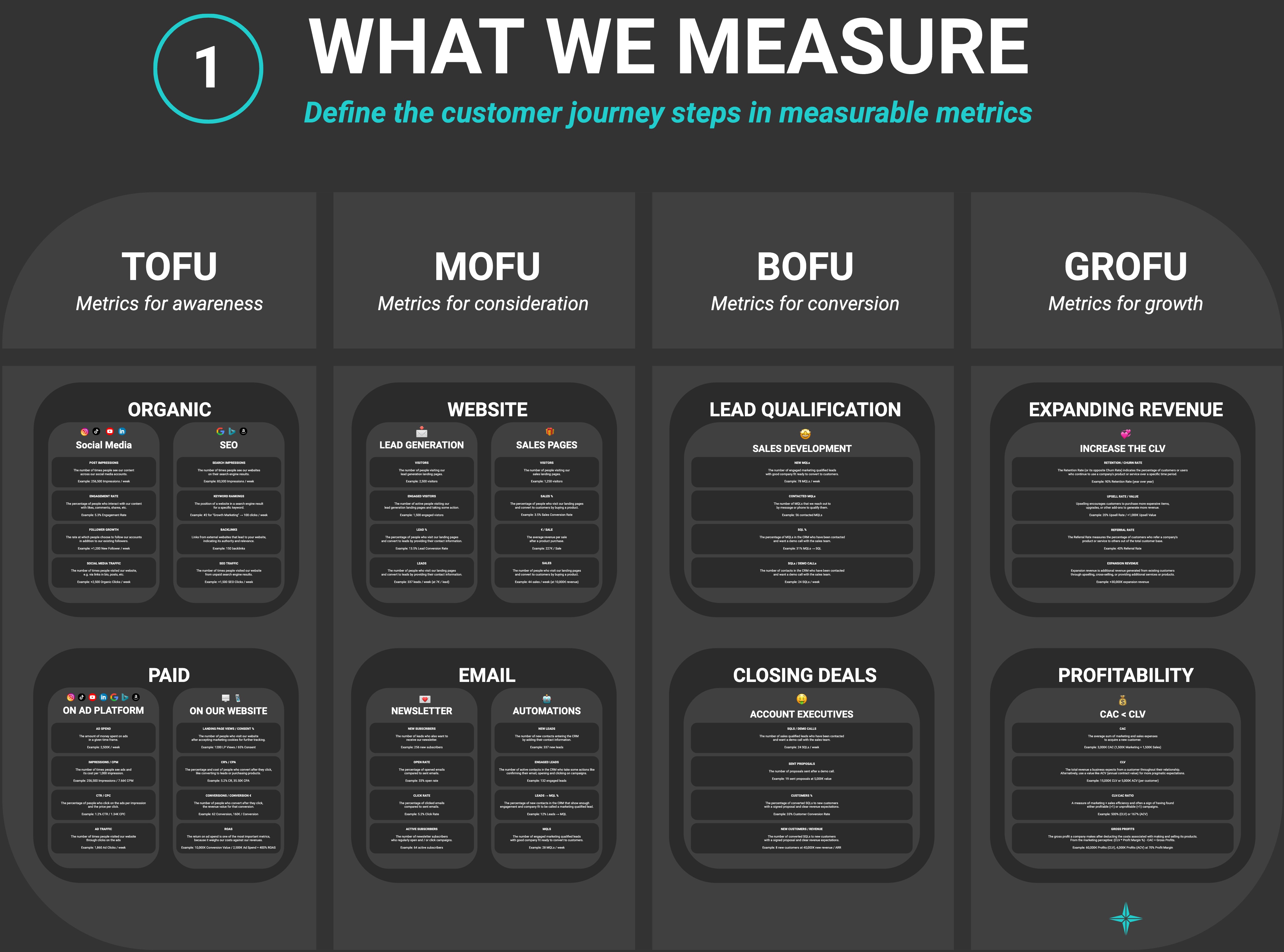
What You've Already Built
In the Funnel Building level, you created your complete customer journey–mapping how people move from first awareness to loyal customers. You have a funnel structure with clear stages: awareness (ToFu), consideration (MoFu), conversion (BoFu), and growth (GroFu). Now it's time to measure what's happening at each stage.
What You're Deciding Here
This lesson helps you make a critical strategic decision: Which metrics should you track at each stage of your funnel? Not all metrics are created equal. Some metrics look impressive but don't drive decisions. Others seem small but reveal exactly where to focus your efforts.
The goal is to identify actionable metrics–numbers that tell you something meaningful and help you make better decisions. A metric like "website visitors" is interesting, but "visitors who downloaded our lead magnet" is actionable because it connects directly to your funnel.
What Should You Focus On First?
Your starting point depends on your funnel structure and business model:
For Low-Touch Funnels (Self-serve, content-driven)
Focus on metrics that show content performance and self-service conversion: organic traffic, lead magnet downloads, email open rates, trial signups, and self-service purchases. These metrics reveal how well your content and automated systems are working.
For High-Touch Funnels (Sales-assisted, relationship-driven)
Focus on metrics that show lead quality and sales effectiveness: qualified leads generated, demo requests, call-to-close rates, average deal size, and sales cycle length. These metrics reveal how well your sales process converts interest into revenue.
For Multi-Tier Funnels (Both low-touch and high-touch)
Track metrics for each tier separately: self-serve conversion metrics for your low/mid tiers, and sales metrics for your high-tier/enterprise offers. This helps you optimize each path independently.
Your Decision
By the end of this lesson, you'll have defined specific, actionable metrics for each stage of your customer journey–metrics that connect directly to your funnel structure and help you make data-driven decisions.
2. ToFu (Awareness) - Metrics for top of funnel
The top of your funnel (ToFu) is where people first discover you. This stage is about attraction–getting the right people to notice you and take their first action. The metrics here should answer: "Are we attracting the right people, and are they engaging?"
Organic vs Paid ToFu Metrics
ToFu metrics fall into two categories: organic (free, content-driven) and paid (advertising-driven). You might be doing only organic, only paid, or both. Start with what you're actually using.
Organic ToFu Metrics (Content & SEO)
Social Media Metrics:
- Post impressions: Number of times people see your content across social platforms
- Engagement rate: Percentage of people who interact with your content (likes, comments, shares)
- Follower growth: Rate at which people choose to follow your accounts
- Social media traffic: Number of people visiting your website from social media links
SEO Metrics:
- Search impressions: Number of times people see your website in search engine results
- Keyword rankings: Position of your website in search results for specific keywords
- Backlinks: Links from external websites leading to your site (indicates authority)
- SEO traffic: Number of people visiting your website from unpaid search results
Paid ToFu Metrics (Advertising)
On Ad Platform:
- Ad spend: Amount of money spent on ads in a given time frame
- Impressions / CPM: Number of times people see ads and cost per 1,000 impressions
- CTR / CPC: Percentage of people who click on ads and price per click
- Ad traffic: Number of people visiting your website through ad clicks
On Your Website:
- Landing page views / Consent %: Number of people visiting your website after accepting marketing cookies
- CR% / CPA: Conversion rate and cost per acquisition (converting clicks to leads or purchases)
- Conversions / Conversion value: Number of conversions and revenue value per conversion
- ROAS: Return on ad spend (revenue generated vs ad costs)
What Makes a Good ToFu Metric
A good ToFu metric:
- Shows you're attracting the right audience (not just any traffic)
- Connects to your funnel (leads to next stage, not just vanity metrics)
- Is actionable (you can improve it with specific changes)
- Aligns with your strategy (measures what your content or ads are designed to do)
Outcome: You have defined specific, actionable metrics for your awareness stage that connect to your funnel structure.
3. MoFu (Consideration) - Metrics for middle of funnel
The middle of your funnel (MoFu) is where people are considering whether you're the right solution. This stage is about nurture–building trust, demonstrating value, and guiding people toward a decision. The metrics here should answer: "Are we building trust and moving people closer to a purchase?"
Website and Email MoFu Metrics
MoFu metrics track how people engage with your website and email communications. You might have lead generation pages, sales pages, newsletters, email automations, or some combination. Focus on what you're actually using.
Website Metrics (Lead Generation & Sales Pages)
Lead Generation Pages:
- Visitors: Number of people visiting your lead generation landing pages
- Engaged visitors: Number of active people visiting and taking some action
- Lead %: Percentage of visitors who convert to leads by providing contact information
- Leads: Number of people who convert to leads (with cost per lead)
Sales Pages:
- Visitors: Number of people visiting your sales landing pages
- Sales %: Percentage of visitors who convert to customers by buying a product
- € / Sale: Average revenue per sale after a product purchase
- Sales: Number of people who convert to customers (with total revenue)
Email Metrics (Newsletter & Automations)
Newsletter:
- New subscribers: Number of leads who also want to receive your newsletter
- Open rate: Percentage of opened emails compared to sent emails
- Click rate: Percentage of clicked emails compared to sent emails
- Active subscribers: Number of newsletter subscribers who regularly open and/or click campaigns
Email Automations:
- New leads: Number of new contacts entering your CRM by adding contact information
- Engaged leads: Number of active contacts in CRM who take actions (confirm email, open, click)
- Leads → MQL %: Percentage of new contacts that show enough engagement and company fit to be marketing qualified leads
- MQLs: Number of engaged marketing qualified leads with good company fit ready to convert
What Makes a Good MoFu Metric
A good MoFu metric:
- Shows engagement quality (not just clicks, but meaningful interaction)
- Indicates purchase intent (people moving toward a decision)
- Reveals where people get stuck (bottlenecks in consideration)
- Connects to conversion (predicts who will become customers)
Outcome: You have defined specific, actionable metrics for your consideration stage that reveal engagement quality and purchase intent.
4. BoFu (Conversion) - Metrics for bottom of funnel
The bottom of your funnel (BoFu) is where people become customers. This stage is about conversion–turning interested leads into paying customers. The metrics here should answer: "Are we converting leads effectively, and what's our conversion rate?"
Self-Serve vs Sales-Assisted BoFu Metrics
BoFu metrics differ depending on your funnel approach. Self-serve funnels track website conversions and trial-to-paid rates. Sales-assisted funnels track the sales process from qualification to closing. You might have one or both–focus on what you're actually using.
Self-Serve BoFu Metrics (Low-Touch Funnels)
Website Conversion:
- Conversion rate: Percentage of visitors who become customers
- Trial-to-paid conversion: For SaaS, percentage of trials that become subscriptions
- Lead-to-customer rate: Overall conversion from qualified lead to customer
- Time to convert: How long it takes from first contact to purchase
Revenue Metrics:
- Average order value: How much each customer spends
- Customer acquisition cost (CAC): How much it costs to acquire each customer
- Lifetime value (LTV): Total revenue from a customer over their lifetime
- LTV:CAC ratio: Health indicator (should be 3:1 or higher)
Sales-Assisted BoFu Metrics (High-Touch Funnels)
Lead Qualification (Sales Development):
- New MQLs: Number of engaged marketing qualified leads with good company fit ready to convert
- Contacted MQLs: Number of MQLs that you reach out to by message or phone to qualify them
- SQL %: Percentage of MQLs who have been contacted and want a demo call with the sales team
- SQLs / Demo calls: Number of contacts who have been contacted and want a demo call
Closing Deals (Account Executives):
- SQLs / Demo calls: Number of sales qualified leads who want a demo call
- Sent proposals: Number of proposals sent after a demo call (with proposal value)
- Customers %: Percentage of converted SQLs to new customers with signed proposal and clear revenue expectations
- New customers / Revenue: Number of converted SQLs to new customers (with total revenue/ARR)
What Makes a Good BoFu Metric
A good BoFu metric:
- Shows conversion effectiveness (not just volume, but rate)
- Connects to revenue (measures actual business impact)
- Reveals profitability (CAC, LTV, ratios)
- Identifies bottlenecks (where conversions drop off)
Outcome: You have defined specific, actionable metrics for your conversion stage that reveal conversion effectiveness and profitability.
5. GroFu (Growth) - Metrics for growth funnel
The growth funnel (GroFu) is where customers become advocates and generate more value. This stage is about expansion–increasing customer value through upsells, referrals, and retention. The metrics here should answer: "Are we growing customer value and turning customers into advocates?"
Expanding Revenue and Profitability Metrics
GroFu metrics focus on two key areas: expanding revenue from existing customers and profitability of your customer acquisition. These metrics show whether your business is sustainable and growing.
Expanding Revenue (Increase the CLV)
Retention Metrics:
- Retention / Churn rate: Percentage of customers who continue using your product or service over a specific time period (retention rate) or percentage who cancel (churn rate)
- Upsell rate / Value: Percentage of customers who purchase upgrades or add-ons, and the additional revenue generated from upselling
- Referral rate: Percentage of customers who refer your product or service to others out of your total customer base
- Expansion revenue: Additional revenue generated from existing customers through upselling, cross-selling, or providing additional services/products
Profitability (CAC < CLV)
Customer Economics:
- CAC (Customer Acquisition Cost): Average sum of marketing and sales expenses to acquire a new customer
- CLV (Customer Lifetime Value): Total revenue a business expects from a customer throughout their relationship (or use ACV - Annual Contract Value for more pragmatic expectations)
- CLV:CAC Ratio: Measure of marketing + sales efficiency (should be >1 for profitability, often 3:1 or higher is healthy)
- Gross profits: Gross profit after deducting costs associated with making and selling products (from marketing perspective: (CLV × Profit Margin %) - CAC = Gross Profits)
What Makes a Good GroFu Metric
A good GroFu metric:
- Shows customer health (retention, satisfaction, engagement)
- Measures expansion success (upsells, referrals, growth)
- Reveals profitability (CAC, CLV, ratios)
- Connects to long-term value (LTV, retention, expansion revenue)
Outcome: You have defined specific, actionable metrics for your growth stage that reveal customer health, expansion success, and advocacy.
6. Your Metrics Overview
Creating Your Metrics Overview
Throughout this lesson, you've defined metrics for each stage of your customer journey: ToFu awareness metrics, MoFu consideration metrics, BoFu conversion metrics, and GroFu growth metrics. Now it's time to create a single overview document that shows all your metrics and how they connect.
The Goal: Complete Overview of All Your Customer Journey Metrics
This metrics overview will serve as your foundation for:
- Setting up tracking systems (Lesson 3: How we Measure)
- Creating reports (Lesson 4: How we Report)
- Identifying improvements (Lesson 5: What to Improve)
- Making data-driven decisions across your entire funnel
Having all your metrics in one place means you can quickly reference what to track, why it matters, and how to interpret the numbers–without searching through multiple conversations or documents.
Defining Your North Star Metric
Among all the metrics you've defined, one stands above the rest: your North Star Metric. This is the one most important metric to focus on right now–the metric that is clearly aligned with your growth strategy but concrete enough to be the center of focus for your activities.
What Makes a Good North Star Metric
A good North Star Metric:
- Leading: Moves before revenue (predicts future success)
- Actionable: You can influence it with your activities
- Aligned: Connects directly to your business goals and growth strategy
- Measurable: You can track it consistently
- Focused: One clear number, not multiple metrics
Common North Star Metrics:
- SaaS: Monthly Recurring Revenue (MRR), Active Users, Product-Market Fit Score
- E-commerce: Customer Lifetime Value (LTV), Repeat Purchase Rate, Average Order Value
- Content/Media: Engaged Users, Content Consumption, Subscriber Growth
- Marketplace: Marketplace GMV, Supply-Demand Balance, Transaction Frequency
Why It Matters
Your North Star Metric helps you:
- Prioritize: Focus on changes that move this number
- Measure progress: Track this metric weekly/monthly to see if you're improving
- Align team: Everyone works toward the same goal
- Make decisions: If it doesn't move the North Star, it's lower priority
You'll use your North Star Metric in Lesson 5 (What to Improve) to identify bottlenecks and prioritize improvements.
Outcome: You have a complete metrics overview that shows all your customer journey metrics and your North Star Metric.