
Ad Testing
Increasing the conversion rate of our ads
1. Goal - Optimize ad conversions
What You've Already Built
In the Traffic Generation level, you designed ad creatives and campaign structures. In the Email Testing lesson, you learned to optimize email performance. Now it's time to close the loop with ad testing–systematically improving how your ads capture attention, drive clicks, and convert.
What You're Deciding Here
This lesson helps you answer: How do I systematically improve ad performance while controlling costs?
Ad optimization is unique because you're often paying per impression or click. Every improvement in conversion rate directly impacts your cost per acquisition. The stakes are high, but so are the rewards.
You'll optimize across three dimensions:
- Visual Design: Images, videos, layouts that capture attention
- Copy & Messaging: Headlines, descriptions, and CTAs that drive action
- Channel & Placement: Where and how ads appear for maximum impact
What Should You Focus On First?
Your starting point depends on your current situation:
If You're Just Starting with Ads
Focus on creative fundamentals. Get your message and visuals right before optimizing for efficiency. A poorly conceived ad won't improve much with testing.
If You Have Running Campaigns
Identify your best performers and understand why they work. Then test variations to find even better combinations. Don't spread tests too thin.
If You're Spending Significantly
Small improvements have big dollar impact. Systematic testing should be continuous. Build a creative testing pipeline that feeds your campaigns.
Your Decision
By the end of this lesson, you'll understand your ad performance strengths and gaps, plus have specific experiments designed to improve results while reducing costs.
Outcome: You have an audit of your ad performance with prioritized improvements.
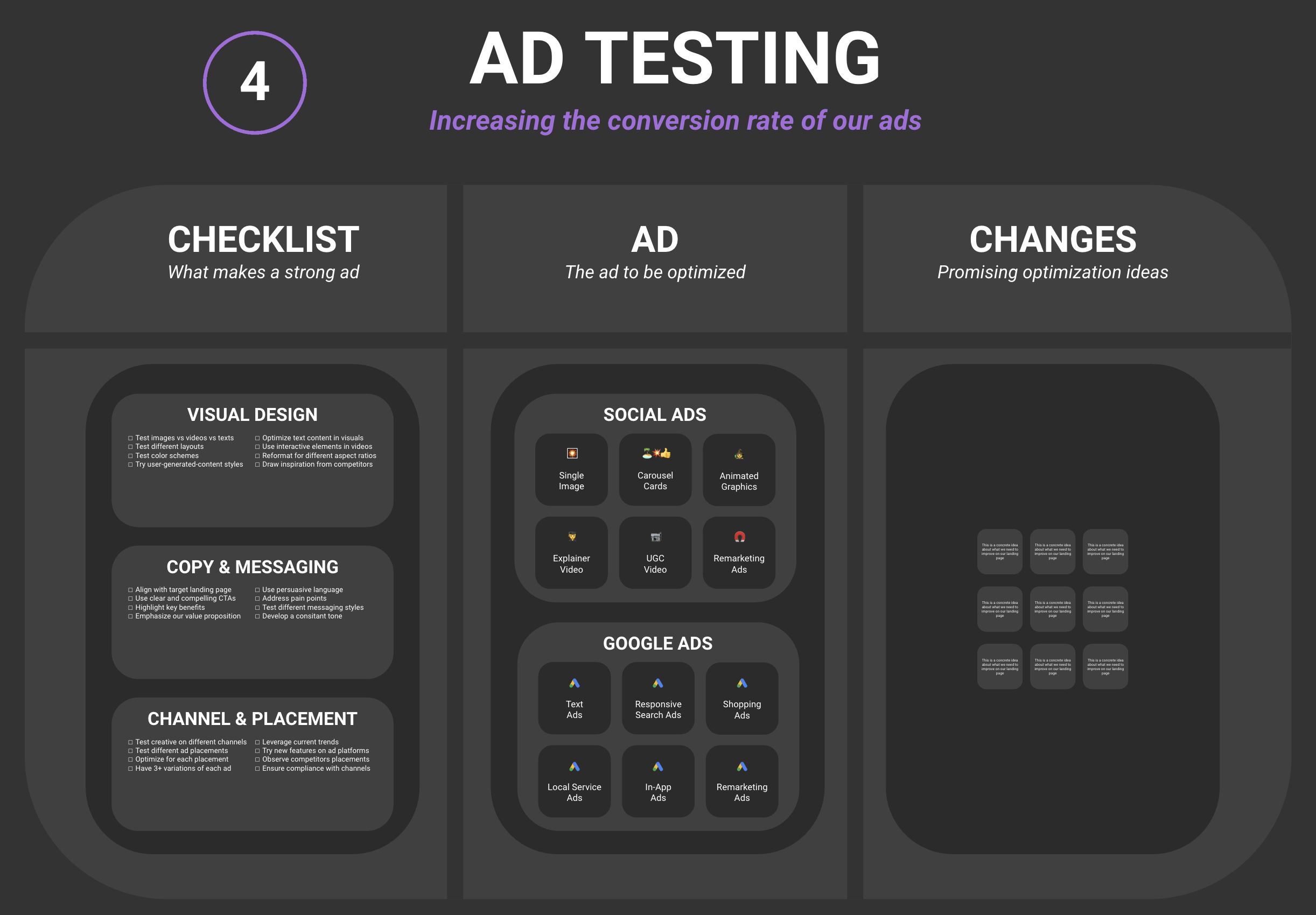
2. Ad Checklist - What makes a strong ad
Before running advanced experiments, ensure your ads meet baseline standards. High-performing ads nail the fundamentals across three areas.
Visual Design
Visuals must stop the scroll and capture attention in milliseconds.
- Thumb-stopping: Does it interrupt the feed?
- Clear focal point: Is there one thing to look at?
- Brand consistency: Is it recognizably yours?
- Format variety: Testing images, videos, carousels?
- Native feel: Does it fit the platform's aesthetic?
- High quality: Professional but not overly polished (UGC often wins)
Copy & Messaging
Words must communicate value and compel action.
- Headline impact: Does it capture attention and interest?
- Clear value proposition: What's in it for them?
- Benefit-focused: Outcomes over features
- Aligned with landing page: Message match from ad to page
- Strong CTA: Clear, specific, action-oriented
- Appropriate length: Platform-appropriate copy length
Channel & Placement
Context matters–the same ad performs differently in different places.
- Platform optimization: Creative tailored to each platform
- Placement testing: Feed vs. stories vs. reels vs. search
- Audience alignment: Message matches the audience
- Timing optimization: Running when audience is active
- Mobile-first: Most traffic is mobile
- Competitor awareness: Differentiated from what else they're seeing
Outcome: You have a checklist assessment with prioritized fixes for your ads.
3. Ad Optimization - Systematic improvement
With your audit complete and checklist gaps identified, it's time to design specific ad experiments. Ad testing requires discipline–you're spending money on every impression, so tests must be structured to learn quickly.
The Ad Testing Mindset
Ad testing differs from website or email testing because of cost. Every ad impression costs money, so you need to:
- Test meaningful differences, not tiny tweaks
- Kill losers fast
- Scale winners quickly
- Always have fresh creative in development
High-Impact Test Areas
Based on typical results, these areas often yield the biggest improvements:
Creative Format
Format can dramatically affect performance. Test:
- Static image vs. video
- Single image vs. carousel
- Short video vs. long video
- UGC-style vs. polished
Visual Elements
What you show affects attention. Test:
- People vs. product vs. illustration
- Face-forward vs. scene
- Text overlay vs. clean
- Color schemes and contrasts
Headlines and Hooks
First words determine engagement. Test:
- Question vs. statement
- Problem-focused vs. solution-focused
- Curiosity vs. direct benefit
- Specificity level
Offers and CTAs
What you're asking affects conversion. Test:
- Different offers (guide, trial, demo, discount)
- CTA button text
- Urgency elements
- Risk reducers
Audiences and Placements
Context affects performance. Test:
- Audience segments
- Placement types (feed, stories, search)
- Device targeting
- Time-of-day optimization
Outcome: You have specific ad experiments ready to run.
4. Your Ad Testing Library
Creating Your Ad Testing Document
Throughout this lesson, you've audited your ad performance, run the checklist, and designed experiments. Now it's time to consolidate everything into a single reference document for ongoing ad optimization.
The Goal: An Ad Optimization System
This Ad Testing document will serve as your:
- Reference for ad standards and best practices
- Record of performance audits
- Experiment tracker for ad tests
- Creative library of what works
Having your ad optimization documented means you build institutional knowledge about what resonates with your audience and reduces costs.
Outcome: You have a complete Ad Testing document that captures your ad optimization system.