
Summary
Fix your leaks
1. From Guesswork to Systematic Optimization
You started this level with hopes and hunches about what might improve conversions. You end it with a complete optimization system: a structured experiment pipeline, systematic approaches to testing websites, emails, and ads, and a practice of compounding learnings over time.
The Transformation
-
Before: "I think this page could convert better"
After: "Our headline test increased conversions by 23%–here's why, and here's what we're testing next" -
Before: "Let's try a different subject line"
After: "Subject lines with specific numbers outperform curiosity hooks by 15% for our audience" -
Before: "This ad isn't working, let's make a new one"
After: "Ad A has a €28 CPA vs. €45 for Ad B–we're scaling A and testing a variation" -
Before: Scattered changes with no tracking
After: Documented experiments, learnings, and a prioritized backlog of what to test next
The Foundation You Built
Throughout this level, you've created four essential documents that form your complete conversion optimization system:
- [Business Name] - Next Experiments.md: Your experiment pipeline–ideas backlog, active experiments, learnings log
- [Business Name] - Website Testing.md: Landing page audits, checklist results, website experiments
- [Business Name] - Email Testing.md: Email performance audits, checklist results, email experiments
- [Business Name] - Ad Testing.md: Ad performance audits, checklist results, ad experiments
These documents work together to create a systematic approach to continuous improvement.
2. The Complete Conversion Optimization System
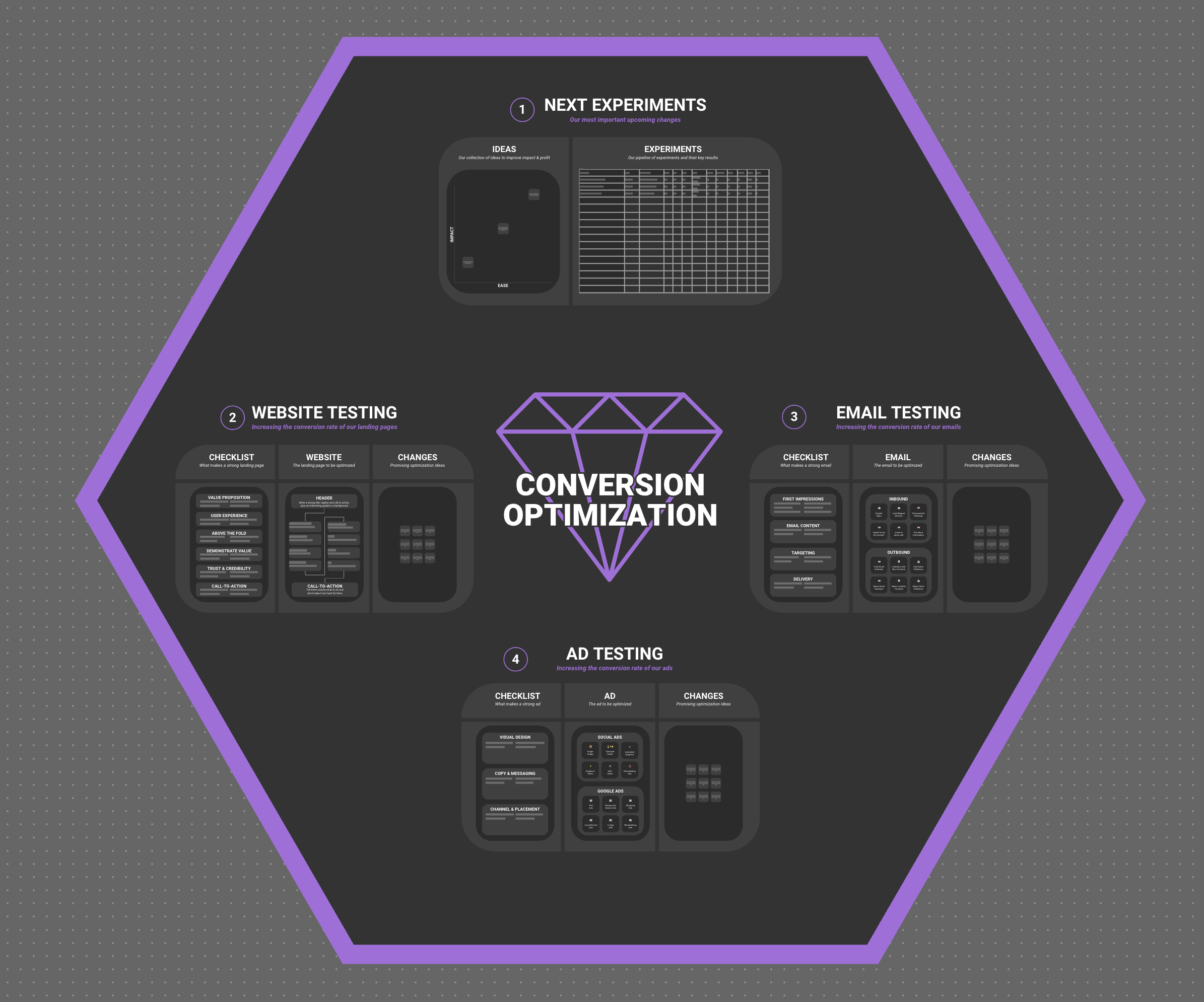
Your conversion optimization system has four components that work together:
How we Prioritize → Build and maintain your experiment pipeline
In Lesson 2, you built a system for generating improvement ideas, scoring them by impact and ease, and tracking experiments through completion. Your Next Experiments document captures all your ideas and learnings.
How we Test Websites → Systematically improve landing pages
In Lesson 3, you audited your landing pages, ran the conversion checklist, and designed specific experiments. Your Website Testing document captures your approach to optimizing web conversions.
How we Test Emails → Systematically improve email performance
In Lesson 4, you audited your email performance, ran the email checklist, and designed specific experiments. Your Email Testing document captures your approach to optimizing email conversions.
How we Test Ads → Systematically improve ad performance
In Lesson 5, you audited your ad performance, ran the ad checklist, and designed specific experiments. Your Ad Testing document captures your approach to optimizing ad conversions.
How They Work Together
Each component builds on the previous one:
- Next Experiments provides the prioritization framework for all testing
- Website Testing optimizes where traffic converts
- Email Testing optimizes how you nurture and convert leads
- Ad Testing optimizes how you acquire traffic efficiently
The Continuous Cycle
Conversion optimization isn't a one-time project–it's an ongoing practice:
- Generate ideas from data, feedback, and research
- Prioritize by impact, ease, and confidence
- Test with clear hypotheses and success criteria
- Learn from results, whether they win or lose
- Document learnings so knowledge compounds
- Repeat the cycle to continuously improve
This cycle ensures you're always getting better, always learning, always improving your conversion rates.
3. What You've Accomplished
Lesson 1: Overview
You learned what conversion optimization is and why it matters. You understood the four components: experiments, websites, emails, and ads. You set up a new Claude chat with your conversion baseline context.
Lesson 2: Next Experiments
You built your experiment pipeline with an ideas backlog and tracking system. You created your [Business Name] - Next Experiments.md document that captures your prioritization approach and learnings.
Lesson 3: Website Testing
You audited your landing pages and ran the conversion checklist. You created your [Business Name] - Website Testing.md document that captures your website optimization approach.
Lesson 4: Email Testing
You audited your email performance and ran the email checklist. You created your [Business Name] - Email Testing.md document that captures your email optimization approach.
Lesson 5: Ad Testing
You audited your ad performance and ran the ad checklist. You created your [Business Name] - Ad Testing.md document that captures your ad optimization approach.
The Complete System
Together, these four documents create a complete conversion optimization system:
- Next Experiments tells you what to test and how to prioritize
- Website Testing tells you how to optimize your landing pages
- Email Testing tells you how to optimize your emails
- Ad Testing tells you how to optimize your ads
All working together to systematically improve how your funnel converts.
4. Best Practices for Sustaining Conversion Performance
Always Be Testing
The moment you stop testing, you stop improving. Run at least one experiment per week. No experiment is too small if it teaches you something.
Document Everything
Every test, whether it wins or loses, teaches something. Document hypotheses before you see results. Record learnings systematically. This knowledge compounds over time.
Start with High-Impact Areas
Don't spread tests thin. Focus on your highest-traffic pages, most-sent emails, and biggest-spend campaigns. Small improvements on high-volume touchpoints yield the biggest results.
Test Bold Hypotheses
Incremental tweaks yield incremental results. Occasionally test something bold–a completely different approach, a new positioning, a radical redesign. The biggest wins often come from rethinking fundamentals.
Kill Losers Fast
Don't let losing experiments drain resources. Set clear kill criteria before you start. When something's clearly not working, stop it and move on.
Scale Winners Quickly
When you find something that works, implement it broadly. A winning headline should replace losing headlines everywhere. A winning ad structure should inform all new creative.
Connect to Business Metrics
Conversion rate improvements are means, not ends. Always connect to business outcomes–more leads, more customers, more revenue. A 10% conversion lift that doesn't affect revenue isn't really a win.
5. Your Complete Conversion Optimization Master Document
Creating Your Master Conversion Optimization Document
Throughout this level, you've created four essential documents that form your complete conversion optimization system. Now it's time to consolidate everything into a single master document that you can reference in the future–a document that contains all the important information an AI assistant might need to help you with your optimization strategy.
The Goal: Single Master Document for All Conversion Optimization Knowledge
This master document will serve as your complete reference for:
- Your complete conversion optimization system
- All experiments, checklists, and learnings
- How everything works together to improve conversions
- Future AI assistants understanding your optimization setup
Having all your optimization knowledge in one place means you can quickly reference your system, onboard new team members, and ensure AI assistants have complete context when helping you optimize.
Outcome: You have a complete Conversion Optimization master document that consolidates all your optimization knowledge into one reference document for future use.
🎉 Congratulations! You've completed the Conversion Optimization topic. You now have a systematic approach to continuously improving how your funnel converts–from landing pages to emails to ads.
🏴☠️ You've completed the entire Growth Codex! From understanding your market and customers, to building your strategy, crafting your message, generating traffic, and optimizing conversions–you now have the complete growth system. You're no longer guessing. You're building with intention, testing with rigor, and scaling with confidence. Fair winds and following seas, Captain.