
You don't need a better idea, you need one you will commit to
For founders stuck in ideation mode. By Sunday, you'll have committed to one idea and validated your first assumption.
What's stopping you the most from committing to one idea?
You Don't Have to Quit to Start
You've been in your job for over six months. Maybe longer. You have an idea – something you know could work. But your boss doesn't get it. You keep getting blocked by other people, other priorities, other politics.
And you stay. Because you think the only alternative is to drop everything and lose the safety of your paycheck.
That's the trap. It's a false choice.
The real problem isn't your job. It's not your boss. It's not the lack of a "perfect idea." The real problem is that you're stuck between knowing it's possible and believing you can do it yourself.
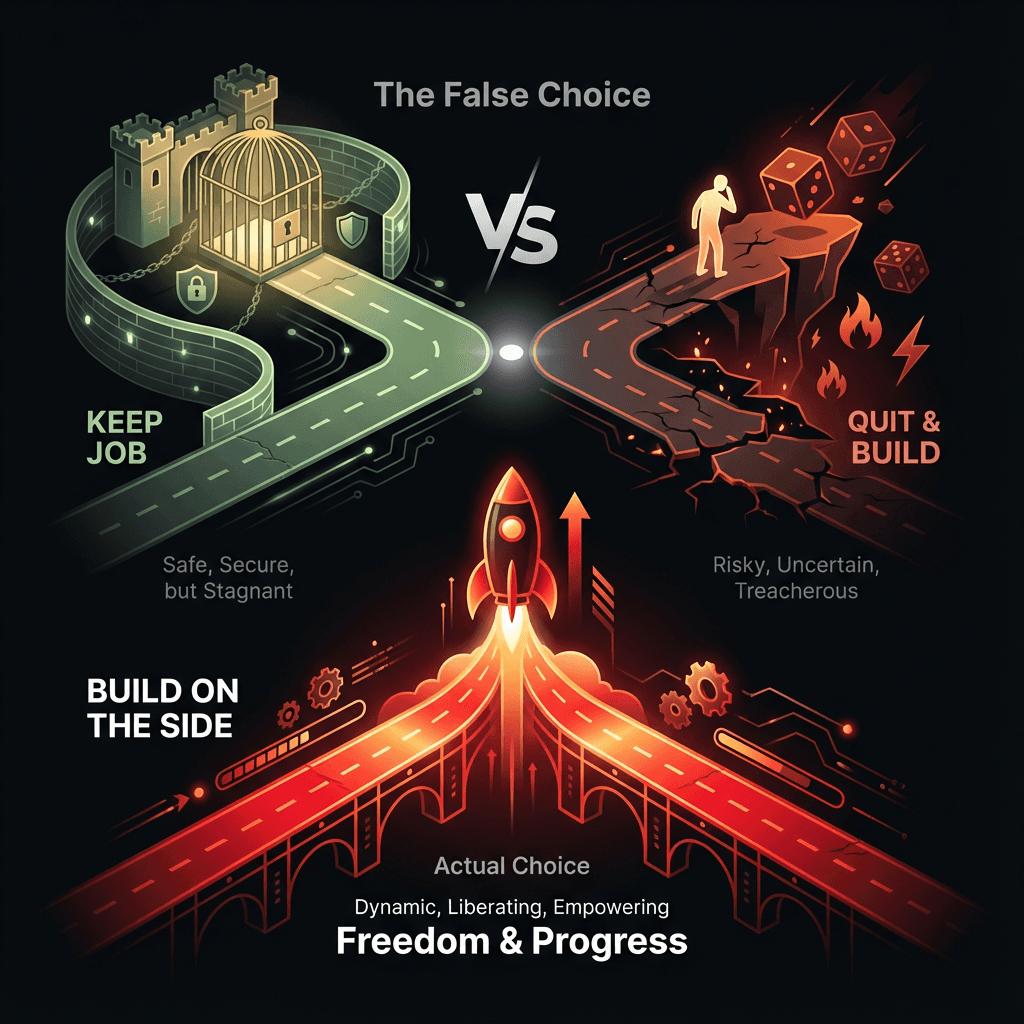
You could start talking about what you want to build online today. You could vibe code a first version this weekend – without making money, without needing to register a company, without getting in trouble with your employer.
Independence doesn't start with quitting. It starts with ownership. Picking one idea you're willing to stand behind and work on consistently – even if it's just a few hours a week.
You don't have to quit to start. You have to commit.
How I messed this up:
"I didn't have a job trap. I had the consulting trap. Getting paid hundreds per hour creates a different kind of paralysis: sell my time now and earn money now, or build something sustainable that could pay off later? I delayed this decision for five years. My main issue wasn't finding the right idea – I had plenty. It was that I didn't feel ready. I was the marketing professional, not the developer. I thought I needed permission or perfect certainty before I could start. Vibe coding changed everything."
Treat It as a Skill, Not a Life Decision
"But what if I commit to the wrong idea and waste months?"
I'd encourage you to waste a month. Seriously.
Don't treat building a product as this life-changing, all-or-nothing moment. That's what keeps you stuck. The mindset of "I need more preparation" or "I need perfect certainty" is the same mindset that keeps capable people circling options instead of making progress.
Commitment isn't gambling. It's treating decisions as small, reversible bets instead of irreversible leaps. You're not betting your career on one idea – you're developing the ability to build, test, and decide based on evidence.
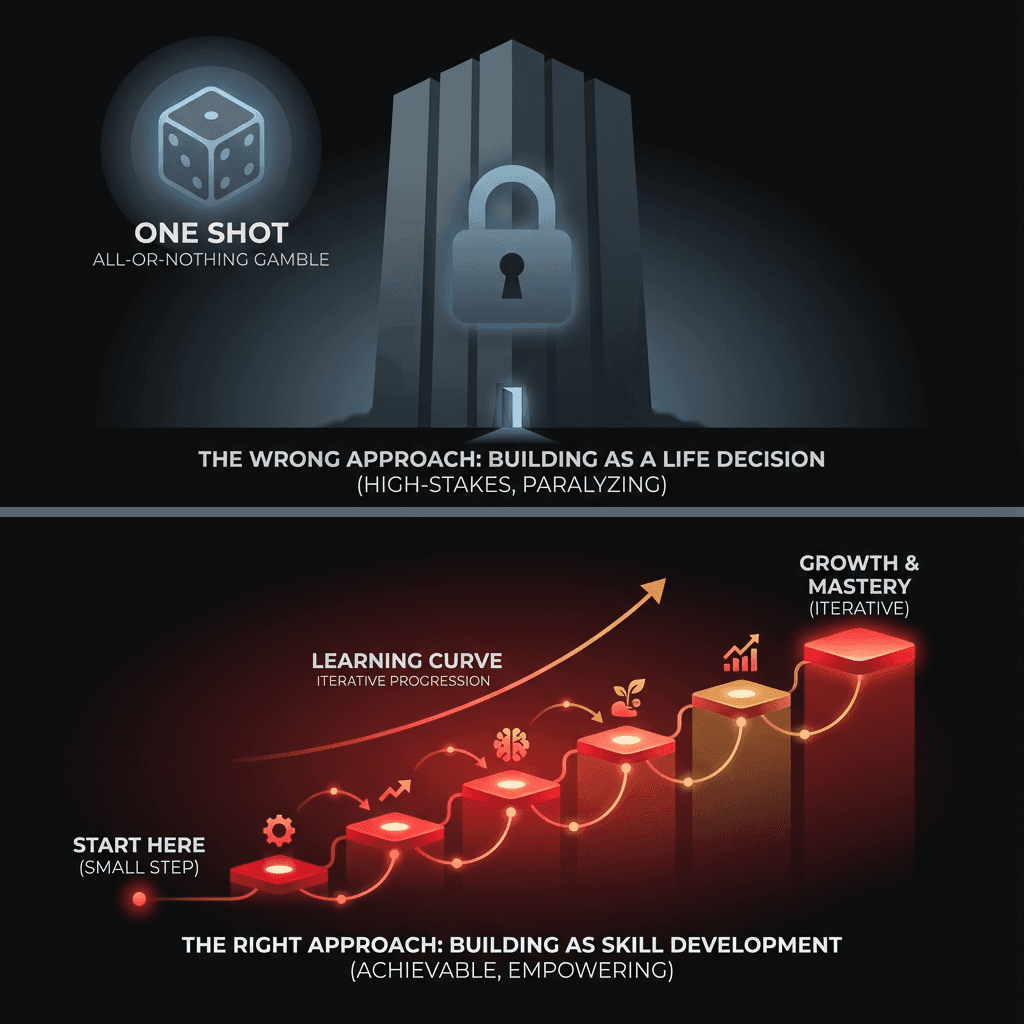
It's unrealistic to hit a home run on your first idea. Treat this as a skill you're developing – one with huge mid- and long-term upsides. Success isn't about finding the perfect idea. Success is evidence of capability: shipping publicly, seeing users activate, receiving your first payment, observing real product-market fit signals.
That's where confidence replaces anxiety. Not from reading more books, not from taking more courses, but from building something real and letting reality tell you what to do next. It's your job to commit to an idea and give it a real chance. It's the idea's job to prove itself through market response.
What changed for me:
"Learning to vibe code took time. But once it clicked, it changed my identity. I went from 'I need permission or perfect certainty' to 'I can validate this step by step.' I stopped being just the marketing professional. I could build AND grow. I could repeat the entire loop. That shift gave me the confidence that I could build products for real – not just market other people's products. Complete freedom. Time-independent income. A sustainable path. The tools exist now. The identity ceiling is gone."
Commit Small, Learn Fast
Commitment doesn't mean disappearing for three months and emerging with a "finished" product. That's the old playbook – and it's a recipe for building something nobody wants.
Real commitment looks different: ship something small every week. A landing page. A working prototype. A feature that solves one problem for one person. Then watch what happens. Do people sign up? Do they come back? Do they pay?
These signals – activation, retention, revenue – are what tell you whether to keep going, pivot, or move on. Not your gut feeling. Not your friend's opinion. Not a business plan you wrote six months ago. Real evidence from real users.
This is the Build-Grow-Repeat loop: you build, you ship, you observe signals, you decide what to do next. Then you repeat. Each cycle gets faster. Each decision gets clearer. Each version gets closer to something people actually want.
The founders who make it aren't the ones with the best first idea. They're the ones who commit to the process – who show up week after week, ship something real, and let reality shape what they build next. Commitment isn't stubbornness. It's showing up consistently and letting evidence guide your decisions.
What this looks like in practice:
"When I built CaptAIn, I didn't wait until it was perfect. I shipped a rough version after four weeks – I was slow back then. Users told me what was missing. I fixed the obvious things, added what they asked for, and ignored my own assumptions. Within three months, I had paying customers – not because the first version was good, but because I kept showing up and responding to real feedback."
Your 7-Day Commitment Plan
A 7-Day Ship Plan breaks down this insight into daily steps you can actually complete. This week, you'll commit to one idea and get your first signal from the market – without quitting anything.
It's interactive and free to use for anyone signed in. Each step includes copy & pasteable prompts you can use with your favorite AI chat app – ChatGPT, Claude, Gemini, or our own CaptAIn. Just copy the prompt, paste it into your chat, and customize it with your specific details.
Ready to turn this insight into action? Unlock the plan below and start your 7-day commitment today.
Cheers,
Ben
Ready to Go Deeper?
Don't miss the next Insight
Join the crew and get fresh perspectives delivered weekly.
Free account. No spam. Unsubscribe anytime.
Questions & Answers
But what if I commit to the wrong idea and waste months?
I can't quit my job to do this. What do I do?
What if I genuinely can't decide between ideas?
How do I know if an idea is 'good enough' to commit to?
What if people don't respond to my outreach?
Should I tell people about my idea?
What if the conversations reveal my idea is bad?
Stuck in a job where my boss doesn't get it. What should I do?
I'm non-technical. Can I really build a product?
What counts as 'going public' on Day 3?

Founder from Cologne with 15 years of startup experience across 9 ventures. After helping thousands master growth marketing, Ben learned vibe coding from scratch and launched CaptAIn within three months. He leads the Vibe Coding Cologne community, blending real founder experience with teaching clarity.