
Who is doing what
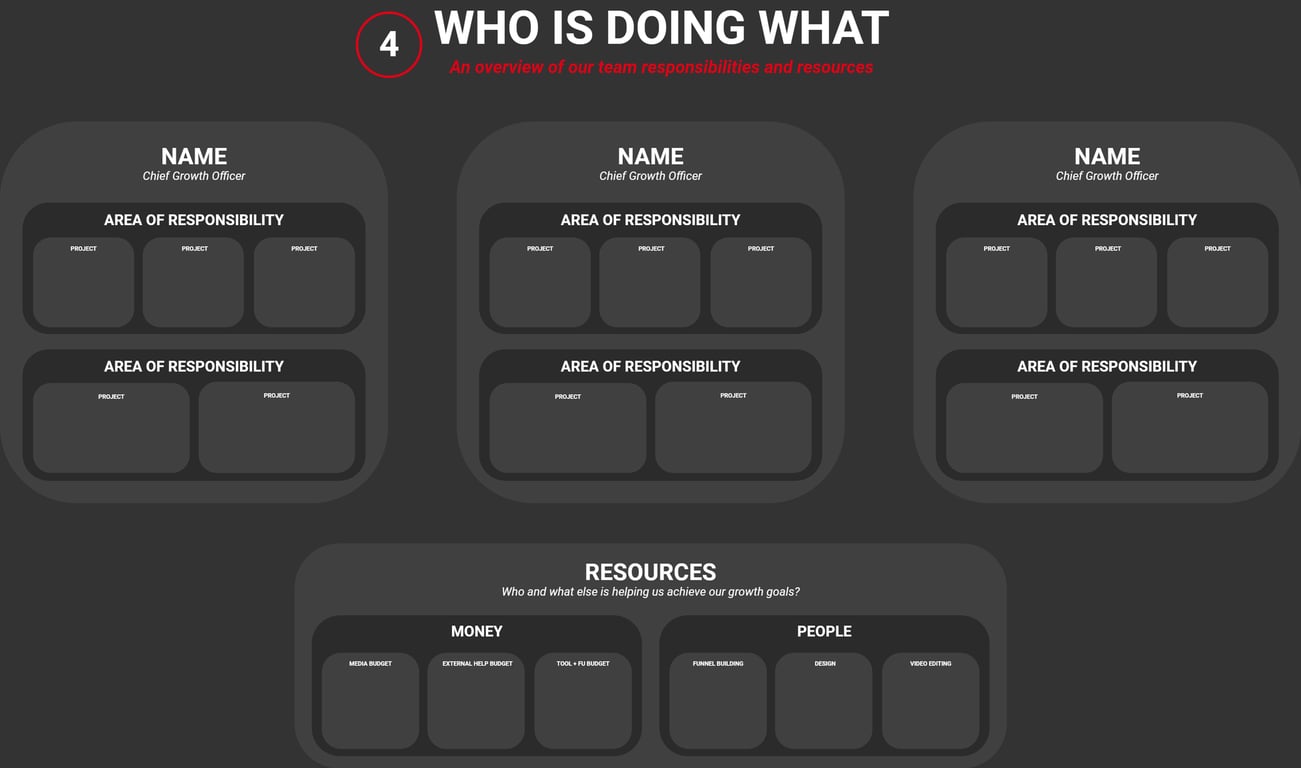
Overview of our team responsibilities and resources
GOAL
Ensure everyone knows their role, has the resources they need, and works in focused sprints to execute the growth roadmap and achieve our key results.
OBJECTIVES
Areas of Responsibility and Projects
Designate captains for each metric, task, and project. Clear ownership ensures accountability and prevents things from falling through the cracks.
Resources - Money and Other People
Allocate budgets and identify when you need external help. Your dashboard isn't just for show; it's your playbook. Stick to it.
Working in Growth Sprints
Organize work into focused sprints that allow for rapid testing, iteration, and implementation. Keep your eyes on the prize: your North Star Metric.
4.1 Areas of responsibility and projects
Everyone on this ship has a role to play. Designate captains for each metric, task, and project, so we know who needs to walk the plank if things go sideways (just kidding, but accountability is key).
Assigning Ownership
Each project needs a clear owner–someone who is accountable for its success. This doesn't mean they do all the work, but they're responsible for ensuring it gets done.
Ownership Principles
- One owner per project - Avoid shared ownership; it dilutes accountability
- Match skills to projects - Assign projects to people with the right expertise
- Clear expectations - Define what success looks like for each project
- Regular check-ins - Schedule regular updates to track progress
Project Ownership Matrix
Create a simple matrix showing:
- Project name
- Owner
- Key result it supports
- Status
- Next milestone
For every project in your growth roadmap, assign one person who is accountable for its success. Avoid shared ownership.
Document who owns what. Create a simple matrix or dashboard showing project, owner, status, and key result.
For each project, clearly define what success looks like. What metrics will indicate the project is successful?
4.2 Resources - money and other people
Allocate budgets, get external help when needed, but always keep your eyes on the prize: our North Star Metric. Your dashboard isn't just for show; it's your playbook. Stick to it.
Budget Allocation
Each project needs resources. Allocate budgets based on:
- Project priority (high-impact projects get more resources)
- Potential ROI (projects with higher returns justify larger budgets)
- Available resources (work within your constraints)
When to Get External Help
Sometimes you need expertise or capacity you don't have in-house. Consider external help for:
- Specialized skills (e.g., design, development, copywriting)
- One-time projects (e.g., website redesign, campaign setup)
- Capacity constraints (when your team is at full capacity)
Resource Planning
Create a resource plan that shows:
- Budget allocation per project
- Time allocation per team member
- External resources needed
- Timeline for resource deployment
Determine how much budget each project needs. Prioritize high-impact projects, but ensure all projects have adequate resources.
Review each project and identify where you need external expertise or capacity. Plan for these resources upfront.
Document your resource plan: budgets, time allocations, external resources, and timelines. Make it visible to the team.
4.3 Working in growth sprints
Organize work into focused sprints that allow for rapid testing, iteration, and implementation. This keeps you agile while maintaining focus on your North Star Metric.
What are Growth Sprints?
Growth sprints are short, focused periods (typically 1-2 weeks) during which your team works on specific growth projects. They allow for:
- Rapid testing and iteration
- Quick wins and momentum
- Focused execution
- Regular progress reviews
Sprint Structure
Each sprint should have:
- Sprint goal - What are we trying to achieve this sprint?
- Projects - Which projects are we working on?
- Success metrics - How will we measure success?
- Sprint review - What did we learn? What's next?
Sprint Planning
At the start of each sprint:
- Review previous sprint results
- Select projects for this sprint (based on priority)
- Assign owners and resources
- Set sprint goals and metrics
- Plan daily check-ins
Sprint Execution
During the sprint:
- Daily standups (quick status updates)
- Focus on sprint goals (avoid scope creep)
- Track metrics daily
- Document learnings
Sprint Review
At the end of each sprint:
- Review results against goals
- Share learnings with the team
- Update your roadmap based on results
- Plan the next sprint
Set up your first 1-2 week sprint. Select 2-3 high-priority projects, assign owners, and define sprint goals.
Set up daily standups, sprint planning, and sprint review meetings. Make these regular rituals.
Run your first sprint, track progress daily, and conduct a sprint review. Learn from the experience and iterate.
Summary
You've now set up accountability and execution:
- Assigned ownership - Every project has a clear owner who is accountable
- Allocated resources - Budgets and external help are planned and allocated
- Organized into sprints - Work is structured into focused, iterative sprints
You now have a complete growth roadmap:
- Where you are - Current situation analysis (Lesson 1)
- Where you're going - Challenging growth goals (Lesson 2)
- How you'll get there - Actionable projects (Lesson 3)
- Who does what - Ownership and execution (Lesson 4)
Working with Your Growth Roadmap
Your dashboard isn't just for show; it's your playbook. Stick to it. Review it weekly, update it monthly, and use it to guide every decision. Keep your eyes on the prize: your North Star Metric.
Regular Reviews
- Weekly - Review project status and metrics
- Monthly - Review progress toward key results
- Quarterly - Review OKRs and plan next quarter
Continuous Improvement
Your growth roadmap is a living document. Update it based on:
- What's working (double down)
- What's not working (pivot or stop)
- New opportunities (add to backlog)
- Changing priorities (reprioritize)
Further Resources
Dig deeper into execution and accountability
Books:
Online:
- Sprint Planning Templates
- Project Management Tools - Tools to track projects and ownership