
Website Testing
Increasing the conversion rate of our landing pages
1. Goal - Optimize landing page conversions
What You've Already Built
In the Next Experiments lesson, you built your experiment pipeline–a system for generating, prioritizing, and tracking optimization experiments. Now it's time to focus on your most important conversion surface: landing pages. These are where traffic becomes leads and customers.
What You're Deciding Here
This lesson helps you answer: How do I systematically improve landing page conversion rates?
Landing pages are often your highest-leverage optimization target. A 10% improvement here multiplies the value of every visitor from every traffic source. But optimization isn't guesswork–it's structured analysis, hypothesis generation, and rigorous testing.
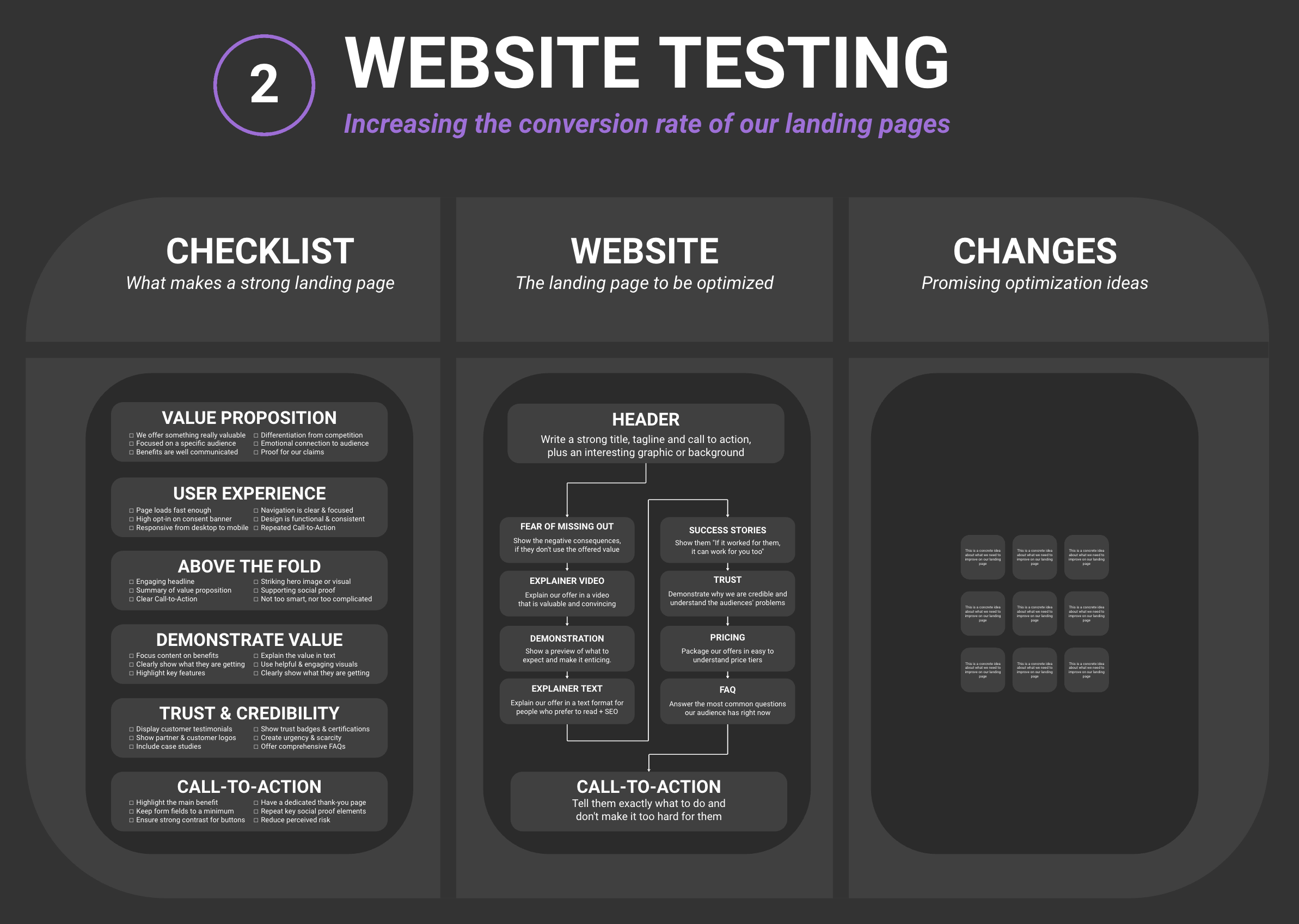
You'll learn to evaluate landing pages across six dimensions:
- Value Proposition: Is the offer compelling and clearly communicated?
- User Experience: Is the path to conversion frictionless?
- Above the Fold: Does the first impression capture attention and drive action?
- Value Demonstration: Do visitors understand what they'll get?
- Trust & Credibility: Do testimonials and proof elements build confidence?
- Call-to-Action: Is the conversion path clear and compelling?
What Should You Focus On First?
Your starting point depends on your current state:
If Your Pages Don't Convert at All
Focus on fundamentals. Is the value proposition clear? Is the CTA visible? Does the page load fast? Often the biggest gains come from fixing obvious problems.
If You Have Baseline Conversions
Start testing systematically. Run the checklist, identify gaps, and prioritize experiments by expected impact. Small improvements compound.
If You're Already Optimizing
Push beyond incremental tweaks. Test bigger hypotheses–new positioning, different page structures, bold design changes. Avoid local maxima.
Your Decision
By the end of this lesson, you'll have a clear picture of your landing page strengths and gaps, plus specific experiments designed to improve conversion rates.
Outcome: You have an audit of your key landing pages with prioritized improvements.
2. Website Checklist - What makes a strong landing page
Every high-converting landing page nails the fundamentals. Before running advanced experiments, ensure your pages meet baseline standards. Use this checklist to identify gaps.
Value Proposition
Your landing page must immediately answer: "Why should I care?"
- Unique value articulated: What makes you different from alternatives?
- Specific to target audience: Does it speak to their specific situation?
- Emotional connection: Does it connect to what they feel, not just think?
- Benefits over features: Are you showing outcomes, not just capabilities?
- Proof provided: Do you back up claims with evidence?
User Experience
Friction kills conversions. Every obstacle between visitor and conversion costs you.
- Fast load time: Under 3 seconds, ideally under 2
- Mobile optimized: Responsive design that works on all devices
- Clear navigation: Visitors know where they are and what to do
- Accessible: Works for users with disabilities
- Cookie consent handled smoothly: Not blocking the experience
Above the Fold
First impressions happen in seconds. The top of your page must grab attention.
- Engaging headline: Captures attention and communicates value
- Compelling visuals: Images or video that reinforce the message
- Clear CTA: Obvious next step visible without scrolling
- Minimal clutter: Focus on what matters, remove distractions
Value Demonstration
Visitors need to understand what they'll get before they convert.
- Benefits explained: What outcomes will they achieve?
- Features supporting benefits: How do you deliver those outcomes?
- Visual demonstration: Screenshots, demos, or examples
- Objection handling: Address common concerns proactively
Trust & Credibility
People buy from brands they trust. Build credibility throughout the page.
- Customer testimonials: Real people, specific results
- Social proof: Numbers, logos, reviews
- Trust badges: Security seals, certifications, guarantees
- Case studies: Detailed success stories (where appropriate)
- FAQ section: Address remaining questions and objections
Call-to-Action
The CTA is where conversion happens. Make it impossible to miss.
- Primary benefit restated: Remind them why to act
- Minimal form fields: Only ask for what you need
- Visually prominent button: Stands out from the page
- Low perceived risk: Money-back guarantee, free trial, no commitment
- Thank you page: Acknowledges action and sets expectations
Outcome: You have a checklist assessment with prioritized fixes for each landing page.
3. Landing Page Optimization - Systematic improvement
With your audit complete and checklist gaps identified, it's time to design specific optimization experiments. This is where you move from analysis to action.
The Optimization Mindset
Optimization isn't about making pages "prettier" or following generic best practices. It's about understanding your specific audience and testing hypotheses about what will make them convert. Every change should be tied to a hypothesis you can learn from.
High-Impact Test Areas
Based on typical results, these areas often yield the biggest improvements:
Headlines
Your headline is often the most-read element. Test different angles:
- Problem-focused vs. solution-focused
- Specific vs. general
- Emotional vs. rational
- Short vs. long
Hero Section
The above-the-fold area sets the tone. Test:
- Image vs. video vs. no media
- Different hero images (people, product, results)
- Layout variations (text left vs. centered)
- CTA placement and styling
Social Proof Placement
Testimonials and proof elements build trust. Test:
- Placement (above fold, near CTA, throughout)
- Format (quotes, video, logos, numbers)
- Specificity (results, names, photos)
Form and CTA
The conversion point is high-leverage. Test:
- Number of form fields
- Button text and color
- Multi-step vs. single-step forms
- Incentives and risk reducers
Page Length
More information isn't always better. Test:
- Long-form vs. short-form
- Information hierarchy
- Progressive disclosure
Outcome: You have specific landing page experiments ready to run.
4. Your Website Testing Library
Creating Your Website Testing Document
Throughout this lesson, you've audited your landing pages, run the checklist, and designed experiments. Now it's time to consolidate everything into a single reference document for ongoing website optimization.
The Goal: A Website Optimization System
This Website Testing document will serve as your:
- Reference for landing page standards and best practices
- Record of audits and findings
- Experiment tracker for website tests
- Learning log for what works on your pages
Having your website optimization documented means you build institutional knowledge about what converts for your audience.
Outcome: You have a complete Website Testing document that captures your landing page optimization system.