My First 365 Days
of Vibe Coding
What it's actually like learning to build real products without a CTO – the tools that worked, the mistakes I made, and what I'd do differently if I started again.
Day 0The Christmas Challenge
It was Christmas 2024. Earlier that year, I'd picked up a new habit: challenging my business strategy through back-and-forth conversations with whatever the latest ChatGPT model was. I had mixed feelings about it – useful, but something was missing.
Then o3 came around. For the first time, I felt an AI model genuinely push back. It wasn't just agreeing with me or generating ideas – it was strengthening my thinking through opposition. Like playing chess against a good opponent: even though it's a mental game, you feel the resistance against your strategy, and that pressure makes it stronger than it would be on its own. Looking back, without that pushback, I might have reached 75% of the quality I ended up with.
That conversation forced me to reflect on my 15 years as a founder – always in growth marketing roles, never in development or product. I was a technical marketer, comfortable with data and systems, but I'd never written a line of coherent code. I understood funnels, positioning, how to make things sell. But I couldn't build the products I was promoting. That dependency on co-founders and investors can be a good thing, but for me, it was mostly something that held me back.
I'd wait for a CTO who never showed up. I'd hire agencies that burned through budgets without shipping. I'd brief freelancers who disappeared mid-project. Just months before, I'd been working on an AI-led enrichment startup with a talented CTO and two other people. Six months in, we still had nothing to show for it.
That was the breaking point. I decided I had to learn to be independent from tech people – at least enough to build a working prototype that could maybe make its first $10K MRR on my own.
That Christmas, I set myself a challenge: Launch my first SaaS and get one happy paying customer – by my birthday on March 29th.
Three months to learn the basics, build something, launch it, and convince someone to pay for it.
If you're reading this, you probably recognize the dependency I was trying to escape. The feeling that your ideas are trapped because you can't execute them yourself.
What's driving you toward vibe coding?
Q1Screaming at the Machine
The first thing I did was hire my friend Ognen – a senior developer – to mentor me. Not to build for me, but to teach me how to think like a developer instead of a marketer.
He helped me refine the tech stack I'd planned out in my long conversations with o3, taught me how to organize projects so the AI could actually help, and showed me the debugging commands that changed everything: tsc and npm run lint. Before that, I was running the build over and over, fixing one error at a time. These two commands let me see all the problems at once. That moment became the foundation for our Debugging Flow lesson – still one of the most valuable lessons in the Builder Codex.
Then came the information binge. YouTube became my university. Databases, authentication, authorization, payment processing – concepts I'd heard of as a user but never had to manage myself.
The channels that shaped how I think about building:

High-signal AI tool tutorials from someone who experiments in public

AI-native company thinking – fewer meetings, tighter loops, shipping as default

The backend bridge for vibe coders – Postgres, auth, policies, realtime
Long-form reps across the stack so AI doesn't become a crutch

Developer literacy – architecture, ecosystems, and strong opinions

The clearest translator from 'AI can code' to 'build properly with AI'
My first tool was v0 – a simple AI builder that gave me a taste of what was possible. But I quickly moved to Cursor. The playground tools are great for experimentation, but if you're building something real – something you'll maintain and scale – you need to understand your project architecture and be able to integrate any external resource that enhances your product.
The frustration was real:
"For the first three to six months, I screamed and shouted at the AI. Constantly. I thought it was broken. Turns out, it was mostly a skill issue on my end – I couldn't prompt properly, couldn't organize my projects, and my lack of technical understanding made it hard to guide the AI in the right direction. My partner Christina suffered through my bad moods. The turning point came when I stopped blaming the AI and started treating prompting as a skill I could develop."
March 29th, 2025 – my 43rd birthday. Goal: 1 paying customer. Result: 7.
The product was CaptAIn. The idea was simple: I was annoyed by jumping between AI chats every week – ChatGPT, then Gemini, then Claude – and having to repeat my business context every time. So I built a tool to save my context and switch between whichever model was currently best.
That moment – seeing real people pay real money for something I built – changed my identity. "I can't build" became "I just built something, and real people actually wanted it."
Q2Finding My Crew

After launching CaptAIn, something unexpected happened. I migrated my entire website from WordPress to Next.js – using the same codebase as CaptAIn.
That's when I felt it: my marketing brain and my product brain were merging.
For 15 years, I'd thought of building and growing as separate disciplines. Now they were becoming one skill. The rhythm I wanted wasn't "build things" or "grow things" – it was Build. Grow. Repeat.
But I also realized I needed to talk to people. I had Ognen for the developer perspective, but I wanted to connect with others who were coming at this from the non-developer side.
So Christina and I launched Vibe Coding Cologne – an in-person meetup for people learning to build with AI. We hosted it at Startplatz, our co-working home for eight years, with incredible support from the Graef family – Lorenz and his three sons. We created a WhatsApp group that quickly grew to over 500 members – a place where I'd never miss another significant AI model launch or new tool. If you want to join the conversation, the Vibe Coders group is open.
I'm incredibly grateful for everyone who's contributed to that community. It kept me sane during the hard parts.
Among many other things, one of the most valuable things I discovered through the community was the power of MCP servers. Think of them as arms and legs you give to the brain – the large language model – so it can reach beyond the codebase and interact directly with the services you're using. These became essential to my workflow:
Interact with my database without knowing SQL
Organize project work without agile theater – visible progress every week
Analytics beyond anything I could do with Google Analytics – custom events, A/B testing, session replay
Products, pricing, discount codes, revenue analysis
Managing my repository without leaving the AI conversation
Interacting with my business knowledge base
Q3Turning Chaos into Systems
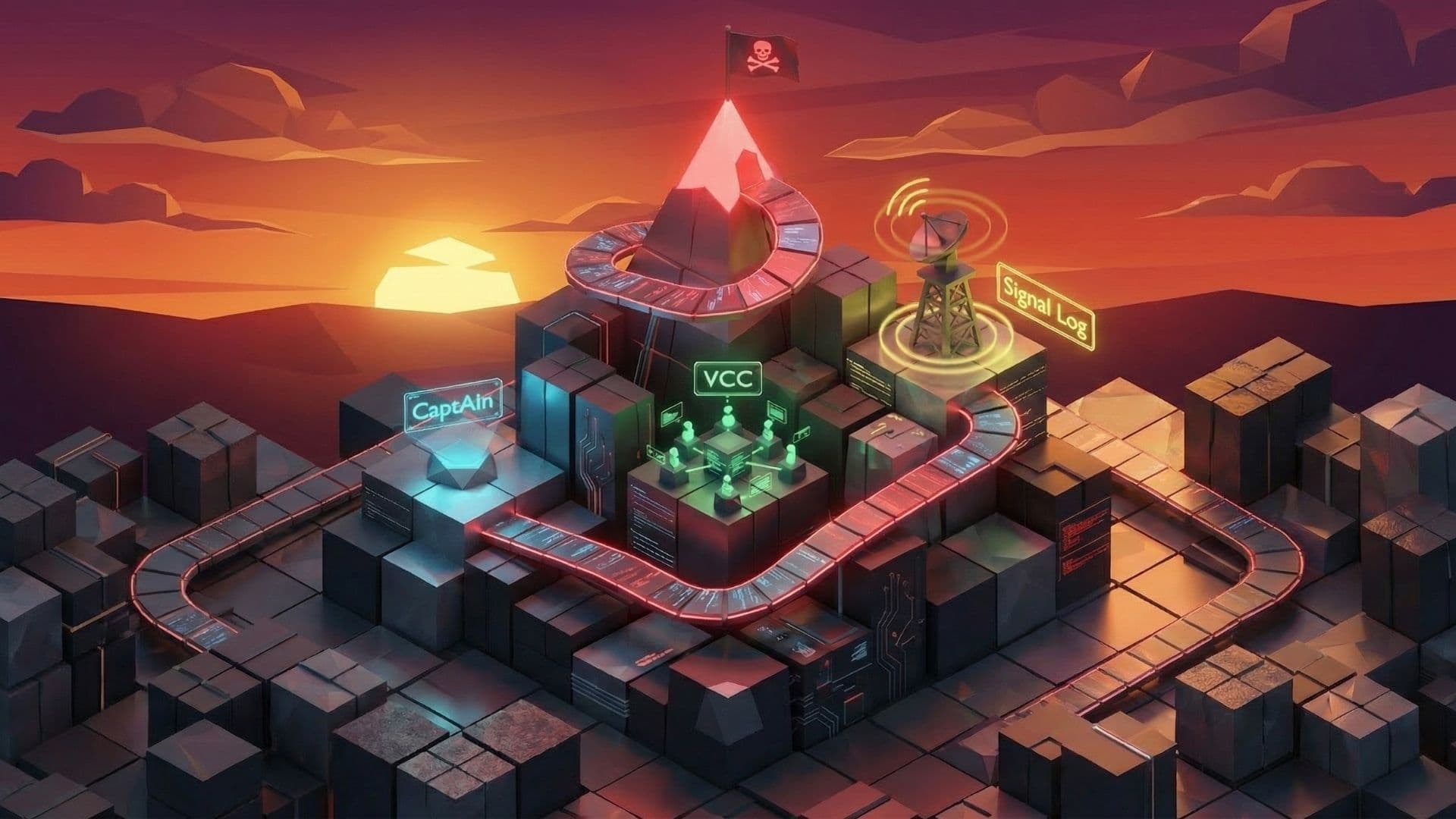
By Q3, I'd built enough to finally see the journey – where I'd been and where I was heading. The path that felt like chaos in the moment now looked like a winding road up a mountain, each struggle a switchback that got me higher.
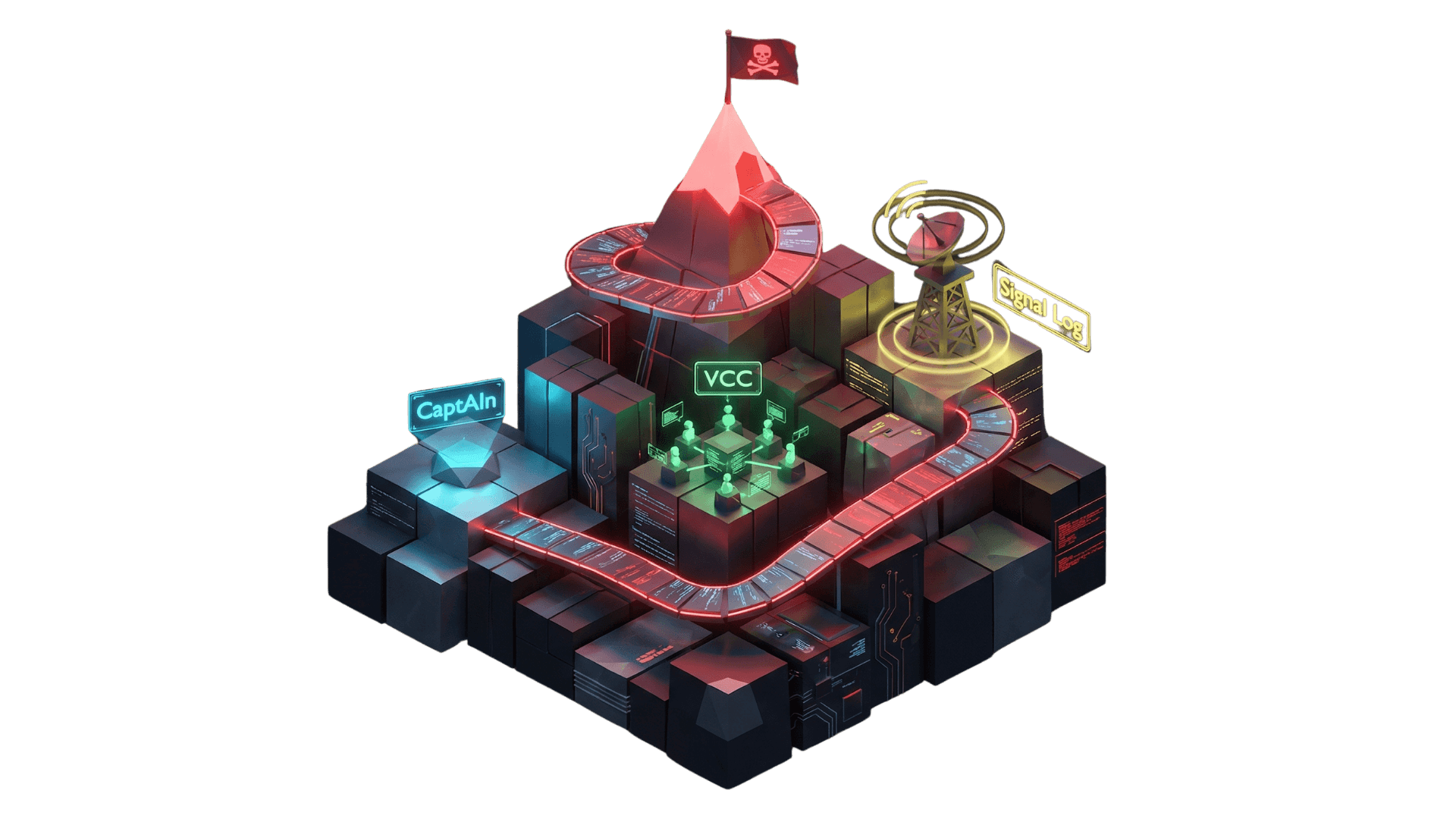
With that clarity came the urge to codify – to turn hard-won lessons into reusable systems. This has been a habit since my youth. I was a student tutor throughout school and university, and teaching always helped me solidify my own understanding. Once I could explain a concept in simpler terms, it stuck. Pirate Skills, at its essence, is that same instinct: a platform that helps me deepen my understanding of building and growing products by teaching others.
First came the Builder Codex – a clear 6-step structure for setting up any new app. I had community members and experienced developers like Ognen and Gero, and many other technical and non-technical founders helped me make improvements. We set it up for free on pirateskills.com, built entirely with vibe coding techniques.
Then I wanted to build my next project with others – to teach what I'd learned while I was still learning. The idea was Signal Log: a voice-first project journal for indie founders. The concept was simple – drop quick spoken check-ins that become tidy progress logs. An AI coach reflects back what you've done, challenges your next step, and keeps a gentle cadence across all your ideas.
I recruited a pilot cohort from the Vibe Coding Cologne community to build it together. Every week, we'd work on Signal Log as a group – me teaching what I'd just learned, them building alongside me.
That experimental group became the first cohort of what's now the Builder Forge – a 6-week program that runs every quarter for people who want to build real products.
Q4Completing the Circle
After months of heavy building focus, I realized the pendulum had swung too far. I wasn't applying my 15 years of growth experience to what I was building.
So I built the Growth Codex – everything I'd learned about marketing, sales, and growth, codified into a system. Also free on pirateskills.com.
Writing the Growth Codex made me realize how much on track I'd already been in Q2 with our mantra of Build. Grow. Repeat. But of course, this has its price. Here's how my AI spending developed – for both building and growing my fledgling SaaS empire:
AI Spending in My First 365 Days of Vibe Coding
January – December 2025
$1,447.95 total
12 months of building real products – less than 2 weeks of developer salary
The chart tells a story. I started at the beginning of 2025 with just the $20 Cursor Pro subscription – learning, fumbling, not using many tokens at all. By April, my usage climbed as my skills improved.
Then I got scared. I saw the costs rising and thought: "Am I just going to keep spending more and more?" So I pulled back for two months.
In July, I had a realization: fuck it – doesn't matter. The value I was getting from AI was so much higher than the cost. I upgraded my subscription and leaned in. The way I see it now: a $200 subscription is like having three pre-AI developers at your fingernails. Instead of paying $500 a day, you're paying $10. Of course, this means I need to be much more involved in the product development process. But that actually turned out to be an incredible speed boost – no more daily or weekly meetings with other people, which adds even more to the value. This could be absolute copium, and I'm curious to see what I'll say in a year.
October was my peak month – over $300. I'd embraced Claude Opus 4.5 for complex tasks, and it felt like gaining superpowers. But I also got smarter about token usage. By November, I'd learned when to use the expensive models and when Cursor's Composer 1 would do.
Claude Opus 4.5 felt like a breakthrough – not just for me, but for the entire vibe coding community. Even the previously skeptical senior developers started to realize that with this model, the game had truly changed.
Recently, I've been using Claude Code within Cursor. Anthropic's philosophy resonates with me, and they seem to be at the cutting edge of what matters – MCP servers, skills, the infrastructure that makes AI-assisted building actually work. January 2026 is an experiment: can I get most of what I need from the $90 Claude Code Max subscription plus $20 for Cursor? We'll see next month.
Day 365: I can build and grow things I couldn't have imagined a year ago. I'm still learning fundamental software and product development principles every week. But I ship – and that's what matters.
Day 365What I'd Tell Day-0 Me
If I could go back to Christmas 2024 and give myself five pieces of advice, here's what I'd say:
Hire a mentor – even for a few hours.
The investment paid back a hundred times. Having someone who can answer "is this normal?" accelerates everything.
Use Cursor, not the playground tools.
v0, Lovable, Bolt – they're great for experimenting. But if you're serious about building products for real users, you need to see your code. Cursor will break your fear of the terminal – and that's your entry point to Claude Code.
Expect the frustration – it's a skill issue.
I blamed the AI for months. The real problem was that prompting is a skill, and I hadn't developed it yet. Skills can be learned.
Ship something real – even if it's small.
The identity shift happened when I had paying customers, not when I finished a tutorial. Build something people can use.
Join a community – you'll learn faster and stay sane.
The conversations kept me going when I wanted to give up. Join the Vibe Coders WhatsApp group, come to our events, or find your own crew – just don't build alone.
Ready to Go Deeper?
Don't miss the next Insight
Join the crew and get fresh perspectives delivered weekly.
Free account. No spam. Unsubscribe anytime.
Questions & Answers
Do I need to know how to code to start vibe coding?
What tools do I actually need to get started?
How long until I can build something real?
Should I use v0/Lovable/Bolt or Cursor?
What if I get stuck and the AI can't help?
Is vibe coding just for side projects, or can I build a real business?
What's the difference between the build track and the growth track?
I've tried learning to code before and failed. Why would this be different?
How much does it cost to run AI tools for vibe coding?
What should I build first?

Founder from Cologne with 15 years of startup experience across 9 ventures. After helping thousands master growth marketing, Ben learned vibe coding from scratch and launched CaptAIn within three months. He leads the Vibe Coding Cologne community, blending real founder experience with teaching clarity.